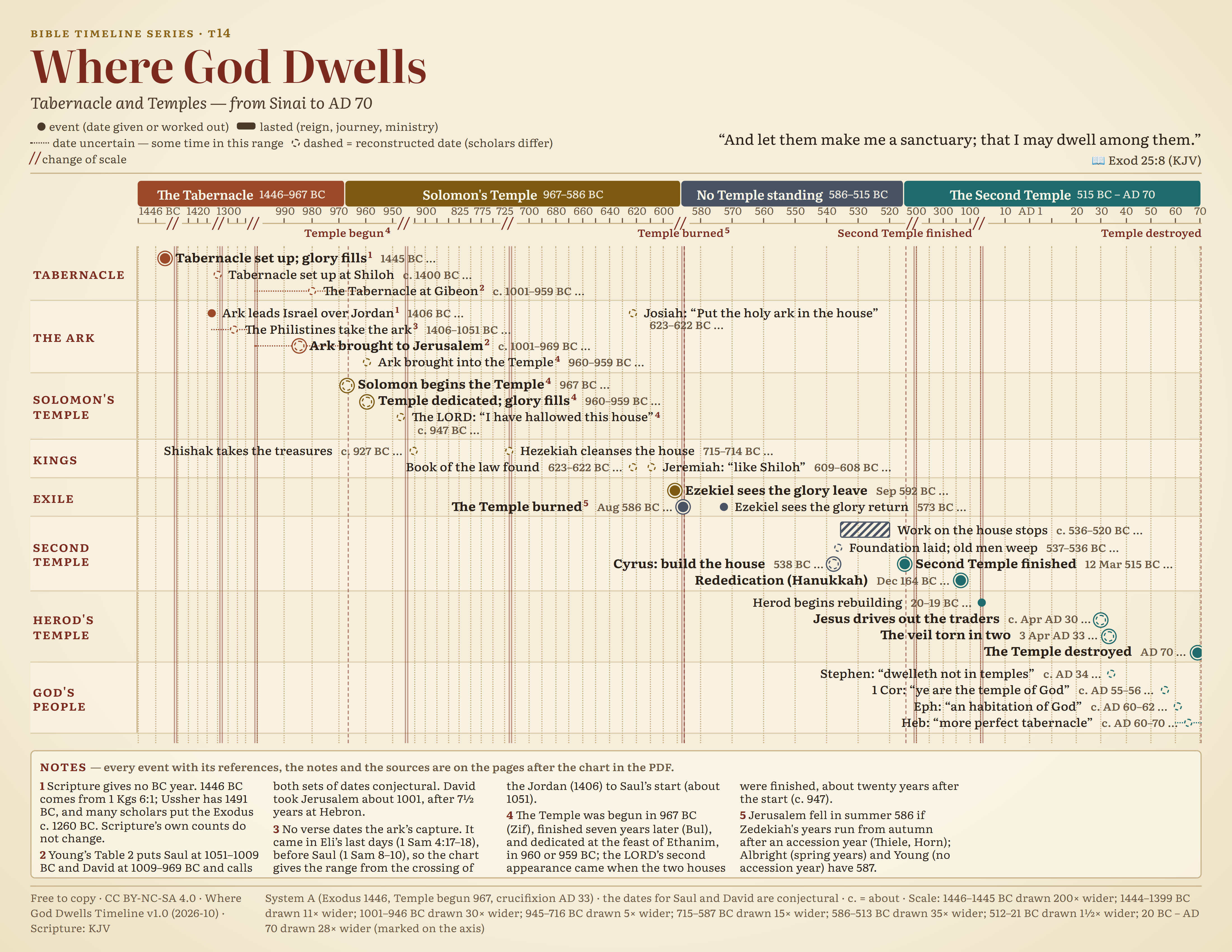

Where God Dwells
 Exod 25:8 (KJV)
Put the holy ark in the house
I have hallowed this house4
like Shiloh
dwelleth not in temples
ye are the temple of God
an habitation of God
more perfect tabernacle
Notes — every event with its references, the notes and the sources are on the pages after the chart in the PDF.
1Scripture gives no BC year. 1446 BC comes from 1 Kgs 6:1; Ussher has 1491 BC, and many scholars put the Exodus c. 1260 BC. Scripture’s own counts do not change.
2Young’s Table 2 puts Saul at 1051–1009 BC and David at 1009–969 BC and calls both sets of dates conjectural. David took Jerusalem about 1001, after 7½ years at Hebron.
3No verse dates the ark’s capture. It came in Eli’s last days (1 Sam 4:17–18), before Saul (1 Sam 8–10), so the chart gives the range from the crossing of the Jordan (1406) to Saul’s start (about 1051).
4The Temple was begun in 967 BC (Zif), finished seven years later (Bul), and dedicated at the feast of Ethanim, in 960 or 959 BC; the LORD’s second appearance came when the two houses were finished, about twenty years after the start (c. 947).
5Jerusalem fell in summer 586 if Zedekiah's years run from autumn after an accession year (Thiele, Horn); Albright (spring years) and Young (no accession year) have 587.
Where God Dwells — Study notes
Every event on the chart, with its Bible references, certainty and notes. One chronology for the whole series: the Bible's own numbers with the main ancient records. "c." = about; a range (e.g. 6–4 BC) = some time in that range.
| Date | Event | Bible references | Lane | Cert. |
|---|---|---|---|---|
| The Tabernacle · 1446–967 BC6 | ||||
| 1446 BC | God commands a sanctuary1 At Sinai, where Israel came in the third month(Exod 19:1), the LORD says: let them make me a sanctuary; that I may dwell among them(Exod 25:8) |
Exod 25:8–9; 19:1 | Tabernacle | B |
| 1446–1445 BC | Bezaleel and Aholiab make the Tabernacle1 The LORD has called by name Bezaleel the son of Uri, the son of Hur, of the tribe of Judah, and given him Aholiab (Exod 31:2, 6); Thus was all the work of the tabernacle of the tent of the congregation finished(Exod 39:32) |
Exod 31:1–6; 39:32, 43 | Tabernacle | B |
| 1446–1445 BC | The ark made: there I will meet with thee1 Bezaleel made the ark of shittim wood(Exod 37:1); I will commune with thee from above the mercy seat, from between the two cherubims which are upon the ark of the testimony(Exod 25:22) |
Exod 25:10, 22; 37:1 | The Ark | B |
| 1445 BC | Tabernacle set up; glory fills1in the first month in the second year, on the first day of the month, that the tabernacle was reared up(Exod 40:17); the glory of the Lord filled the tabernacle(Exod 40:34) |
Exod 40:2, 17, 34–35 | Tabernacle | B |
| 1406 BC | Ark leads Israel over Jordan81the priests that bare the ark of the covenant of the Lord stood firm on dry ground in the midst of Jordan, and all the Israelites passed over on dry ground(Josh 3:17); the people came up out of Jordan on the tenth day of the first month(Josh 4:19) |
Josh 3:3, 14–17; 4:19 | The Ark | B |
| c. 1400 BC | Tabernacle set up at Shiloh7the whole congregation of the children of Israel assembled together at Shiloh, and set up the tabernacle of the congregation there(Josh 18:1) |
Josh 18:1; 14:6–10 | Tabernacle | D |
| 1406–1051 BC | The Philistines take the ark3the ark of God was taken(1 Sam 4:11); The glory is departed from Israel(1 Sam 4:22) |
1 Sam 4:10–11, 17–22 | The Ark | E |
| 1406–1051 BC | The ark comes to Kirjathjearim3 The men of Kirjathjearim fetched up the ark of the Lord, and brought it into the house of Abinadab in the hill(1 Sam 7:1); the time was long; for it was twenty years(1 Sam 7:2); when David says let us bring again the ark of our God to us, he adds that Israel had not inquired at it in the days of Saul (1 Chr 13:3) |
1 Sam 7:1–2; 1 Chr 13:3 | The Ark | E |
| c. 1400–1051 BC | Shiloh: the house of God3 all the time that the house of God was in Shiloh(Judg 18:31); Eli the priest sat upon a seat by a post of the temple of the Lord(1 Sam 1:9), where the ark of God was(1 Sam 3:3) |
Judg 18:31; 1 Sam 1:3, 9; 3:3 | Tabernacle | E |
| 1051–1009 BC | David at Nob: the hallowed bread2 David comes to Nob to Ahimelech the priest, who says: there is no common bread under mine hand, but there is hallowed bread(1 Sam 21:1, 4); there was no bread there but the shewbread, that was taken from before the Lord(1 Sam 21:6) Sources: Rodger C. Young |
1 Sam 21:1–6 | Tabernacle | D |
| c. 1001–969 BC | Ark brought to Jerusalem2 David brought up the ark of Godfrom the house of Obededom into the city of David with gladness(2 Sam 6:12); they set it in his place, in the midst of the tabernacle that David had pitched for it(2 Sam 6:17) Sources: Rodger C. Young |
2 Sam 6:2, 12, 17; 5:5 | The Ark | E |
| c. 1001–969 BC | God to David: Shalt thou build me an house2 David lives in an house of cedarwhile the ark of God dwelleth within curtains(2 Sam 7:2); the LORD says he has not dwelt in any housesince the Exodus, but have walked in a tent and in a tabernacle(2 Sam 7:6), and that David's seed shall build an house for my name(2 Sam 7:13) Sources: Rodger C. Young |
2 Sam 7:1–7, 12–13 | Solomon's Temple | E |
| c. 1001–969 BC | David buys the threshingfloor of Ornan2 David built there an altar, and said: This is the house of the Lord God, and this is the altar of the burnt offering for Israel(1 Chr 22:1); it was mount Moriah, where the Lord appeared unto David his father, in the place that David had prepared in the threshingfloor of Ornan the Jebusite(2 Chr 3:1) Sources: Rodger C. Young |
1 Chr 21:25–26; 22:1; 2 Chr 3:1 | Solomon's Temple | E |
| c. 1001–969 BC | David gives Solomon the pattern2 David tells Solomon that the LORD said: He shall build an house for my name(1 Chr 22:10); he gives him the pattern of the porchand of the rest (1 Chr 28:11), and says: the Lord made me understand in writing by his hand upon me, even all the works of this pattern(1 Chr 28:19) Sources: Rodger C. Young |
1 Chr 22:7–10; 28:11–12, 19 | Solomon's Temple | E |
| c. 1001–959 BC | The Tabernacle at Gibeon2the tabernacle of the Lord in the high place that was at Gibeon(1 Chr 16:39); there was the tabernacle of the congregation of God, which Moses the servant of the Lord had made in the wildernesswhen Solomon sacrificed (2 Chr 1:3) Sources: Rodger C. Young |
1 Chr 16:39; 21:29; 2 Chr 1:3–6; 1 Kgs 3:4 | Tabernacle | E |
| Solomon's Temple · 967–586 BC | ||||
| 967 BC | Solomon begins the Temple4in the four hundred and eightieth year after the children of Israel were come out of the land of Egypt, in the fourth year of Solomon's reign over Israel, in the month Zif, which is the second month, that he began to build the house of the Lord(1 Kgs 6:1) |
1 Kgs 6:1, 37; 2 Chr 3:1–2 | Solomon's Temple | D |
| c. 960 BC | Temple finished (seven years)4in the eleventh year, in the month Bul, which is the eighth month, was the house finished throughout all the parts thereof; So was he seven years in building it(1 Kgs 6:38) |
1 Kgs 6:37–38; 7:51 | Solomon's Temple | D |
| 960–959 BC | Ark brought into the Temple4they brought up the ark of the Lord, and the tabernacle of the congregation, and all the holy vessels that were in the tabernacle(1 Kgs 8:4); the priests brought in the ark of the covenant of the Lord unto his place, into the oracle of the house, to the most holy place(1 Kgs 8:6) |
1 Kgs 8:1–6; 2 Chr 5:2–7 | The Ark | D |
| 960–959 BC | Temple dedicated; glory fills4the cloud filled the house of the Lord(1 Kgs 8:10), and Solomon says: I have surely built thee an house to dwell in, a settled place for thee to abide in for ever(1 Kgs 8:13); the feast lasts seven days and seven days, even fourteen days(1 Kgs 8:65) |
1 Kgs 8:2, 10–13, 62–66; 2 Chr 7:1–3 | Solomon's Temple | D |
| 960–959 BC | Solomon: will God indeed dwell on the earth4 will God indeed dwell on the earth? behold, the heaven and heaven of heavens cannot contain thee; how much less this house that I have builded?(1 Kgs 8:27) |
1 Kgs 8:27 | Solomon's Temple | D |
| c. 947 BC | The LORD: I have hallowed this house4 I have hallowed this house, which thou hast built, to put my name there for ever; and mine eyes and mine heart shall be there perpetually(1 Kgs 9:3); if Israel forsakes him, this house, which I have hallowed for my name, will I cast out of my sight(1 Kgs 9:7) |
1 Kgs 9:1–10 | Solomon's Temple | D |
| c. 927 BC | Shishak takes the treasures11in the fifth year of king Rehoboam, that Shishak king of Egypt came up against Jerusalem: And he took away the treasures of the house of the Lord(1 Kgs 14:25–26) Sources: Rodger C. Young |
1 Kgs 14:25–26; 2 Chr 12:9 | Kings | D |
| c. 814 BC | Joash repairs the house12in the three and twentieth year of king Jehoash the priests had not repaired the breaches of the house(2 Kgs 12:6); Jehoiada took a chest, and bored a hole in the lid of it, and set it beside the altarfor the money (2 Kgs 12:9) Sources: Rodger C. Young |
2 Kgs 12:4–16 | Kings | D |
| c. 732–716 BC | Ahaz sets up a Damascus altar Ahaz sees an altar that was at Damascus(2 Kgs 16:10) and has Urijah the priest build one like it; he puts the brasen altar, which was before the Lordon the north side of it (2 Kgs 16:14) and shut up the doors of the house of the Lord(2 Chr 28:24) Sources: Rodger C. Young |
2 Kgs 16:10–18; 2 Chr 28:24 | Kings | D |
| 715–714 BC | Hezekiah cleanses the house13He in the first year of his reign, in the first month, opened the doors of the house of the Lord(2 Chr 29:3); the priests sanctified the house of the Lord in eight days; and in the sixteenth day of the first month they made an end(2 Chr 29:17) Sources: Rodger C. Young |
2 Chr 29:3–5, 16–19 | Kings | D |
| c. 697–643 BC | Manasseh's altars in the househe built altars in the house of the Lord, of which the Lord said, In Jerusalem will I put my name(2 Kgs 21:4); he set a carved image, the idol which he had made, in the house of God(2 Chr 33:7) Sources: Rodger C. Young |
2 Kgs 21:1–7; 2 Chr 33:4–7 | Kings | D |
| 623–622 BC | Josiah: Put the holy ark in the house910 Put the holy ark in the house which Solomon the son of David king of Israel did build(2 Chr 35:3), in the eighteenth year of the reign of Josiah(2 Chr 35:19) Sources: Rodger C. Young |
2 Chr 35:3, 19 | The Ark | D |
| 623–622 BC | Book of the law found9in the eighteenth year of king Josiahthe king sends Shaphan to the house of the LORD (2 Kgs 22:3); Hilkiah says: I have found the book of the law in the house of the Lord(2 Kgs 22:8) Sources: Rodger C. Young |
2 Kgs 22:3–10; 2 Chr 34:8 | Kings | D |
| 609–608 BC | Jeremiah: like Shiloh14 In the beginning of the reign of Jehoiakimthe LORD sends Jeremiah to the court of the Lord's house: Then will I make this house like Shiloh(Jer 26:1–2, 6) Sources: Rodger C. Young |
Jer 26:1–9 | Kings | D |
| 16 Mar 597 BC | Nebuchadnezzar strips the house15 The city is taken on 2 Adar (16 March 597); Nebuchadnezzar carried out thence all the treasures of the house of the Lordand cut in pieces all the vessels of gold which Solomon king of Israel had made in the temple of the Lord(2 Kgs 24:13) Sources: Babylonian Chronicle ABC 5 (BM 21946), tr. A. K. Grayson (1975), adapted by Jona Lendering; Siegfried H. Horn; Richard A. Parker and Waldo H. Dubberstein |
2 Kgs 24:10–13; 2 Chr 36:10 | Exile | C |
| Sep 592 BC | Ezekiel sees the glory leave 5th day, 6th month, 6th year (Sept 592), in the visions of God(Ezek 8:3): the glory of the Lord departed from off the threshold of the house(Ezek 10:18) and went up from the midst of the city, and stood upon the mountain which is on the east side of the city(Ezek 11:23) Sources: Richard A. Parker and Waldo H. Dubberstein |
Ezek 8:1–4; 10:18–19; 11:22–23 | Exile | C |
| No Temple standing · 586–515 BC | ||||
| Aug 586 BC | The Temple burned516 5th month, 7th or 10th day (14 or 17 Aug 586 in Horn's figures): he burnt the house of the Lord, and the king's house, and all the houses of Jerusalem(2 Kgs 25:9); the Chaldees break in piecesthe pillars and the brasen sea (2 Kgs 25:13) Sources: Siegfried H. Horn; Richard A. Parker and Waldo H. Dubberstein |
2 Kgs 25:8–9, 13–17; 2 Chr 36:17–19; Jer 52:12–13 | Exile | C |
| 573 BC | Ezekiel sees the glory return17In the five and twentieth year of our captivity(Ezek 40:1), in the vision of the new house, the glory of the Lord came into the house by the way of the gate whose prospect is toward the east(Ezek 43:4) Sources: Richard A. Parker and Waldo H. Dubberstein |
Ezek 40:1–2; 43:1–5 | Exile | B |
| 538 BC | Cyrus: build the house18the Lord God of heaven hath given me all the kingdoms of the earth; and he hath charged me to build him an house at Jerusalem, which is in Judah(Ezra 1:2) Sources: Richard A. Parker and Waldo H. Dubberstein; Cyrus Cylinder, tr. after M. Cogan and H. Schaudig, with B. van der Spek |
Ezra 1:1–4; 6:3–5; 2 Chr 36:22–23 | Second Temple | D |
| 538–537 BC | Altar rebuilt; Feast of Tabernacles19 In the seventh month Jeshua and Zerubbabel builded the altar of the God of Israel, to offer burnt offerings thereon, as it is written in the law of Moses the man of God(Ezra 3:2) |
Ezra 3:1–6 | Second Temple | D |
| 537–536 BC | Foundation laid; old men weep19in the second year of their coming unto the house of God at Jerusalem, in the second month(Ezra 3:8), the foundation of the house of the Lord was laid(Ezra 3:11), and the ancient men wept with a loud voice(Ezra 3:12) |
Ezra 3:8–13; 5:16 | Second Temple | D |
| c. 536–520 BC | Work on the house stops20 No start date is given: it began after the foundation of 537 or 536 BC; the work ceased unto the second year of the reign of Darius(Ezra 4:24) |
Ezra 4:1–5, 24; Hag 1:2–4 | Second Temple | D |
| 21 Sep 520 BC | Haggai: work resumes21 24th day of the 6th month (21 Sept 520), after Haggai asked: Is it time for you, O ye, to dwell in your cieled houses, and this house lie waste?(Hag 1:4) Sources: Richard A. Parker and Waldo H. Dubberstein |
Hag 1:1–4, 12–15; Ezra 5:1–2 | Second Temple | C |
| Oct 520 BC | Haggai: the glory of this latter house21 21st day of the 7th month (Oct 520): The glory of this latter house shall be greater than of the former, saith the Lord of hosts(Hag 2:9) Sources: Richard A. Parker and Waldo H. Dubberstein |
Hag 2:1–9; Zech 4:9 | Second Temple | C |
| The Second Temple · 515 BC – AD 70 | ||||
| 12 Mar 515 BC | Second Temple finished22 3 Adar, Darius' 6th year (12 March 515): this house was finished on the third day of the month Adar, which was in the sixth year of the reign of Darius the king(Ezra 6:15) Sources: Richard A. Parker and Waldo H. Dubberstein |
Ezra 6:14–15 | Second Temple | C |
| 21 Apr 515 BC | Passover, after the dedication The children of Israel kept the dedication of this house of God with joy(Ezra 6:16); the day is not given, but it follows the finishing on 12 March. 14th of the 1st month (21 April 515): they kept the passover upon the fourteenth day of the first month(Ezra 6:19) Sources: Richard A. Parker and Waldo H. Dubberstein |
Ezra 6:16–22 | Second Temple | C |
| Dec 167 BC | Sacrifice begins on the idol altar23 On 25 Chislev, SE 145, sacrifice is made on the idol altar set up on the altar of God (1 Macc 1:54, 59); the king's decree had required swine's flesh (1 Macc 1:47) Sources: The King James translators (eBible.org / CrossWire standardized text of 1769) |
Second Temple | C | |
| Dec 164 BC | Rededication (Hanukkah)24 Sanctuary cleansed (1 Macc 4:36–51); the new altar dedicated on 25 Chislev SE 148 (1 Macc 4:52–59) Sources: The King James translators (eBible.org / CrossWire standardized text of 1769) |
John 10:22 | Second Temple | C |
| 20–19 BC | Herod begins rebuilding25 Commenced in his 18th year (20/19 BC); the main sanctuary was finished in 18 months Sources: Flavius Josephus |
John 2:20 | Herod's Temple | C |
| c. AD 7–9 | In the Temple at twelve years old26wist ye not that I must be about my Father's business?(Luke 2:49) Sources: A. T. Robertson |
Luke 2:41–50 | Herod's Temple | D |
| c. Apr AD 30 | Jesus drives out the traders2728make not my Father's house an house of merchandise(John 2:16); Forty and six years was this temple in building(John 2:20); Jesus: Destroy this temple, and in three days I will raise it up, but he spake of the temple of his body(John 2:19, 21) Sources: A. T. Robertson; Colin J. Humphreys and W. Graeme Waddington |
John 2:13–22 | Herod's Temple | D |
| 30 Mar AD 33 | Drives the traders out again27My house shall be called the house of prayer; but ye have made it a den of thieves(Matt 21:13) Sources: A. T. Robertson |
Matt 21:12–13; Mark 11:15–18; Luke 19:45–48 | Herod's Temple | D |
| 3 Apr AD 33 | The veil torn in twothe veil of the temple was rent in twain from the top to the bottom(Matt 27:51); Hebrews calls the way into the holiest through the veil, that is to say, his flesh(Heb 10:20) |
Matt 27:50–51; Mark 15:37–38; Luke 23:44–46; Heb 10:19–20 | Herod's Temple | D |
| c. AD 33 | The first believers worship in the Temple32continuing daily with one accord in the temple(Acts 2:46); Peter and John went up together into the temple at the hour of prayer, being the ninth hour(Acts 3:1) |
Acts 2:46; 3:1 | God's people | D |
| c. AD 34 | Stephen: dwelleth not in temples33 Stephen, accused of speaking against this holy place(Acts 6:13): Howbeit the most High dwelleth not in temples made with hands(Acts 7:48) |
Acts 7:47–50; 6:13–14 | God's people | D |
| c. AD 50 | Paul: dwelleth not in temples34 God that made the world and all things therein, dwelleth not in temples made with hands(Acts 17:24) |
Acts 17:16–34 | God's people | D |
| c. AD 55–56 | 1 Cor: ye are the temple of God35 Know ye not that ye are the temple of God, and that the Spirit of God dwelleth in you?(1 Cor 3:16); your body is the temple of the Holy Ghost(1 Cor 6:19) Sources: Kenneth Berding (Talbot School of Theology) |
1 Cor 3:16–17; 6:19; 16:8, 19 | God's people | D |
| c. AD 55–56 | 2 Corinthians: the temple of the living God35 ye are the temple of the living God; as God hath said, I will dwell in them, and walk in them(2 Cor 6:16) Sources: Kenneth Berding (Talbot School of Theology) |
2 Cor 6:16; 2:12–13; 7:5–7 | God's people | D |
| c. AD 60–62 | Eph: an habitation of God36 an holy temple in the Lord: ye also are builded together for an habitation of God through the Spirit(Eph 2:21–22) Sources: J. B. Lightfoot; Kenneth Berding (Talbot School of Theology); Peter Kirby (Early Christian Writings) |
Eph 2:19–22; 3:1; 6:20–22 | God's people | D |
| c. AD 62–64 | Herod's Temple completed29 Josephus: the whole was finished only under the procurator Albinus (Ant. 20.9.7) Sources: Flavius Josephus |
Luke 21:5–6 | Herod's Temple | C |
| c. AD 62–64 | 1 Peter: a spiritual house37 Ye also, as lively stones, are built up a spiritual house, an holy priesthood(1 Pet 2:5) Sources: Eusebius of Caesarea (tr. A. C. McGiffert, NPNF 2nd series vol. 1) |
1 Pet 2:4–5; 1:1; 5:12–13 | God's people | E |
| c. AD 60–70 | Heb: more perfect tabernacle37 Christ is a minister of the sanctuary, and of the true tabernacle, which the Lord pitched, and not man(Heb 8:2); he came by a greater and more perfect tabernacle, not made with hands(Heb 9:11) Sources: Eusebius of Caesarea (tr. A. C. McGiffert, NPNF 2nd series vol. 1) |
Heb 8:1–5; 9:11, 24 | God's people | E |
| AD 70 | The Temple destroyed3031 Foretold by Jesus: There shall not be left here one stone upon another, that shall not be thrown down(Matt 24:2) Sources: Flavius Josephus |
Matt 24:1–2; Luke 21:5–6, 20 | Herod's Temple | C |
Certainty: A Stated in Scripture · B Worked out from Scripture · C Ancient record or astronomy · D Scholarly reconstruction · E Tradition / uncertain — scholars differ.
Where God Dwells — notes and sources
How the dates were worked out
Dates follow the series' System A: the Exodus in 1446 BC, the Temple begun in 967 BC (1 Kgs 6:1) and the crucifixion in AD 33. Scripture dates the Tabernacle by the Exodus (Exod 40:17; Num 1:1), the Temple by Solomon's reign and by the Exodus (1 Kgs 6:1), the later events by the years of the kings, and the second Temple by the years of the Persian kings (Ezra 6:15). Between Joshua and Saul the Bible gives lengths of time but no dates that tie them to the calendar: the capture of the ark is drawn as a range from the crossing of the Jordan to the start of Saul's reign, and the dates for Saul and David are those Rodger Young calls conjectural. The axis is drawn to different scales (each change is marked), the long centuries before David being squeezed. Dates with a month or a day come from the sources named in the notes. Scale: 1446–1445 BC drawn 200× wider; 1444–1399 BC drawn 11× wider; 1001–946 BC drawn 30× wider; 945–716 BC drawn 5× wider; 715–587 BC drawn 15× wider; 586–513 BC drawn 35× wider; 512–21 BC drawn 1½× wider; 20 BC – AD 70 drawn 28× wider (marked on the axis).
Dated lines on the chart
Temple begun4 — 967 BC (1 Kgs 6:1; Cert. D)
Temple burned5 — Aug 586 BC (2 Kgs 25:8–9; Cert. C)
Second Temple finished — 12 Mar 515 BC (Ezra 6:15; Cert. C)
Temple destroyed — AD 70 (Luke 21:5–6; Cert. C)
 Notes
Notes
1 Scripture gives no BC year. 1446 BC comes from 1 Kgs 6:1; Ussher has 1491 BC, and many scholars put the Exodus c. 1260 BC. Scripture’s own counts do not change. 1 Kings 6:1 puts the beginning of the Temple’s building in the 480th year after the Exodus, in the fourth year of Solomon, which this series dates to 967 BC. The 480th year comes 479 years after the Exodus, so 967 + 479 = 1446 BC. Young’s review of Steinmann’s book writes "Nisan 14, 1446 B.C." for the Exodus. Ussher dated the Exodus to 1491 BC. The late date, c. 1260 BC, reads the 480 years as a representative number for twelve generations and ties the city of Raamses (Exod 1:11) to Ramesses II; the ESV Study Bible says that both dates are held by established evangelical scholars. Another date moves every BC year on this chart that rests on the Exodus (1446 and 1445 BC here), but not the months, days and years that Scripture itself counts. (1 Kgs 6:1; Exod 1:11)
2 Young’s Table 2 puts Saul at 1051–1009 BC and David at 1009–969 BC and calls both sets of dates conjectural. David took Jerusalem about 1001, after 7½ years at Hebron. Young’s Table 2 (2005) has Saul from Tishri 1051 to Tishri 1009 and David from Tishri 1009 to Tishri 969, with the note that the dates are conjectural for Saul and David. David reigned in Hebron … over Judah seven years and six months: and in Jerusalem … thirty and three years
(2 Sam 5:5), and 7½ years from Tishri 1009 is Nisan 1001, so his capture of Jerusalem and the events that follow it (the ark, the plan for the house) fall in the range 1001 to 969. The Bible does not date them more closely. (2 Sam 5:4–5; 1 Sam 13:1)
3 No verse dates the ark’s capture. It came in Eli’s last days (1 Sam 4:17–18), before Saul (1 Sam 8–10), so the chart gives the range from the crossing of the Jordan (1406) to Saul’s start (about 1051). Eli had judged Israel forty years
when the ark was taken and he died (1 Sam 4:18). Samuel was old
when Israel asked for a king (1 Sam 8:1, 5), and Saul was anointed after that (1 Sam 10:1); the ark stayed at Kirjathjearim at least twenty years
(1 Sam 7:2) and was still there when David came to bring it up (1 Chr 13:5–6); in the days of Saul the people did not ask at it (1 Chr 13:3). Saul’s date, about 1051, is Young’s conjecture (see the note on Saul and David). The Bible’s own count gives almost the same: the 479 years to the Temple (1 Kgs 6:1) less the wilderness (40), Saul (40, Acts 13:21), David (40) and Solomon’s first three years (3) leave 356 years from the crossing, so Saul begins about 1406 − 356 = 1050. The ark’s capture, and the years at Shiloh, lie between. (1 Sam 4:17–18; 7:2; 8:1, 5; 10:1; 1 Chr 13:3–6; 1 Kgs 6:1; Acts 13:21; 1 Kgs 2:11)
4 The Temple was begun in 967 BC (Zif), finished seven years later (Bul), and dedicated at the feast of Ethanim, in 960 or 959 BC; the LORD’s second appearance came when the two houses were finished, about twenty years after the start (c. 947). 1 Kgs 6:1 and 2 Chr 3:2 put the foundation in Zif, the second month of Solomon’s fourth year (967 BC in this series), and 1 Kgs 6:37–38 puts the finishing in the eleventh year, in the month Bul, which is the eighth month
— seven years
later, c. 960. 1 Kgs 8:2 names the month of the feast at the dedication, Ethanim, the seventh month, but not the year. The feast that followed the finishing in Bul fell in the autumn of 960 BC if Solomon’s years are counted from the autumn, or of 959 BC if they are counted from the spring, so the chart gives both. 1 Kgs 9:1–2 says that the LORD appeared to Solomon the second time when he had finished the house of the LORD and the king’s house, and 1 Kgs 9:10 reckons that completion at the end of twenty years, when Solomon had built the two houses
: the Temple seven years (1 Kgs 6:38) and his own house thirteen (1 Kgs 7:1), so c. 947; 1 Kgs 9:1 adds that Solomon had also done all that he desired, so this is the earliest date the appearance can have. (1 Kgs 6:1, 37–38; 7:1; 8:2; 9:1–2, 10; 2 Chr 3:2)
5 Jerusalem fell in summer 586 if Zedekiah's years run from autumn after an accession year (Thiele, Horn); Albright (spring years) and Young (no accession year) have 587. The Bible dates the breach to the 9th day of the 4th month of Zedekiah's 11th year (2 Kgs 25:2–4; Jer 39:2; 52:5–7) and Nebuzaradan's coming, followed by the burning, to the 5th month of Nebuchadnezzar's 19th year (the 7th day in 2 Kgs 25:8–9, the 10th in Jer 52:12–13); no Babylonian record of the event survives. Counting Zedekiah's years from 1 Tishri (autumn) and from an accession year, his 11th year is autumn 587 – autumn 586, and Nebuchadnezzar's 19th year (Babylonian count from Nisan 586, or Judean count from Tishri 587) contains the 4th and 5th months only in 586: breach 18 July, Nebuzaradan's coming (the 7th of Ab) 14 August 586 (Julian dates, as Horn 1967 gives them; the 1942 Parker and Dubberstein table is a day later in three of Horn's four dates). Horn's figures for a spring-to-spring count of Zedekiah's years are 29 July and 25 August 587. Young (2004) argues for 587 with Zedekiah's years counted from autumn (Tishri) and Nebuchadnezzar's from Nisan, both without an accession year, the siege beginning in January 589 and Ezekiel's years counted from autumn 598. Jer 52:29 (832 taken in Nebuchadnezzar's 18th year) is read either as the fall (the usual 587 view) or as a deportation during the siege (the usual 586 view). This chart follows System A (586). (2 Kgs 25:1–9; Jer 39:1–2; 52:4–13, 29; Ezek 24:1–2; 33:21)
6 The tent was still in use at Gibeon in Solomon’s first years (2 Chr 1:3); 1 Kgs 8:4 says the tabernacle of the congregation
was brought up with the ark, usually read as that tent. (1 Kgs 3:4; 2 Chr 1:3; 1 Kgs 8:4)
7 No verse dates Shiloh. Caleb is fourscore and five years old
forty-five years after the word spoken at Kadesh in the second year, about 1400 BC (Josh 14:10); the assembly at Shiloh (Josh 18:1) comes later in the book. Caleb was forty when sent from Kadeshbarnea (Josh 14:7), and says: the Lord hath kept me alive, as he said, these forty and five years, even since the Lord spake this word unto Moses, while the children of Israel wandered in the wilderness
(Josh 14:10). Israel left Sinai in the second year (Num 10:11–12) and the spies, whom Moses sent from Kadeshbarnea (Josh 14:7), came back to Kadesh (Num 13:26), so the word was spoken in year 2 (1445 BC) and the forty-five years end about 1400 BC. Caleb speaks at Gilgal (Josh 14:6), and the assembly at Shiloh follows the lots given to Judah and to Joseph’s sons (Josh 15–17), so about 1400 is the earliest date: the chart gives "c. 1400" and no later limit. (Josh 14:6–10; 18:1; Num 10:11–12; 13:26; 14:24)
8 Joshua gives no year number. The crossing follows Moses’s death, after month 11 of year 40 (Deut 1:3), so the first month
(Josh 4:19) is the first month of year 41. (Josh 4:19; Deut 1:3; 34:8; Josh 1:11)
9 Josiah’s 18th year (2 Kgs 22:3) runs from Tishri 623 to Tishri 622 in Young’s table, and the Passover of that year (2 Chr 35:19) fell in Nisan 622. (2 Kgs 22:3; 2 Chr 35:19)
10 After this verse the books of Chronicles, Ezra, Nehemiah and Esther name the ark no more; Jeremiah foretells that they shall say no more, The ark of the covenant of the Lord
(Jer 3:16). (2 Chr 35:3; Jer 3:16)
11 Rehoboam’s fifth year is the year from Tishri 927 BC in Young’s table. Young's Table 2 begins Rehoboam in 932t and counts his 17 years (1 Kgs 14:21) in the accession sense, so his fifth year is the year that begins in Tishri 927 (932 minus 5). (1 Kgs 14:21, 25)
12 Counted from Young’s official start in Tishri 836 (non-accession counting), Jehoash’s 23rd year begins in Tishri 814 (2 Kgs 12:6). (2 Kgs 12:1, 6)
13 Young’s Table 2 starts Hezekiah’s sole reign at 716t (715n by Nisan years), so the first month
of his first year
(2 Chr 29:3) is Nisan 715 or Nisan 714, depending on whether that year is counted from his accession or from the next Tishri (Young counts his 29 years with an accession year, which gives Nisan 714). The chart takes it as the first year of his sole reign, after Ahaz had shut up the doors of the house of the Lord
(2 Chr 28:24). (2 Chr 29:3; 28:24; 2 Kgs 18:2)
14 Young’s table dates Jehoiakim’s reign from Tishri 609, so the beginning of the reign
(Jer 26:1) falls in 609 or 608. (Jer 26:1)
15 The Chronicle dates the capture to Nebuchadnezzar's 7th year; 2 Kgs 24:12 says his eighth year
— Judah counted his years from autumn 605 (Horn). Horn (1967): Judah counted Nebuchadnezzar's first year from 1 Tishri 605 (7 October), so its 8th year began in autumn 598; the Babylonian 7th year ran 27 March 598 – 12 April 597. Others explain the 8th year by the deportation itself taking place after Nisan 597 (2 Chr 36:10 when the year was expired
). (2 Kgs 24:12; 2 Chr 36:10)
16 2 Kgs 25:8 gives the 7th day of the 5th month, Jer 52:12 the 10th day (14 and 17 Aug 586 in Horn's figures). (2 Kgs 25:8; Jer 52:12)
17 Ezekiel counts years from king Jehoiachin's captivity
(597). His call fell in July 593 — 1 July in the 1942 tables, 31 July as Zimmerli cites them. Year 5, month 4, day 5 (Ezek 1:2): Parker & Dubberstein's 1942 table gives 1 July 593; Zimmerli's commentary (citing Parker–Dubberstein) gives 31 July 593 — a one-month difference that comes from where an extra month was inserted. His last dated word (29:17), 1st of the 1st month of the 27th year, = 26 April 571 in both. Ezek 40:1 (the five and twentieth year of our captivity
, the fourteenth year after that the city was smitten
) = 573. (Ezek 1:1–2; 29:17; 33:21; 40:1)
18 Cyrus' first year
(Ezra 1:1, Cyrus king of Persia
) as king of Babylon began, by the Babylonian count, 1 Nisan = 24 March 538 BC (Julian); he had taken Babylon in October 539. Ezra does not say how he counts Cyrus' first year; this is the usual reading. The Cyrus Cylinder records that he returned the gods of the sacred centres "on the other side of the Tigris" (Ashur, Susa, Agade, Eshnunna and others) to their places and "gathered all their inhabitants and returned to them their dwellings"; it does not name the Jews. (Ezra 1:1)
19 Cyrus' first year began in spring 538 (by the Babylonian count). Ezra 3 dates the altar by month only (the seventh) and the foundation by the second year of their coming
(the second month), with no BC year, so they fall in 538 or 537 and in 537 or 536. (Ezra 1:1; 3:1, 8)
20 Ezra 4:6–23 jumps ahead to an accusation under Ahasuerus (usually identified with Xerxes) and letters under Artaxerxes about the city walls; 4:24 returns to the temple under Darius. The chapter is generally understood to be arranged by subject — opposition to the Jews — not in time order (Ahasuerus is usually identified with Xerxes, 486–465, and Artaxerxes with Artaxerxes I, 465–424). (Ezra 4:5–7, 23–24)
21 Julian-calendar dates are read from Parker & Dubberstein's Babylonian tables; a few may be a day out, and Jerusalem's month could begin a day before Babylon's. Parker & Dubberstein (1942, pp. 23–24) say about 70 % of their dates are exact and the rest may be one day out; the crescent was visible at Jerusalem 37 minutes earlier than at Babylon. Their 1956 edition changed a few month starts by a day (e.g. 9 Tammuz 586 = 18 July in Horn's 1956 figures, 19 July in the 1942 table). A computer check of every month start used (new moon by Meeus' method) found none that is impossible.
22 3 Adar of Darius' 6th year = 12 March 515 (Parker & Dubberstein). His 6th year began in spring 516, but its 12th month fell in 515. (Ezra 6:15)
23 First Maccabees (1:54) dates the abomination to 15 Chislev, SE 145: Dec 167 BC counting the era from spring 311, Dec 168 BC from autumn 312. Most scholars take 167. SE 145 ran from autumn 168 to autumn 167 BC if the era is counted from autumn 312 (Macedonian reckoning), and from spring 167 to spring 166 BC if it is counted from spring 311 (Babylonian reckoning). Chislev, the ninth Jewish month, falls in November–December, so the abomination was set up in December 168 or December 167 BC. Most scholars read 1 Maccabees as counting Jewish events from spring 311 and so give December 167 BC. Sacrifice on the idol altar, set up on the altar of God (1 Macc 1:54), began on 25 Chislev (1 Macc 1:59); the rededication three years later was on the same day of the month (1 Macc 4:52–54). (Dan 11:31)
24 The rededication was on 25 Chislev SE 148 (1 Macc 4:52): Dec 165 BC counting the era from autumn 312, Dec 164 BC from spring 311 (the usual date). (John 10:22)
25 Josephus dates the start of the Temple rebuilding to Herod's 18th year (Ant. 15.11.1: 20/19 BC) or his 15th (War 1.21.1); John 2:20 says it had been 46 years in building. (John 2:20)
26 There is no year 0. Born 6, 5 or 4 BC, he was twelve in AD 7, 8 or 9 (from 5 BC to AD 8 is twelve years). (Luke 2:42)
27 John tells of a cleansing at the first Passover (John 2:13–22); the others at the last (Mark 11:15–17). Robertson counts two; many take them for one incident. Robertson (§31, note a): "Many scholars consider this the same incident as that in the Synoptic Gospels … But there is no inherent difficulty in the repetition of such an act …" This chart follows Robertson and shows both. (John 2:13–22; Mark 11:15–17; Matt 21:12–13; Luke 19:45–46)
28 Forty and six years
(John 2:20) from Herod's start, 20/19 BC, gives AD 27/28 (fits an AD 30 cross); from the shrine's completion, a year and six months later by Josephus (about 18/17 BC), AD 29/30. Josephus: Herod began the temple in his 18th year (Antiquities 15.11.1), the year Augustus came to Syria — 20 BC in Dio Cassius 54.7; the priests built the shrine itself in a year and six months (15.11.6); the whole was finished only under Albinus, c. AD 62–64 (20.9.7). Arithmetic: 20/19 BC + 46 years = AD 27/28; 18/17 BC + 46 = AD 29/30. Humphreys and Waddington (1992, n. 24) read John 2:20 of the finished shrine and cite Hoehner's AD 30 for this Passover; Edwards allows AD 31. (John 2:20)
29 Josephus says that the whole Temple was finished only under the procurator Albinus, c. AD 62–64 (Ant. 20.9.7).
30 Josephus: the war began in AD 66 (Nero's 12th year); the Temple was burned on the 10th of the month Lous (Ab), AD 70 — as Jesus foretold (Luke 21:6). (Luke 21:5–6, 20)
31 Revelation, which this chart does not date, ends with no temple: I saw no temple therein: for the Lord God Almighty and the Lamb are the temple of it
(Rev 21:22), and the tabernacle of God is with men, and he will dwell with them
(Rev 21:3). (Rev 21:2–3, 22)
32 Acts 3–8 gives no years. These events fall between Pentecost (AD 33) and Saul's conversion (c. AD 34–35); their spacing on the chart is estimated. (Acts 3:1; 6:1; 9:1)
33 Acts does not date Stephen's death; it came before Saul's conversion (Acts 8:1; 22:20). The chart’s own estimate with System A is c. AD 34; with AD 30, c. AD 31–34. (Acts 7:58–8:1; 22:20)
34 Acts does not number Paul's journeys or give their years. The years are worked out from the Gallio anchor and Acts' time words; charts differ by a year or two. Berding (2021): 1st journey 47–48, 2nd 49–52, 3rd 52–57. "Three missionary journeys" is a modern way of dividing Acts. (Acts 13:1–21:16)
35 Paul wrote to Corinth at least three times: an earlier letter (1 Cor 5:9), 1 Corinthians and 2 Corinthians. Many scholars add a fourth, the letter written with many tears
(2 Cor 2:4). 2 Corinthians was written from Macedonia after Titus came (2 Cor 7:5–7), about a year after the collection was begun (2 Cor 8:10; 9:2). The closing line printed in the KJV after 1 Cor 16:24, "written from Philippi", is a later scribe's note, not part of the letter: 1 Cor 16:8 and 16:19 show Paul was at Ephesus, in Asia. The dates AD 55 and 56 are Berding's (2021); other writers differ by a year or two. (1 Cor 5:9; 2 Cor 2:3–4; 7:5–8; 8:10; 9:2)
36 Written in bonds
(Eph 6:20; Col 4:3). Tradition and many scholars place these letters in Rome (c. AD 60–62); others in Caesarea (c. 57–59) or a possible imprisonment at Ephesus (c. 53–55). Rome: "The oldest tradition or conjecture dated all four epistles from Rome: and this is the opinion of most modern writers" (Lightfoot, Philippians); Berding 2021: Rome, AD 60–62. Caesarea: Böttger, Thiersch, Reuss and Meyer assigned Ephesians, Colossians and Philemon to it (listed by Lightfoot). Ephesus: Deissmann (1912) believed Paul was "then also a prisoner at Ephesus" when he wrote Philemon. Acts records no imprisonment at Ephesus, but Paul speaks of prisons more frequent
(2 Cor 11:23). Many critical scholars also doubt that Paul wrote Ephesians (Kirby, quoting Kümmel), and many doubt Colossians. (Eph 6:20; Col 4:3; Phil 1:13; Phlm 9; 2 Cor 11:23)
37 Hebrews and 1 Peter name no date. Hebrews speaks as if priests still offer (Heb 8:4; 10:1–2), which fits a date before AD 70; others date it AD 80–95. 1 Peter was sent from "Babylon", taken to mean Rome. Hebrews: the author is unnamed — Origen: "who wrote the epistle, in truth, God knows" (Eusebius 6.25.14); it mentions Timothy’s release (Heb 13:23). 1 Peter: "Babylon" (1 Pet 5:13) = Rome "by a figure" (Eusebius 2.15.2, passing on the Roman tradition). Scholars’ dates for both range widely, so the chart gives wide ranges and grade E. (Heb 8:4; 10:1–2; 13:23; 1 Pet 5:13)
Sources
The King James translators, The Holy Bible, King James Version — Pure Cambridge Edition text (bibleprotector.com), checked against eBible.org's 1769 text, 1611 (Cambridge text).
James Ussher, Annales Veteris Testamenti (English, The Annals of the World, 1658), 1650.
Flavius Josephus, Antiquities of the Jews; The Jewish War, c. AD 75–94.
Colin J. Humphreys and W. Graeme Waddington, The Jewish Calendar, a Lunar Eclipse and the Date of Christ's Crucifixion, Tyndale Bulletin 43.2, 331–351, 1992.
A. T. Robertson, A Harmony of the Gospels for Students of the Life of Christ, George H. Doran, New York, 1922.
Jean Meeus, Astronomical Algorithms, 2nd edition (ch. 7 Julian Day, ch. 49 phases of the Moon), Willmann-Bell, Richmond VA, 1998.
Eusebius of Caesarea (tr. A. C. McGiffert, NPNF 2nd series vol. 1), Church History, c. AD 325 (tr. 1890).
Adolf Deissmann (tr. L. R. M. Strachan), St. Paul: A Study in Social and Religious History (p. 18; Appendix I, “The Proconsulate of L. Junius Gallio”), Hodder and Stoughton, London, 1912.
J. B. Lightfoot, Saint Paul's Epistle to the Philippians (Introduction: Order of the Epistles of the Captivity), Macmillan, London, 1903 printing (1st ed. 1868).
Kenneth Berding (Talbot School of Theology), Chronology of the Apostle Paul, The Good Book Blog, Biola University, 2021.
Peter Kirby (Early Christian Writings), Introduction pages for 1 Timothy, 2 Thessalonians and Ephesians, online.
Richard A. Parker and Waldo H. Dubberstein, Babylonian Chronology 626 B.C.–A.D. 45 (Studies in Ancient Oriental Civilization 24), University of Chicago Press (Oriental Institute), Chicago, 1942.
Babylonian Chronicle ABC 5 (BM 21946), tr. A. K. Grayson (1975), adapted by Jona Lendering, ABC 5 (Jerusalem Chronicle) — Livius.org, 6th century BC (tr. 1975).
Cyrus Cylinder, tr. after M. Cogan and H. Schaudig, with B. van der Spek, Cyrus Cylinder — translation, Livius.org, 539/538 BC.
Siegfried H. Horn, The Babylonian Chronicle and the Ancient Calendar of the Kingdom of Judah, Andrews University Seminary Studies 5, 12–27, 1967.
Rodger C. Young, When Did Jerusalem Fall? Journal of the Evangelical Theological Society 47/1, 21–38, 2004.
Walther Zimmerli, Ezekiel 1 (Hermeneia), p. 11 — preview at biblia.com, Fortress Press, Philadelphia, 1979 (English edition).
The King James translators (eBible.org / CrossWire standardized text of 1769), The Apocrypha — 1 and 2 Maccabees, Sirach, 1 Esdras (King James Version, USFM), 1769 text (USFM file dated 14 October 2009).
ESV Study Bible (Crossway), article by the study-Bible team, The Date of the Exodus (ESV Study Bible, as published at Bible Study Tools), 2008 (online).
Rodger C. Young, Book Review — From Abraham to Paul: A Biblical Chronology, Part I (Associates for Biblical Research), 2012.
Rodger C. Young, Book Review — From Abraham to Paul: A Biblical Chronology, Part II (Associates for Biblical Research), 2012.
Rodger C. Young, Ussher, Explained and Corrected (Associates for Biblical Research), 2018.
Rodger C. Young, Tables of Reign Lengths from the Hebrew Court Recorders (Journal of the Evangelical Theological Society 48/2), 2005.
Only sources actually checked are listed. Copyrighted charts were used for cross-checking only.
Free to copy, print and share for non-commercial use. Licence: Creative Commons BY-NC-SA 4.0 (creativecommons.org/licenses/by-nc-sa/4.0). Scripture quotations: King James Version (KJV) (Cambridge text). Where God Dwells Timeline v1.0, 2026-10-10.