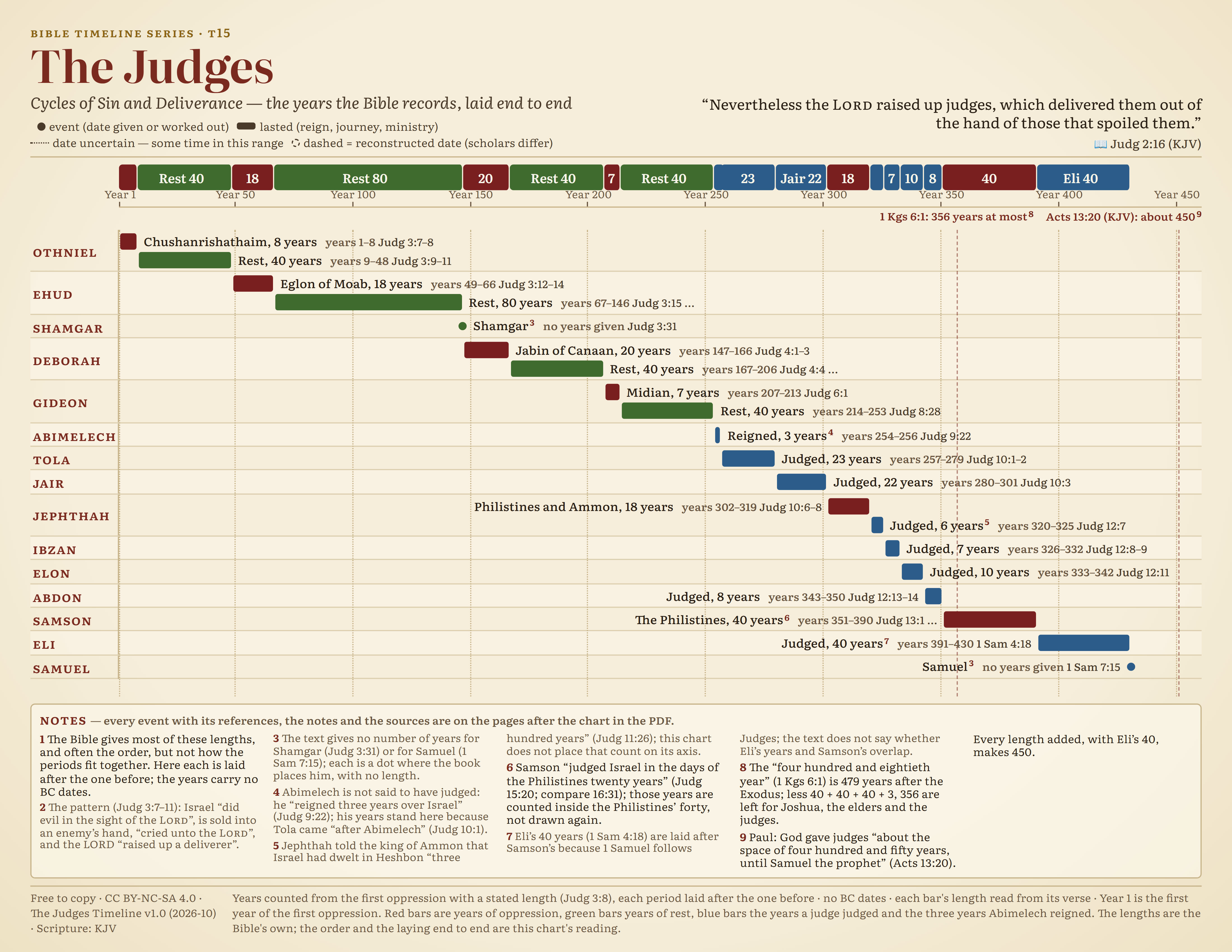

The Judges
 Judg 2:16 (KJV)
Notes — every event with its references, the notes and the sources are on the pages after the chart in the PDF.
1The Bible gives most of these lengths, and often the order, but not how the periods fit together. Here each is laid after the one before; the years carry no BC dates.
2The pattern (Judg 3:7–11): Israel did evil in the sight of the Lord
, is sold into an enemy’s hand, cried unto the Lord
, and the LORD raised up a deliverer
.
3The text gives no number of years for Shamgar (Judg 3:31) or for Samuel (1 Sam 7:15); each is a dot where the book places him, with no length.
4Abimelech is not said to have judged: he reigned three years over Israel
(Judg 9:22); his years stand here because Tola came after Abimelech
(Judg 10:1).
5Jephthah told the king of Ammon that Israel had dwelt in Heshbon three hundred years
(Judg 11:26); this chart does not place that count on its axis.
6Samson judged Israel in the days of the Philistines twenty years
(Judg 15:20; compare 16:31); those years are counted inside the Philistines’ forty, not drawn again.
7Eli’s 40 years (1 Sam 4:18) are laid after Samson’s because 1 Samuel follows Judges; the text does not say whether Eli’s years and Samson’s overlap.
8The four hundred and eightieth year
(1 Kgs 6:1) is 479 years after the Exodus; less 40 + 40 + 40 + 3, 356 are left for Joshua, the elders and the judges.
9Paul: God gave judges about the space of four hundred and fifty years, until Samuel the prophet
(Acts 13:20). Every length added, with Eli’s 40, makes 450.
The Judges — Study notes
Every event on the chart, with its Bible references, certainty and notes. One chronology for the whole series: the Bible's own numbers with the main ancient records. "c." = about; a range (e.g. 6–4 BC) = some time in that range.
| Date | Event | Bible references | Lane | Cert. |
|---|---|---|---|---|
| Chushanrishathaim 8 · years 1–812 | ||||
| years 1–8 | Chushanrishathaim, 8 years The LORD sold Israel into the hand of Chushanrishathaim king of Mesopotamia, and they served him eight years (Judg 3:8) |
Judg 3:7–8 | Othniel | B |
| Rest 40 · years 9–48 | ||||
| years 9–48 | Rest, 40 years When Israel cried unto the Lord, he raised up a deliverer, Othniel the son of Kenaz, and the land had rest forty years |
Judg 3:9–11 | Othniel | B |
| Eglon of Moab 18 · years 49–66 | ||||
| years 49–66 | Eglon of Moab, 18 yearsthe children of Israel served Eglon the king of Moab eighteen years |
Judg 3:12–14 | Ehud | B |
| Rest 80 · years 67–146 | ||||
| years 67–146 | Rest, 80 years The LORD raised them up a deliverer, Ehud the son of Gera, a Benjamite, a man lefthanded; afterwards the land had rest fourscore years |
Judg 3:15, 30 | Ehud | B |
| no years given | Shamgar3after him was Shamgar the son of Anath, who slew of the Philistines six hundred men with an ox goadand delivered Israel |
Judg 3:31 | Shamgar | B |
| Jabin of Canaan 20 · years 147–166 | ||||
| years 147–166 | Jabin of Canaan, 20 years The LORD sold them into the hand of Jabin king of Canaan, and for twenty years he mightily oppressed the children of Israel |
Judg 4:1–3 | Deborah | B |
| Rest 40 · years 167–206 | ||||
| years 167–206 | Rest, 40 yearsDeborah, a prophetess, the wife of Lapidoth, she judged Israel at that time; afterwards the land had rest forty years |
Judg 4:4; 5:31 | Deborah | B |
| Midian 7 · years 207–213 | ||||
| years 207–213 | Midian, 7 yearsthe Lord delivered them into the hand of Midian seven years |
Judg 6:1 | Gideon | B |
| Rest 40 · years 214–253 | ||||
| years 214–253 | Rest, 40 yearsthe country was in quietness forty years in the days of Gideon |
Judg 8:28 | Gideon | B |
| Abimelech 3 · years 254–256 | ||||
| years 254–256 | Reigned, 3 years4Abimelech had reigned three years over Israel |
Judg 9:22 | Abimelech | B |
| Tola 23 · years 257–279 | ||||
| years 257–279 | Judged, 23 yearsafter Abimelech there arose to defend Israel Tola, who judged Israel twenty and three years |
Judg 10:1–2 | Tola | B |
| Jair 22 · years 280–301 | ||||
| years 280–301 | Judged, 22 yearsafter him arose Jair, a Gileadite, and judged Israel twenty and two years |
Judg 10:3 | Jair | B |
| Philistines and Ammon 18 · years 302–319 | ||||
| years 302–319 | Philistines and Ammon, 18 years The LORD sold them into the hands of the Philistines, and into the hands of the children of Ammon, who vexed and oppressed the children of Israelfor eighteen years, all the children of Israel that were on the other side Jordan in the land of the Amorites, which is in Gilead |
Judg 10:6–8 | Jephthah | B |
| Jephthah 6 · years 320–325 | ||||
| years 320–325 | Judged, 6 years5Jephthah judged Israel six years |
Judg 12:7 | Jephthah | B |
| Ibzan 7 · years 326–332 | ||||
| years 326–332 | Judged, 7 years Ibzan of Bethlehem judged Israel, and he judged Israel seven years |
Judg 12:8–9 | Ibzan | B |
| Elon 10 · years 333–342 | ||||
| years 333–342 | Judged, 10 yearsElon, a Zebulonite, judged Israel; and he judged Israel ten years |
Judg 12:11 | Elon | B |
| Abdon 8 · years 343–350 | ||||
| years 343–350 | Judged, 8 yearsAbdon the son of Hillel, a Pirathonite, judged Israel, and he judged Israel eight years |
Judg 12:13–14 | Abdon | B |
| The Philistines 40 · years 351–390 | ||||
| years 351–390 | The Philistines, 40 years6 The LORD delivered them into the hand of the Philistines forty years; Samson judged Israel in the days of the Philistines twenty years |
Judg 13:1; 15:20 | Samson | B |
| Eli 40 · years 391–430 | ||||
| years 391–430 | Judged, 40 years7he had judged Israel forty years |
1 Sam 4:18 | Eli | B |
| no years given | Samuel3Samuel judged Israel all the days of his life |
1 Sam 7:15 | Samuel | B |
Certainty: A Stated in Scripture · B Worked out from Scripture · C Ancient record or astronomy · D Scholarly reconstruction · E Tradition / uncertain — scholars differ.
The Judges — notes and sources
How the dates were worked out
Every bar on this chart is a length of time the Bible itself gives (Judg 3–16; 1 Sam 4:18), read from its verse by a program. The chart gives no BC dates: the Bible does not say when the first oppression began, how long Joshua and the elders lived after the land was divided (Judg 2:7–10), or whether any of these periods overlapped. The years are counted from the first year of the first oppression the book gives a length for (Judg 3:8), and each period is laid after the one before it, in the order of the book (Eli, from 1 Samuel, after Samson); that arrangement is this chart's reading of the book, not a statement of the text. The last five chapters of Judges (17–21) give no number of years and are not drawn. Laid end to end, the periods reach year 430, counting Samson's 20 years (Judg 15:20; 16:31, one period) inside the Philistines' 40 (Judg 13:1) and including Eli's 40; adding Samson's 20 once more as a separate period, the lengths add up to 450. The four hundred and eightieth year
of 1 Kgs 6:1 is 479 years after the Exodus; less the wilderness (40, Josh 5:6), Saul (40, a figure only Paul gives, Acts 13:21), David (40, 1 Kgs 2:11) and Solomon's first three years, 356 years are left for Joshua, the elders and the judges together. Year 1 is the first year of the first oppression. Red bars are years of oppression, green bars years of rest, blue bars the years a judge judged and the three years Abimelech reigned. The lengths are the Bible's own; the order and the laying end to end are this chart's reading.
Dated lines on the chart
1 Kgs 6:1: 356 years at most8 — month 12, year 356 (1 Kgs 6:1; Cert. B)
Acts 13:20 (KJV): about 4509 — month 12, year 450 (Acts 13:20; Cert. B)
 Notes
Notes
1 The Bible gives most of these lengths, and often the order, but not how the periods fit together. Here each is laid after the one before; the years carry no BC dates. Year 1 is the first year of the first oppression the book gives a length for (Judg 3:7–8). The Bible does not say when that was, how many years Joshua and the elders lived on after the land was divided (Judg 2:7–10), or whether any of the periods overlapped; the book places one judge after another (after him
, Judg 3:31; 10:3; 12:8, 11, 13). The five chapters at the end of Judges (17–21) give no number of years; they say that there was no king in Israel
(Judg 17:6; 18:1; 19:1; 21:25) and are not drawn. This chart's only choices are the order, the laying end to end, and counting Samson's 20 years inside the Philistines' 40 (see the note on Samson); every length is the Bible's own. (Judg 2:7–10; 3:7–8, 31; 10:3; 12:8, 11, 13; 17:6; 18:1; 19:1; 21:25)
2 The pattern (Judg 3:7–11): Israel did evil in the sight of the Lord
, is sold into an enemy’s hand, cried unto the Lord
, and the LORD raised up a deliverer
. Judg 3:7–11 shows the whole pattern in Othniel's time: Israel did evil in the sight of the Lord
, the LORD sold them into the hand of Chushanrishathaim, Israel cried unto the Lord
, the LORD raised up a deliverer
, and the land had rest forty years
. Seven verses of Judges say that Israel did evil in the sight of the Lord
(2:11; 3:7, 12; 4:1; 6:1; 10:6; 13:1), and again
is in four of them (3:12; 4:1; 10:6; 13:1) — found by searching the KJV. (Judg 3:7–11; 2:11; 3:12; 4:1; 6:1; 10:6; 13:1)
3 The text gives no number of years for Shamgar (Judg 3:31) or for Samuel (1 Sam 7:15); each is a dot where the book places him, with no length. Shamgar slew of the Philistines six hundred men with an ox goad
and delivered Israel
(Judg 3:31), after Ehud; Judg 4:1 says that Israel did evil again when Ehud was dead
. Samuel judged Israel all the days of his life
(1 Sam 7:15); his dot is laid at the end of Eli's years, the earliest it can stand, for the ark's seven months among the Philistines and its twenty years at Kirjath-jearim come between (1 Sam 6:1; 7:2). (Judg 3:31; 4:1; 1 Sam 6:1; 7:2, 15)
4 Abimelech is not said to have judged: he reigned three years over Israel
(Judg 9:22); his years stand here because Tola came after Abimelech
(Judg 10:1). (Judg 9:22; 10:1)
5 Jephthah told the king of Ammon that Israel had dwelt in Heshbon three hundred years
(Judg 11:26); this chart does not place that count on its axis. Judg 11:26 is another length the Bible gives. It counts the time Israel dwelt in Heshbon and its towns, which began when Israel took Heshbon (Num 21:25); this chart does not place that start, so it does not use the number. (Judg 11:26; Num 21:25)
6 Samson judged Israel in the days of the Philistines twenty years
(Judg 15:20; compare 16:31); those years are counted inside the Philistines’ forty, not drawn again. The verses give two numbers: the LORD delivered them into the hand of the Philistines forty years
(Judg 13:1), and Samson judged Israel in the days of the Philistines twenty years
(Judg 15:20; compare 16:31). This chart counts the 20 inside the 40. Counted again, the periods would end in year 450 instead of 430. The text does not say in which of the 40 years Samson judged. (Judg 13:1; 15:20; 16:31)
7 Eli’s 40 years (1 Sam 4:18) are laid after Samson’s because 1 Samuel follows Judges; the text does not say whether Eli’s years and Samson’s overlap. Eli had judged Israel forty years
when he died on hearing that the ark of God was taken (1 Sam 4:17–18). The Philistines are the enemy in 1 Sam 4 as in Judg 13–16, and the text does not say how Eli's 40 years relate to the Philistines' 40 or to Samson's 20. (1 Sam 4:1–2, 17–18)
8 The four hundred and eightieth year
(1 Kgs 6:1) is 479 years after the Exodus; less 40 + 40 + 40 + 3, 356 are left for Joshua, the elders and the judges. 1 Kgs 6:1 dates the start of the building of the Temple in the four hundred and eightieth year after the children of Israel were come out of the land of Egypt
, in Solomon's fourth year — 479 full years after the Exodus. The text itself gives these parts: the wilderness, forty years (Josh 5:6: walked forty years in the wilderness
); Saul, by the space of forty years
(Acts 13:21, Paul speaking; 1 Sam 13:1 in the KJV gives no usable number, so this figure rests on Paul alone); David, the days that David reigned over Israel were forty years
(1 Kgs 2:11); and Solomon's three years of reign before his fourth. 479 − 40 − 40 − 40 − 3 = 356, to cover the conquest, the rest of Joshua's life, the elders that outlived Joshua
(Judg 2:7) and the judges up to Saul. The line on the chart stands at the end of year 356 counted from year 1, as if Joshua and the elders had no years; every year they had moves the true end of the 356 that many years earlier, so the line marks the latest year at which the judges' periods could end, if the 480 years are a plain sum. A year or two may be lost or gained at each join, because part-years may be counted as whole years. The numbers of the judges laid end to end (430) come to more than 356, and the text does not say how they fit together. One view of the date of the Exodus, set out in the ESV Study Bible's article on it, reads the 480 years as a representative number for twelve generations rather than a plain sum; this chart makes no choice. (1 Kgs 6:1; 2:11; Josh 5:6; Acts 13:21; Judg 2:7–10)
9 Paul: God gave judges about the space of four hundred and fifty years, until Samuel the prophet
(Acts 13:20). Every length added, with Eli’s 40, makes 450. Acts 13:19–20 says that God divided their land to them by lot
and after that
gave judges for this long. Every length the book of Judges gives for an oppression, a rest or a judge, added (8 + 40 + 18 + 80 + 20 + 40 + 7 + 40 + 3 + 23 + 22 + 18 + 6 + 7 + 10 + 8 + 40 + 20), is 410, and Eli's 40 years (1 Sam 4:18) make 450 (Samson's 20 years, Judg 15:20; 16:31, are one period, counted once here). This chart draws Samson's 20 years inside the Philistines' 40, so its periods end in year 430; the marker stands where year 450 would end, counted from year 1 as if Joshua and the elders had no years. The text does not say that Paul was adding these numbers. This follows the KJV, which puts the 450 years on the judges; the ESV and NIV read "All this took about 450 years" as the time before the judges (Acts 13:19–20 in parallel translations). (Acts 13:19–20; 1 Sam 4:18; Judg 15:20; 16:31)
Sources
The King James translators, The Holy Bible, King James Version — Pure Cambridge Edition text (bibleprotector.com), checked against eBible.org's 1769 text, 1611 (Cambridge text).
ESV Study Bible (Crossway), article by the study-Bible team, The Date of the Exodus (ESV Study Bible, as published at Bible Study Tools), 2008 (online).
Bible Hub (parallel Bible translations), Acts 13:20 in parallel translations (biblehub.com/acts/13-20.htm), 2026 (read).
Only sources actually checked are listed. Copyrighted charts were used for cross-checking only.
Free to copy, print and share for non-commercial use. Licence: Creative Commons BY-NC-SA 4.0 (creativecommons.org/licenses/by-nc-sa/4.0). Scripture quotations: King James Version (KJV) (Cambridge text). The Judges Timeline v1.0, 2026-10-10.