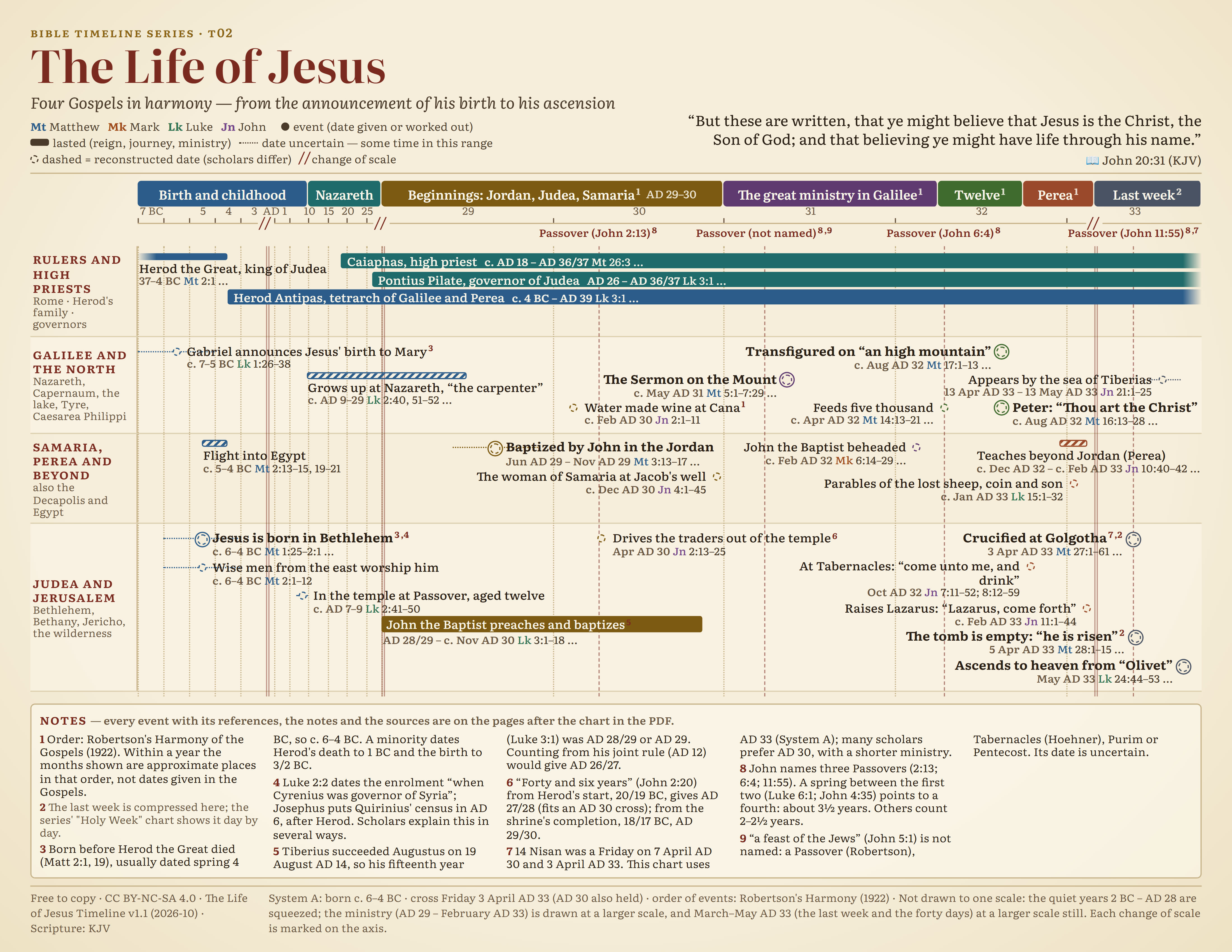

The Life of Jesus
 John 20:31 (KJV)
Thou art the Christ
an high mountain
come unto me, and drink
Lazarus, come forth
he is risen2
Olivet
Notes — every event with its references, the notes and the sources are on the pages after the chart in the PDF.
1Order: Robertson's Harmony of the Gospels (1922). Within a year the months shown are approximate places in that order, not dates given in the Gospels.
2The last week is compressed here; the series' "Holy Week" chart shows it day by day.
3Born before Herod the Great died (Matt 2:1, 19), usually dated spring 4 BC, so c. 6–4 BC. A minority dates Herod's death to 1 BC and the birth to 3/2 BC.
4Luke 2:2 dates the enrolment when Cyrenius was governor of Syria
; Josephus puts Quirinius' census in AD 6, after Herod. Scholars explain this in several ways.
5Tiberius succeeded Augustus on 19 August AD 14, so his fifteenth year (Luke 3:1) was AD 28/29 or AD 29. Counting from his joint rule (AD 12) would give AD 26/27.
6Forty and six years
(John 2:20) from Herod's start, 20/19 BC, gives AD 27/28 (fits an AD 30 cross); from the shrine's completion, 18/17 BC, AD 29/30.
714 Nisan was a Friday on 7 April AD 30 and 3 April AD 33. This chart uses AD 33 (System A); many scholars prefer AD 30, with a shorter ministry.
8John names three Passovers (2:13; 6:4; 11:55). A spring between the first two (Luke 6:1; John 4:35) points to a fourth: about 3½ years. Others count 2–2½ years.
9a feast of the Jews
(John 5:1) is not named: a Passover (Robertson), Tabernacles (Hoehner), Purim or Pentecost. Its date is uncertain.
The Life of Jesus — Study notes
Every event on the chart, with its Bible references, certainty and notes. One chronology for the whole series: the Bible's own numbers with the main ancient records. "c." = about; a range (e.g. 6–4 BC) = some time in that range.
| Date | Event | Matthew | Mark | Luke | John / other | Lane | Cert. |
|---|---|---|---|---|---|---|---|
| Birth and childhood · 7 BC – AD 9 | |||||||
| 37–4 BC | Herod the Great, king of Judea12 Named king by Rome 40 BC; took Jerusalem 37 BC; died 4 BC Sources: Flavius Josephus |
2:1 | 1:5 | Rulers and high priests | C | ||
| 27 BC – 19 Aug AD 14 | Caesar Augustus, emperor 27 BC – 19 August AD 14; a decree from Caesar Augustus(Luke 2:1) Sources: Andrew E. Steinmann |
2:1 | Rulers and high priests | C | |||
| c. 7–5 BC | Gabriel appears to Zacharias in the temple3In the days of Herod, the king of Judaea(Luke 1:5) Sources: A. T. Robertson |
1:5–25 | Judea and Jerusalem | D | |||
| c. 7–5 BC | Gabriel announces Jesus' birth to Mary3 At Nazareth, in the sixth monthof Elisabeth's pregnancy Sources: A. T. Robertson |
1:26–38 | Galilee and the north | D | |||
| c. 7–5 BC | Mary visits Elisabeth; Mary's song Sources: A. T. Robertson |
1:39–56 | Judea and Jerusalem | D | |||
| c. 7–5 BC | An angel speaks to Joseph in a dreamthou shalt call his name JESUS(Matt 1:21) Sources: A. T. Robertson |
1:18–25 | Galilee and the north | D | |||
| c. 7–4 BC | John the Baptist is born3 About six months before Jesus (Luke 1:26, 36) Sources: A. T. Robertson |
1:57–80 | Judea and Jerusalem | D | |||
| c. 6–4 BC | Decree that all the world should be taxed4 Joseph and Mary go from Nazareth to Bethlehem, the city of David Sources: David J. Armitage |
2:1–5 | Rulers and high priests | E | |||
| c. 6–4 BC | Jesus is born in Bethlehem3428laid him in a manger(Luke 2:7) Scripture fulfilled: Mic 5:2 (as stated in Matt 2:5–6) Sources: Flavius Josephus; A. T. Robertson |
1:25–2:1 | 2:1–7 | Judea and Jerusalem | D | ||
| c. 6–4 BC | Angels appear to shepherds28keeping watch over their flock by night(Luke 2:8) Sources: A. T. Robertson |
2:8–20 | Judea and Jerusalem | D | |||
| c. 6–4 BC | Named Jesus on the eighth day Sources: A. T. Robertson |
2:21 | Judea and Jerusalem | D | |||
| c. 6–4 BC | Presented in the temple: Simeon and Anna About forty days after the birth (Lev 12:2–4) Sources: A. T. Robertson |
2:22–38 | Lev 12:2–4 | Judea and Jerusalem | D | ||
| c. 6–4 BC | Wise men from the east worship him15 They found the young childin the house(Matt 2:11) Sources: A. T. Robertson |
2:1–12 | Judea and Jerusalem | E | |||
| c. 5–4 BC | Flight into Egypt15Out of Egypt have I called my son(Matt 2:15) Scripture fulfilled: Hos 11:1 (as stated in Matt 2:15) Sources: Flavius Josephus; A. T. Robertson |
2:13–15, 19–21 | Samaria, Perea and beyond | D | |||
| c. 6–4 BC | Herod kills the boys of Bethlehem15from two years old and under(Matt 2:16) Scripture fulfilled: Jer 31:15 (as stated in Matt 2:17–18) Sources: A. T. Robertson |
2:16–18 | Judea and Jerusalem | D | |||
| c. 4 BC | Back from Egypt to Nazareth15 Archelaus ruled Judea, so Joseph turned aside into the parts of Galilee Sources: Flavius Josephus; A. T. Robertson |
2:19–23 | 2:39 | Galilee and the north | D | ||
| 4 BC – AD 6 | Archelaus reigns in Judea11in the room of his father Herod(Matt 2:22); deposed by Augustus AD 6 Sources: Flavius Josephus |
2:22 | Rulers and high priests | C | |||
| c. 4 BC – AD 39 | Herod Antipas, tetrarch of Galilee and Perea11Herod the tetrarch, who killed John the Baptist; to AD 39 Sources: Flavius Josephus |
14:1–12 | 23:7–12 | Rulers and high priests | C | ||
| 4 BC – AD 33/34 | Philip, tetrarch of Ituraea11 Died in Tiberius' twentieth year, AD 33/34, after 37 years Sources: Flavius Josephus |
3:1 | Rulers and high priests | C | |||
| AD 6 | Census of Judea under Quirinius (Cyrenius)4 Judea becomes a Roman province; Judas of Galilee rebels in the days of the taxing(Acts 5:37) Sources: Flavius Josephus |
Acts 5:37 | Rulers and high priests | C | |||
| AD 6–15 | Annas, high priest13 AD 6–15; still a leading figure in AD 33 (John 18:13) Sources: Flavius Josephus |
3:2 | 18:13 | Rulers and high priests | C | ||
| AD 6–26 | Roman prefects govern Judea Coponius, Ambivius, Rufus, then Valerius Gratus (AD 15–26) Sources: Flavius Josephus |
Rulers and high priests | C | ||||
| c. AD 7–9 | In the temple at Passover, aged twelve29about my Father's business(Luke 2:49) Sources: A. T. Robertson |
2:41–50 | Judea and Jerusalem | D | |||
| c. AD 9–29 | Grows up at Nazareth, the carpenter Jesus increased in wisdom and stature(Luke 2:52) Sources: A. T. Robertson |
6:3 | 2:40, 51–52 | Galilee and the north | D | ||
| Growing up at Nazareth · AD 10–28 | |||||||
| 19 Aug AD 14 – 16 Mar AD 37 | Tiberius Caesar, emperor5 19 August AD 14 – 16 March AD 37; Luke dates John's preaching by his fifteenth year Sources: Andrew E. Steinmann |
3:1 | Rulers and high priests | C | |||
| c. AD 18 – AD 36/37 | Caiaphas, high priest13 Son-in-law of Annas (John 18:13); removed AD 36/37 Sources: Flavius Josephus |
26:3 | 11:49–51; 18:13 | Rulers and high priests | C | ||
| AD 26 – AD 36/37 | Pontius Pilate, governor of Judea14 Ten years (Josephus); Pontius Pilate the governor(Matt 27:2) Sources: Flavius Josephus; Colin J. Humphreys and W. Graeme Waddington |
27:2 | 3:1 | Rulers and high priests | C | ||
| Beginnings: Jordan, Judea, Samaria · AD 29–301 | |||||||
| AD 28/29 – c. Nov AD 30 | John the Baptist preaches and baptizes5in the fifteenth year of the reign of Tiberius Caesar(Luke 3:1) Sources: Andrew E. Steinmann; Colin J. Humphreys and W. Graeme Waddington |
3:1–12 | 1:1–8 | 3:1–18 | Judea and Jerusalem | C | |
| Jun AD 29 – Nov AD 29 | Baptized by John in the Jordan2324Thou art my beloved Son; in thee I am well pleased(Luke 3:22) Sources: Colin J. Humphreys and W. Graeme Waddington; Andrew E. Steinmann; A. T. Robertson |
3:13–17 | 1:9–11 | 3:21–23 | Samaria, Perea and beyond | D | |
| c. Sep AD 29 | Tempted in the wilderness forty days Sources: A. T. Robertson; Andrew E. Steinmann |
4:1–11 | 1:12–13 | 4:1–13 | Judea and Jerusalem | D | |
| c. Dec AD 29 | First disciples: Behold the Lamb of God24 Andrew, Simon Peter, Philip and Nathanael, at Bethabara beyond Jordan Sources: A. T. Robertson |
1:19–51 | Samaria, Perea and beyond | D | |||
| c. Feb AD 30 | Water made wine at Cana1This beginning of miracles(John 2:11) Sources: A. T. Robertson |
2:1–11 | Galilee and the north | D | |||
| c. Mar AD 30 | A few days at Capernaum with his family Sources: A. T. Robertson |
2:12 | Galilee and the north | D | |||
| Apr AD 30 | Drives the traders out of the temple306Forty and six years was this temple in building(John 2:20) Sources: A. T. Robertson; Colin J. Humphreys and W. Graeme Waddington |
2:13–25 | Judea and Jerusalem | D | |||
| c. Apr AD 30 | Nicodemus: Ye must be born again For God so loved the world(John 3:16) Sources: A. T. Robertson |
3:1–21 | Judea and Jerusalem | D | |||
| c. May AD 30 – c. Nov AD 30 | Ministry in Judea: He must increase His disciples baptize; John says of him He must increase, but I must decrease Sources: A. T. Robertson |
3:22–36; 4:1–3 | Judea and Jerusalem | D | |||
| c. Nov AD 30 | John the Baptist put in prison by Herod25 For reproving him over Herodias his brother Philip's wife Sources: Flavius Josephus; A. T. Robertson |
4:12; 14:3–5 | 1:14; 6:17–20 | 3:19–20 | 3:24 | Samaria, Perea and beyond | D |
| c. Dec AD 30 | The woman of Samaria at Jacob's well26There are yet four months, and then cometh harvest(John 4:35) Sources: A. T. Robertson; Andrew E. Steinmann |
4:1–45 | Samaria, Perea and beyond | D | |||
| The great ministry in Galilee · AD 31 – Mar AD 321 | |||||||
| c. Jan AD 31 | Preaches in Galilee, Repent Sources: A. T. Robertson |
4:17 | 1:14–15 | 4:14–15 | Galilee and the north | D | |
| c. Jan AD 31 | Heals a nobleman's son from Canathe second miraclein Galilee (John 4:54) Sources: A. T. Robertson |
4:43–54 | Galilee and the north | D | |||
| c. Jan AD 31 | Rejected at Nazareth16This day is this scripture fulfilled in your ears(Luke 4:21) Sources: A. T. Robertson |
4:16–30 | Galilee and the north | D | |||
| c. Jan AD 31 | Makes his home at Capernaumdwelt in Capernaum, which is upon the sea coast(Matt 4:13) Sources: A. T. Robertson |
4:13–16 | Galilee and the north | D | |||
| c. Feb AD 31 | Calls four fishermen: fishers of men Simon Peter, Andrew, James and John, by the sea of Galilee Sources: A. T. Robertson |
4:18–22 | 1:16–20 | 5:1–11 | Galilee and the north | D | |
| c. Feb AD 31 | Capernaum: Simon's wife's mother healed Also an unclean spirit cast out in the synagogue on the sabbath Sources: A. T. Robertson |
8:14–17 | 1:21–34 | 4:31–41 | Galilee and the north | D | |
| c. Feb AD 31 | First preaching tour of Galilee Sources: A. T. Robertson |
4:23–25 | 1:35–39 | 4:42–44 | Galilee and the north | D | |
| c. Mar AD 31 | Heals a leper Sources: A. T. Robertson |
8:2–4 | 1:40–45 | 5:12–16 | Galilee and the north | D | |
| c. Mar AD 31 | A paralysed man let down through the roofSon, thy sins be forgiven thee(Mark 2:5) Sources: A. T. Robertson |
9:1–8 | 2:1–12 | 5:17–26 | Galilee and the north | D | |
| c. Mar AD 31 | Calls Matthew (Levi), a publicanFollow me; a feast with publicans and sinners Sources: A. T. Robertson |
9:9–17 | 2:13–22 | 5:27–39 | Galilee and the north | D | |
| c. Apr AD 31 | The disciples pluck ears of corn on a sabbath8 Grain ripe — a spring between the Passovers of John 2:13 and 6:4 Sources: A. T. Robertson; Andrew E. Steinmann |
12:1–8 | 2:23–28 | 6:1–5 | Galilee and the north | D | |
| c. Apr AD 31 | Heals a withered hand; leaders plot The Pharisees take counsel with the Herodians(Mark 3:6) Sources: A. T. Robertson |
12:9–14 | 3:1–6 | 6:6–11 | Galilee and the north | D | |
| c. May AD 31 | Chooses the twelve apostles After a night of prayer on a mountain(Luke 6:12) Sources: A. T. Robertson |
10:2–4 | 3:13–19 | 6:12–16 | Galilee and the north | D | |
| c. May AD 31 | The Sermon on the Mount17Blessed are the poor in spirit(Matt 5:3) Sources: A. T. Robertson |
5:1–7:29 | 6:17–49 | Galilee and the north | D | ||
| c. Jun AD 31 | Heals a centurion's servant Sources: A. T. Robertson |
8:5–13 | 7:1–10 | Galilee and the north | D | ||
| c. Jun AD 31 | Raises a widow's son at NainYoung man, I say unto thee, Arise(Luke 7:14) Sources: A. T. Robertson |
7:11–17 | Galilee and the north | D | |||
| Feb AD 31 – Oct AD 31 | Heals a man at the pool of Bethesda9 At a feast of the Jews(John 5:1), on the sabbath Sources: A. T. Robertson |
5:1–47 | Judea and Jerusalem | E | |||
| c. Jul AD 31 | John asks from prison: Art thou he Jesus' answer; woes on the cities; Come unto me(Matt 11:28) Sources: A. T. Robertson |
11:2–30 | 7:18–35 | Galilee and the north | D | ||
| c. Jul AD 31 | A sinful woman anoints his feet18 In the house of Simon the Pharisee; the parable of the two debtors Sources: A. T. Robertson |
7:36–50 | Galilee and the north | D | |||
| c. Aug AD 31 | Second tour of Galilee with the twelve Women who had been healed minister to him, among them Mary Magdalene Sources: A. T. Robertson |
8:1–3 | Galilee and the north | D | |||
| c. Sep AD 31 | Accused of casting out devils by Beelzebub A sign refused but the sign of the prophet Jonas; his mother and brethren seek him Sources: A. T. Robertson |
12:22–50 | 3:19–35 | 8:19–21 | Galilee and the north | D | |
| c. Sep AD 31 | Parables by the sea: the sower Also the tares, mustard seed, leaven, treasure, pearl and net Sources: A. T. Robertson |
13:1–53 | 4:1–34 | 8:4–18 | Galilee and the north | D | |
| c. Sep AD 31 | Stills the storm: Peace, be still Sources: A. T. Robertson |
8:18, 23–27 | 4:35–41 | 8:22–25 | Galilee and the north | D | |
| c. Sep AD 31 | Heals the demoniac called Legion27 the other side of the sea, the country of the Gadarenes Sources: A. T. Robertson |
8:28–34 | 5:1–20 | 8:26–39 | Samaria, Perea and beyond | D | |
| c. Oct AD 31 | Raises Jairus' daughter; a woman healedTalitha cumi(Mark 5:41) Sources: A. T. Robertson |
9:18–26 | 5:21–43 | 8:40–56 | Galilee and the north | D | |
| c. Oct AD 31 | Two blind men and a dumb man healed Sources: A. T. Robertson |
9:27–34 | Galilee and the north | D | |||
| c. Nov AD 31 | Rejected again at Nazareth16Is not this the carpenter(Mark 6:3) Sources: A. T. Robertson |
13:54–58 | 6:1–6 | Galilee and the north | D | ||
| c. Dec AD 31 | Sends out the twelve by two and two Sources: A. T. Robertson |
9:35–11:1 | 6:6–13 | 9:1–6 | Galilee and the north | D | |
| c. Feb AD 32 | John the Baptist beheaded25 At the request of Herodias' daughter; Antipas then hears of Jesus Sources: Flavius Josephus; A. T. Robertson |
14:1–12 | 6:14–29 | 9:7–9 | Samaria, Perea and beyond | D | |
| Training the Twelve; journeys north · Apr AD 32 – Sep AD 321 | |||||||
| c. Apr AD 32 | Feeds five thousand19 Near Bethsaida, shortly before the Passover (John 6:4) Sources: A. T. Robertson; Colin J. Humphreys and W. Graeme Waddington |
14:13–21 | 6:30–44 | 9:10–17 | 6:1–15 | Galilee and the north | D |
| c. Apr AD 32 | Walks on the sea to the disciplesin the fourth watch of the night(Matt 14:25) Sources: A. T. Robertson |
14:22–36 | 6:45–56 | 6:16–21 | Galilee and the north | D | |
| c. Apr AD 32 | I am the bread of life; many turn back many of his disciples went back(John 6:66) Sources: A. T. Robertson |
6:22–71 | Galilee and the north | D | |||
| c. May AD 32 | Pharisees from Jerusalem accuse his disciples Unwashed hands; the tradition of the elders Sources: A. T. Robertson |
15:1–20 | 7:1–23 | 7:1 | Galilee and the north | D | |
| c. May AD 32 | Near Tyre and Sidon: a Gentile woman's faith Her daughter is healed Sources: A. T. Robertson |
15:21–28 | 7:24–30 | Galilee and the north | D | ||
| c. Jun AD 32 | Decapolis: deaf man healed; four thousand fed Sources: A. T. Robertson |
15:29–38 | 7:31–8:9 | Samaria, Perea and beyond | D | ||
| c. Jun AD 32 | Pharisees and Sadducees demand a sign Sources: A. T. Robertson |
15:39–16:4 | 8:10–12 | Galilee and the north | D | ||
| c. Jul AD 32 | A blind man healed at Bethsaida On the way, Beware of the leaven of the Pharisees Sources: A. T. Robertson |
16:5–12 | 8:13–26 | Galilee and the north | D | ||
| c. Aug AD 32 | Peter: Thou art the Christ Near Caesarea Philippi; then he foretells his death and rising Sources: A. T. Robertson |
16:13–28 | 8:27–9:1 | 9:18–27 | Galilee and the north | D | |
| c. Aug AD 32 | Transfigured on an high mountain20 Moses and Elias appear; This is my beloved Son Sources: A. T. Robertson |
17:1–13 | 9:2–13 | 9:28–36 | Galilee and the north | D | |
| c. Aug AD 32 | Heals a boy the disciples could not heal Sources: A. T. Robertson |
17:14–21 | 9:14–29 | 9:37–43 | Galilee and the north | D | |
| c. Sep AD 32 | At Capernaum: tribute money; who is greatest His death foretold again; Except ye be converted, and become as little children Sources: A. T. Robertson |
17:22–18:35 | 9:30–50 | 9:43–50 | Galilee and the north | D | |
| c. Sep AD 32 | His brethren urge him to go to the feastFor neither did his brethren believe in him(John 7:5) Sources: A. T. Robertson |
7:2–9 | Galilee and the north | D | |||
| Later ministry in Judea and Perea · Oct AD 32 – Feb AD 33110 | |||||||
| c. Oct AD 32 | Goes up to the feast in secret, via Samaria10 he stedfastly set his face to go to Jerusalem(Luke 9:51) Sources: A. T. Robertson |
9:51–56 | 7:10 | Samaria, Perea and beyond | E | ||
| Oct AD 32 | At Tabernacles: come unto me, and drink31 Before Abraham was, I am(John 8:58); they take up stones Sources: Fred Espenak (NASA Goddard Space Flight Center); A. T. Robertson |
7:11–52; 8:12–59 | Judea and Jerusalem | D | |||
| c. Oct AD 32 | A woman taken in adultery22He that is without sin among you, let him first cast a stone(John 8:7) Sources: A. T. Robertson; Bruce M. Metzger |
7:53–8:11 | Judea and Jerusalem | E | |||
| c. Oct AD 32 | A man born blind: now I see Then I am the good shepherd(John 10:11) Sources: A. T. Robertson |
9:1–10:21 | Judea and Jerusalem | D | |||
| c. Nov AD 32 | Sends out the seventy10 Sources: A. T. Robertson |
10:1–24 | Judea and Jerusalem | E | |||
| c. Nov AD 32 | The good Samaritan; Martha and Mary10 A lawyer asks who is my neighbour?; Mary hath chosen that good part Sources: A. T. Robertson |
10:25–42 | Judea and Jerusalem | E | |||
| c. Nov AD 32 | Teaching in Judea: prayer, warnings, parables10 The Lord's prayer again; the rich fool; the barren fig tree; a crippled woman healed Sources: A. T. Robertson |
11:1–13:21 | Judea and Jerusalem | E | |||
| Dec AD 32 | Feast of dedication: I and my Father are one31 it was winter; they try to stone him Sources: Fred Espenak (NASA Goddard Space Flight Center); A. T. Robertson |
10:22–39 | Judea and Jerusalem | D | |||
| c. Dec AD 32 – c. Feb AD 33 | Teaches beyond Jordan (Perea)10where John at first baptized(John 10:40) Sources: A. T. Robertson |
13:22–17:10 | 10:40–42 | Samaria, Perea and beyond | D | ||
| c. Jan AD 33 | Tell that fox: a warning about Herod10 O Jerusalem, Jerusalem(Luke 13:34) Sources: A. T. Robertson |
13:22–35 | Samaria, Perea and beyond | E | |||
| c. Jan AD 33 | A sabbath meal: the great supper parable10 A man with the dropsy healed; counting the cost of discipleship Sources: A. T. Robertson |
14:1–35 | Samaria, Perea and beyond | E | |||
| c. Jan AD 33 | Parables of the lost sheep, coin and son10 Told when the Pharisees murmured, This man receiveth sinners Sources: A. T. Robertson |
15:1–32 | Samaria, Perea and beyond | E | |||
| c. Feb AD 33 | The unjust steward; the rich man and Lazarus10 Sources: A. T. Robertson |
16:1–17:10 | Samaria, Perea and beyond | E | |||
| c. Feb AD 33 | Raises Lazarus: Lazarus, come forth I am the resurrection, and the life(John 11:25) Sources: A. T. Robertson |
11:1–44 | Judea and Jerusalem | D | |||
| c. Feb AD 33 | The council plots; he withdraws to Ephraima city called Ephraimnear the wilderness (John 11:54) Sources: A. T. Robertson |
11:45–54 | Judea and Jerusalem | D | |||
| The last week and the forty days · Mar AD 33 – May AD 332 | |||||||
| c. Mar AD 33 | Ten lepers healed; one, a Samaritan, returns10through the midst of Samaria and Galilee(Luke 17:11) Sources: A. T. Robertson |
17:11–37 | Samaria, Perea and beyond | E | |||
| c. Mar AD 33 | The unjust judge; Pharisee and publican10 Sources: A. T. Robertson |
18:1–14 | Samaria, Perea and beyond | E | |||
| c. Mar AD 33 | Perea: marriage, little children, a rich rulerSuffer the little children to come unto me; his death foretold a third time Sources: A. T. Robertson |
19:1–20:28 | 10:1–45 | 18:15–34 | Samaria, Perea and beyond | D | |
| c. Mar AD 33 | Blind Bartimaeus healed at Jericho32 Sources: A. T. Robertson |
20:29–34 | 10:46–52 | 18:35–43 | Judea and Jerusalem | D | |
| c. Mar AD 33 | Zacchaeus at Jericho: to seek and to save Then the parable of the pounds, on the way up to Jerusalem Sources: A. T. Robertson |
19:1–28 | Judea and Jerusalem | D | |||
| 27 Mar AD 33 | Arrives at Bethany before the Passover2six days before the passover(John 12:1) |
11:55–12:1, 9–11 | Judea and Jerusalem | D | |||
| 29 Mar AD 33 | Rides into Jerusalem on a colt2 Scripture fulfilled: Zech 9:9 (as stated in Matt 21:4–5; John 12:14–15) |
21:1–11 | 11:1–11 | 19:29–44 | 12:12–19 | Judea and Jerusalem | D |
| 30 Mar AD 33 | Drives the traders out of the temple again302 Sources: A. T. Robertson |
21:12–13 | 11:15–18 | 19:45–48 | Judea and Jerusalem | D | |
| 31 Mar AD 33 | Last teaching in the temple and on Olivet2 | 21:23–25:46 | 11:27–13:37 | 20:1–21:38 | Judea and Jerusalem | D | |
| 2 Apr AD 33 | The Last Supper2 Gethsemane and his arrest follow that night |
26:17–56 | 14:12–52 | 22:7–53 | 13:1–18:12 | Judea and Jerusalem | D |
| 3 Apr AD 33 | Crucified at Golgotha72 Friday 14 Nisan; tried by the council, Pilate and Herod; buried before sunset Sources: Colin J. Humphreys and W. Graeme Waddington |
27:1–61 | 15:1–47 | 23:1–56 | 18:13–19:42 | Judea and Jerusalem | D |
| 5 Apr AD 33 | The tomb is empty: he is risen222 the first day of the week: he appears to Mary Magdalene, to Simon, to the disciples |
28:1–15 | 16:1–14 | 24:1–43 | 20:1–23; 1 Cor 15:4–5 | Judea and Jerusalem | D |
| 12 Apr AD 33 | Appears to Thomas after eight days7 My Lord and my God(John 20:28) |
20:24–31 | Judea and Jerusalem | D | |||
| 13 Apr AD 33 – 13 May AD 33 | Appears by the sea of Tiberias21 A great catch of fish; Feed my sheep Sources: A. T. Robertson |
21:1–25 | Galilee and the north | D | |||
| 13 Apr AD 33 – 13 May AD 33 | On a mountain in Galilee: teach all nations2122 Robertson links it with the appearance to above five hundred brethren at once Sources: A. T. Robertson |
28:16–20 | 16:15–18 | 1 Cor 15:6 | Galilee and the north | D | |
| May AD 33 | Ascends to heaven from Olivet2122 being seen of them forty days(Acts 1:3) |
16:19–20 | 24:44–53 | Acts 1:3–12 | Judea and Jerusalem | D | |
Certainty: A Stated in Scripture · B Worked out from Scripture · C Ancient record or astronomy · D Scholarly reconstruction · E Tradition / uncertain — scholars differ.
The Life of Jesus — notes and sources
How the dates were worked out
Dates follow System A, the series' master chronology. Jesus was born c. 6–4 BC, before Herod the Great died (usually dated 4 BC). John the Baptist began in Tiberius' fifteenth year (AD 28/29, Luke 3:1) and Jesus was baptized c. AD 29. The ministry is drawn with four Passovers — AD 30, 31, 32 and 33 — three named by John (2:13; 6:4; 11:55) and one inferred, ending with the cross on Friday 3 April AD 33 (14 Nisan). Many scholars prefer AD 30 for the cross, with a ministry of just over two years from c. AD 27/28. The order of events follows A. T. Robertson's Harmony of the Gospels (1922), whose own ministry dates were three years earlier (AD 26–30). Months inside a year are approximate placements in that order. Passover days are astronomical (Humphreys and Waddington 1992); the months of the feasts of AD 32 are computed from NASA new-moon tables. Not drawn to one scale: the quiet years 2 BC – AD 28 are squeezed; the ministry (AD 29 – February AD 33) is drawn at a larger scale, and March–May AD 33 (the last week and the forty days) at a larger scale still. Each change of scale is marked on the axis.
Dated lines on the chart
Passover (John 2:13)8 — 7 Apr AD 30 (John 2:13; Cert. D)
Passover (not named)89 — 27 Mar AD 31
Passover (John 6:4)8 — 13 Apr AD 32 (John 6:4; Cert. D)
Passover (John 11:55)87 — 3 Apr AD 33 (John 11:55; 13:1; Cert. D)
 Notes
Notes
1 Order: Robertson's Harmony of the Gospels (1922). Within a year the months shown are approximate places in that order, not dates given in the Gospels. Fixed points: the baptism (c. AD 29), the Passovers, the feasts of Tabernacles and Dedication AD 32, John 4:35 (winter) and the ripe grain of Luke 6:1 (spring). Events between them are spread in Robertson's order. An event whose date is only a range (for example the feast of John 5:1, February–October AD 31) is listed by the middle of its range, so in a few places two neighbours stand in a different order from Robertson's. Harmonies differ in places (see the notes on Nazareth, the cleansings, the feast of John 5:1 and Luke 9:51–18:14).
2 The last week is compressed here; the series' "Holy Week" chart shows it day by day.
3 Born before Herod the Great died (Matt 2:1, 19), usually dated spring 4 BC, so c. 6–4 BC. A minority dates Herod's death to 1 BC and the birth to 3/2 BC. Josephus says Herod died after a lunar eclipse and before a Passover, 37 years after Rome declared him king (40 BC) and 34 years after he took Jerusalem (37 BC); counted as Josephus usually counts, both give 4 BC. Robertson (1922, note 6) reasons to 6 or 5 BC; Humphreys and Waddington (1992) to spring 5 BC. W. E. Filmer (1966) and A. E. Steinmann (2009) argue that Herod died in 1 BC, which would allow a birth in 3/2 BC (Steinmann 2022, n. 15). The year AD 1 was fixed by Dionysius Exiguus in the sixth century; there is no year 0. (Matt 2:1, 19; Luke 1:5)
4 Luke 2:2 dates the enrolment when Cyrenius was governor of Syria
; Josephus puts Quirinius' census in AD 6, after Herod. Scholars explain this in several ways. Josephus (Antiquities 17.13.5; 18.1.1; 18.2.1) tells of a census of Judea by Quirinius (KJV "Cyrenius") in AD 6, when Archelaus was deposed — the census of Acts 5:37. Views on Luke 2:2: Quirinius held an earlier command in Syria and an earlier enrolment took place under Herod (W. M. Ramsay, followed by Robertson 1922, note 6); Luke's word "first" can mean "before": the enrolment came before the one under Quirinius (held by Nolland, Garland and others); Luke 2:1–5 looks ahead to the AD 6 registration (Armitage 2018); or Luke confused the two (R. E. Brown and many critical scholars). Armitage (2018) surveys these views. (Luke 2:1–5; Acts 5:37)
5 Tiberius succeeded Augustus on 19 August AD 14, so his fifteenth year (Luke 3:1) was AD 28/29 or AD 29. Counting from his joint rule (AD 12) would give AD 26/27. Counted from 19 August AD 14 (or his investiture in September): August AD 28 – August AD 29. Counted in calendar years after his accession: 1 January – 31 December AD 29. Some count the accession year as year 1 (AD 28, or autumn AD 27 – summer AD 28); Robertson (1922) counted from Tiberius' joint rule with Augustus and so dated the baptism AD 26. Steinmann (2022) finds no ancient coin, inscription or writer that counts Tiberius' years from the joint rule. (Luke 3:1)
6 Forty and six years
(John 2:20) from Herod's start, 20/19 BC, gives AD 27/28 (fits an AD 30 cross); from the shrine's completion, 18/17 BC, AD 29/30. Josephus: Herod began the temple in his 18th year (Antiquities 15.11.1), the year Augustus came to Syria — 20 BC in Dio Cassius 54.7; the priests built the shrine itself in a year and six months (15.11.6); the whole was finished only under Albinus, c. AD 63 (20.9.7). Arithmetic: 20/19 BC + 46 years = AD 27/28; 18/17 BC + 46 = AD 29/30. Hoehner reads John 2:20 of the finished shrine and so dates this Passover AD 30 (as cited by Humphreys and Waddington 1992, n. 24); Edwards allows AD 31. (John 2:20)
7 14 Nisan was a Friday on 7 April AD 30 and 3 April AD 33. This chart uses AD 33 (System A); many scholars prefer AD 30, with a shorter ministry. Humphreys and Waddington (1992, Table 1) computed 14 Nisan for AD 26–36; only AD 30 and AD 33 give a Friday that fits the evidence. AD 33 suits Tiberius' fifteenth year (AD 28/29) with three or four Passovers (Steinmann 2022); AD 30 needs the fifteenth year counted from AD 27/28 or earlier. Robertson himself dated the cross AD 30 (or 29). (Mark 15:42; John 19:31)
8 John names three Passovers (2:13; 6:4; 11:55). A spring between the first two (Luke 6:1; John 4:35) points to a fourth: about 3½ years. Others count 2–2½ years. Robertson (note 7) lists three views: one year (two Passovers — needs "the passover" taken out of John 6:4), two and a half years (three Passovers) and three and a half years (four), and thinks four the more probable. Hoehner, Steinmann (2022) and this chart: baptism c. AD 29, Passovers AD 30, 31, 32, 33. With AD 30 for the cross (e.g. Meier, Wright): baptism c. AD 27/28 and three Passovers, AD 28, 29, 30. Humphreys and Waddington (1992): with AD 33 and only the three named Passovers, the ministry was about 2½ years. Passover days shown are 14 Nisan: Friday 7 April AD 30, Tuesday 27 March AD 31, Sunday 13 April AD 32 (or the 14th), Friday 3 April AD 33. (John 2:13; 6:4; 11:55; Luke 6:1; John 4:35)
9 a feast of the Jews
(John 5:1) is not named: a Passover (Robertson), Tabernacles (Hoehner), Purim or Pentecost. Its date is uncertain. Some manuscripts read "the feast". Robertson (note 7) weighs Dedication, Tabernacles, Purim, Pentecost and Passover and prefers the Passover. Hoehner and Steinmann suggest Tabernacles of AD 31 (Steinmann 2022, n. 3). The chart therefore shows the event anywhere between February and October AD 31. (John 5:1)
10 Luke 9:51–18:14 gives few places or times. Robertson spreads it over Judea and Perea beside John 7–11; others read it as one journey or as topical. Robertson, note 10, "the most perplexing question in harmonistic study"; he follows Wieseler in matching Luke 9:51, 13:22 and 17:11 with John 7:10, 11:17 and 12:1. (Luke 9:51; 13:22; 17:11)
11 Herods in the Gospels: Herod the Great (Matt 2), his sons Archelaus (Matt 2:22), Antipas, Herod the tetrarch
(Matt 14:1), and Philip, tetrarch (Luke 3:1). Antipas ruled Galilee and Perea, so John (in Perea) and Jesus (in Galilee) were both his subjects (Luke 23:7). Mark 6:14 calls him king Herod
. The "Philip" whose wife Herodias left him (Mark 6:17) is another son of Herod, not Philip the tetrarch. (Matt 2:1, 22; 14:1; Luke 3:1; 23:7; Mark 6:14, 17)
12 Josephus: Herod died after a lunar eclipse and before a Passover, 37 years after Rome made him king (40 BC) — 4 BC. Some argue for 1 BC. Eclipses seen from Judea in the candidate years (NASA catalogue): partial, 13 March 4 BC; total, 10 January 1 BC. Josephus, Antiquities 17.6.4 (eclipse), 17.8.1 (34 and 37 years), 17.9.3 (the Passover after his death).
13 Annas and Caiaphas being the high priests
(Luke 3:2): Caiaphas held the office c. AD 18–36/37; Annas, his father-in-law, had held it AD 6–15. Josephus: Quirinius made Ananus (Annas) high priest after the census of AD 6/7; Gratus removed him (AD 15); after three short tenures Gratus appointed Joseph Caiaphas; Vitellius removed Caiaphas at a Passover soon after sending Pilate to Rome. (Luke 3:2; John 18:13)
14 Josephus: Gratus governed eleven years from AD 15; Pilate followed and stayed ten years, leaving just before Tiberius died (March AD 37) — so AD 26–36.
15 The wise men found the young child
in the house
(Matt 2:11); Herod killed boys from two years old and under
. The visit was weeks to two years after the birth. Robertson places the visit after the presentation in the temple (Luke 2:22–38). Luke 2:39 goes straight on to Nazareth; Matthew alone tells of the wise men and Egypt, so the two accounts must be fitted together. Herod's two years
may be a margin of safety rather than the child's age (Robertson, note 6). (Matt 2:1–23; Luke 2:39)
16 Luke 4:16–30 (early) and Mark 6:1–6 with Matthew 13:54–58 (later) are two visits in Robertson's view; others see one visit told in different places. (Luke 4:16–30; Mark 6:1–6; Matt 13:54–58)
17 Matthew: he went up into a mountain
(5:1); Luke: he stood in the plain
(6:17). Robertson: one sermon, on a level place on a mountain. (Matt 5:1; Luke 6:17)
18 This anointing in Galilee (Luke 7:36–50) is a different one from Mary's at Bethany in the last week (John 12:1–8; Mark 14:3–9). (Luke 7:36–50; John 12:1–8; Mark 14:3–9)
19 The feeding of the five thousand is the only miracle of his ministry told in all four Gospels.
20 an high mountain
is not named: Hermon, near Caesarea Philippi (Robertson), or Mount Tabor (an old tradition that Robertson rejects). (Matt 17:1; Mark 9:2)
21 being seen of them forty days
(Acts 1:3): counting Sunday 5 April as day 1, day 40 is Thursday 14 May AD 33, the traditional Ascension Day. The Galilee appearances (John 21; Matthew 28:16–20) fell between the Sunday after Easter (John 20:26) and the ascension; the Gospels give no exact days. (Acts 1:3)
22 Mark 16:9–20 and John 7:53–8:11 are missing from the earliest Greek manuscripts and stand in other places in some later ones; the KJV prints them as part of the text. The time of the woman taken in adultery is therefore not known; Robertson placed it the morning after the Feast of Tabernacles. Robertson (1922) printed John 7:53–8:11 but judged it "no longer … part of the Gospel of John, but … in all probability a true story of Jesus". (Mark 16:9–20; John 7:53–8:11)
23 about thirty years of age
(Luke 3:23): born c. 6–4 BC and baptized c. AD 29, he was about 32–34 — an approximate age. Arithmetic (no year 0): born 6 BC → 34 in AD 29; 5 BC → 33; 4 BC → 32. Humphreys and Waddington (1992) call the Greek expression imprecise (any age from about 26 to 34). Robertson (note 6) took it as "just about thirty". (Luke 3:23)
24 The site is not named. John at first baptized
beyond Jordan (John 10:40); the KJV calls the place Bethabara
(John 1:28), other manuscripts Bethany. Robertson's Revised Version text reads "Bethany beyond Jordan", noting that "many ancient authorities" read Bethabarah. (John 1:28; 10:40)
25 The Gospels do not name John's prison. Josephus says Antipas sent him to the fortress of Machaerus, on the border with Aretas' kingdom, and killed him there.
26 There are yet four months, and then cometh harvest
(John 4:35): taken literally, about December–January; Robertson thought it a proverb. (John 4:35)
27 KJV: Gergesenes
(Matt 8:28), Gadarenes
(Mark 5:1; Luke 8:26); manuscripts differ. Matthew tells of two men, Mark and Luke of one. (Matt 8:28; Mark 5:1; Luke 8:26)
28 The Gospels give neither the day nor the season of the birth; 25 December is a later church tradition. Robertson (1922, note 6) lists other early dates (20 May, 20 April, 5 January) and thought December unlikely for shepherds in the fields.
29 There is no year 0. Born 6, 5 or 4 BC, he was twelve in AD 7, 8 or 9 (from 5 BC to AD 8 is twelve years). (Luke 2:42)
30 John tells of a cleansing at the first Passover (John 2:13–22); the others at the last (Mark 11:15–17). Robertson counts two; many think John moved one event. Robertson (§31, note a): "Many scholars consider this the same incident as that in the Synoptic Gospels … But there is no inherent difficulty in the repetition of such an act …" This chart follows Robertson and shows both. (John 2:13–22; Mark 11:15–17; Matt 21:12–13; Luke 19:45–46)
31 Computed from new moons (NASA): in AD 32 Tabernacles (15 Tishri) began about 9 October and Dedication (25 Kislev) about 17 December, ±1–2 days. 1 Nisan AD 32 = 31 March (Humphreys and Waddington 1992: 14 Nisan = 13 April). New moons (UT): 23 September and 21 November AD 32; a month began when the crescent was first seen, a day or two later. These are calendar computations, not dates stated in John. (John 7:2; 10:22)
32 Mark and Luke tell of one blind man (named Bartimaeus in Mark), Matthew of two; Luke sets it as Jesus came near Jericho, the others as he left. (Mark 10:46; Matt 20:29–30; Luke 18:35)
Sources
The King James translators, The Holy Bible, King James Version — Pure Cambridge Edition text (bibleprotector.com), checked against eBible.org's 1769 text, 1611 (Cambridge text).
Flavius Josephus, Antiquities of the Jews; The Jewish War, c. AD 75–94.
Colin J. Humphreys and W. Graeme Waddington, The Jewish Calendar, a Lunar Eclipse and the Date of Christ's Crucifixion, Tyndale Bulletin 43.2, 331–351, 1992.
A. T. Robertson, A Harmony of the Gospels for Students of the Life of Christ, George H. Doran, New York, 1922.
Bruce M. Metzger, The Canon of the New Testament: Its Origin, Development, and Significance, Clarendon Press, Oxford, 1987.
Andrew E. Steinmann, Reckoning Tiberius's Reign and Jesus's Baptism: First- and Second-Century Evidence Concerning Tiberius's Fifteenth Year (Luke 3:1), Tyndale Bulletin 73, 91–118, 2022.
David J. Armitage, Detaching the Census: An Alternative Reading of Luke 2:1–7, Tyndale Bulletin 69.1, 75–95, 2018.
Fred Espenak and Jean Meeus (NASA Goddard Space Flight Center), Catalog of Lunar Eclipses: −0099 to 0000 (Five Millennium Canon of Lunar Eclipses, NASA/TP-2009-214172), 2009.
Fred Espenak (NASA Goddard Space Flight Center), Phases of the Moon: 0001 to 0100 (Universal Time, Julian calendar), 2014.
Only sources actually checked are listed. Copyrighted charts were used for cross-checking only.
Free to copy, print and share for non-commercial use. Licence: Creative Commons BY-NC-SA 4.0 (creativecommons.org/licenses/by-nc-sa/4.0). Scripture quotations: King James Version (KJV) (Cambridge text). The Life of Jesus Timeline v1.1, 2026-10-10.