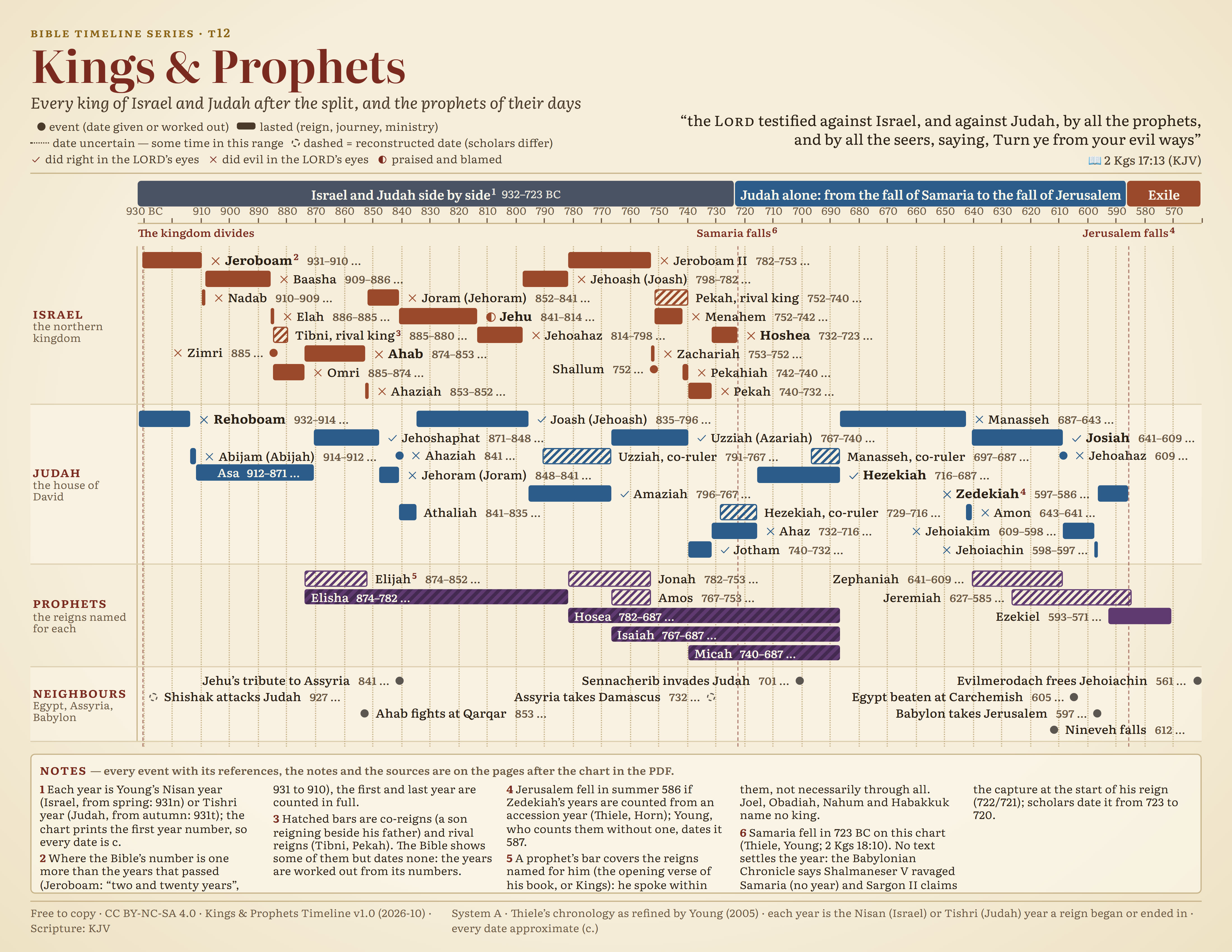

Kings & Prophets
 2 Kgs 17:13 (KJV)
Notes — every event with its references, the notes and the sources are on the pages after the chart in the PDF.
1Each year is Young’s Nisan year (Israel, from spring: 931n) or Tishri year (Judah, from autumn: 931t); the chart prints the first year number, so every date is c.
2Where the Bible’s number is one more than the years that passed (Jeroboam: two and twenty years
, 931 to 910), the first and last year are counted in full.
3Hatched bars are co-reigns (a son reigning beside his father) and rival reigns (Tibni, Pekah). The Bible shows some of them but dates none: the years are worked out from its numbers.
4Jerusalem fell in summer 586 if Zedekiah’s years are counted from an accession year (Thiele, Horn); Young, who counts them without one, dates it 587.
5A prophet’s bar covers the reigns named for him (the opening verse of his book, or Kings): he spoke within them, not necessarily through all. Joel, Obadiah, Nahum and Habakkuk name no king.
6Samaria fell in 723 BC on this chart (Thiele, Young; 2 Kgs 18:10). No text settles the year: the Babylonian Chronicle says Shalmaneser V ravaged Samaria (no year) and Sargon II claims the capture at the start of his reign (722/721); scholars date it from 723 to 720.
Kings & Prophets — Study notes
Every event on the chart, with its Bible references, certainty and notes. One chronology for the whole series: the Bible's own numbers with the main ancient records. "c." = about; a range (e.g. 6–4 BC) = some time in that range.
| Date | Event | Bible references | Lane | Cert. |
|---|---|---|---|---|
| Israel and Judah side by side · 932–723 BC1 | ||||
| c. 932–914 BC | Rehoboam7there was none that followed the house of David, but the tribe of Judah only(1 Kgs 12:20); he reigned seventeen years in Jerusalem(1 Kgs 14:21); he did evil, because he prepared not his heart to seek the Lord(2 Chr 12:14). Young, Table 2: 932t to 914n/914t. Sources: Rodger C. Young |
1 Kgs 12:20; 14:21; 2 Chr 12:14 | Judah | C |
| c. 931–910 BC | Jeroboam2they sent and called him unto the congregation, and made him king over all Israel(1 Kgs 12:20); the days which Jeroboam reigned were two and twenty years(1 Kgs 14:20); the LORD tells him hast done evil above all that were before thee(1 Kgs 14:9). Young, Table 1: 931n to 910t/909n. Sources: Rodger C. Young |
1 Kgs 12:20; 14:9, 20 | Israel | C |
| c. 927 BC | Shishak attacks Judah10in the fifth year of king Rehoboam, that Shishak king of Egypt came up against Jerusalemand took away the treasures of the house of the Lord(1 Kgs 14:25–26). The relief of Pharaoh Shoshenq I at Karnak lists places he claims to have smitten, many in the northern kingdom; it does not date the campaign. Sources: Rodger C. Young; The Epigraphic Survey, Oriental Institute, University of Chicago; James Henry Breasted; Felix Höflmayer and Roman Gundacker; Kevin A. Wilson |
1 Kgs 14:25–26 | Neighbours | D |
| c. 914–912 BC | Abijam (Abijah)in the eighteenth year of king Jeroboam the son of Nebat reigned Abijam over Judah(1 Kgs 15:1); Three years reigned he in Jerusalem(1 Kgs 15:2); he walked in all the sins of his father(1 Kgs 15:3). Young, Table 2: 914n/914t to 912t/911n. Sources: Rodger C. Young |
1 Kgs 15:1–3 | Judah | C |
| c. 912–871 BC | Asain the twentieth year of Jeroboam king of Israel reigned Asa over Judah(1 Kgs 15:9); forty and one years reigned he in Jerusalem(1 Kgs 15:10); Asa did that which was right in the eyes of the Lord(1 Kgs 15:11). Young, Table 2: 912t/911n to 871t/870n. Sources: Rodger C. Young |
1 Kgs 15:9–11 | Judah | C |
| c. 910–909 BC | Nadabbegan to reign over Israel in the second year of Asa king of Judah, and reigned over Israel two years(1 Kgs 15:25); he did evil in the sight of the Lord(1 Kgs 15:26). Young, Table 1: 910t/909n to 909t/908n. Sources: Rodger C. Young |
1 Kgs 15:25–26 | Israel | C |
| c. 909–886 BC | BaashaIn the third year of Asa king of Judah began Baasha the son of Ahijah to reign over all Israel in Tirzah, twenty and four years(1 Kgs 15:33); he did evil in the sight of the Lord(1 Kgs 15:34). Young, Table 1: 909t/908n to 886t/885n. Sources: Rodger C. Young |
1 Kgs 15:33–34 | Israel | C |
| c. 886–885 BC | ElahIn the twenty and sixth year of Asa king of Judah began Elah the son of Baasha to reign over Israel in Tirzah, two years(1 Kgs 16:8); the sins of Elah his son, by which they sinned(1 Kgs 16:13). Young, Table 1: 886t/885n to 885t/884n. Sources: Rodger C. Young |
1 Kgs 16:8, 13 | Israel | C |
| c. 885 BC | ZimriIn the twenty and seventh year of Asa king of Judah did Zimri reign seven days in Tirzah(1 Kgs 16:15); doing evil in the sight of the Lord(1 Kgs 16:19). Young, Table 1: 885t/884n to 885t/884n. Sources: Rodger C. Young |
1 Kgs 16:15, 19 | Israel | C |
| c. 885–880 BC | Tibni, rival king3half of the people followed Tibni the son of Ginath, to make him king; and half followed Omri(1 Kgs 16:21); Tibni died, and Omri reigned(1 Kgs 16:22). The Bible gives no length for his reign. Young, Table 1: rival reign 885t/884n to 880n/880t. Sources: Rodger C. Young |
1 Kgs 16:21–22 | Israel | D |
| c. 885–874 BC | OmriIn the thirty and first year of Asa king of Judah began Omri to reign over Israel, twelve years: six years reigned he in Tirzah(1 Kgs 16:23); Omri wrought evil in the eyes of the Lord, and did worse than all that were before him(1 Kgs 16:25). On Thiele’s and Young’s reading his twelve years are counted from 885, when all Israel made Omri, the captain of the host, king over Israel that day in the camp(1 Kgs 16:16); he ruled all Israel from 880, when Tibni died, and Omri reigned(1 Kgs 16:22). Young, Table 1: rival reign from 885t/884n; sole reign 880n/880t to 874t/873n. Sources: Rodger C. Young |
1 Kgs 16:16, 22–23, 25 | Israel | C |
| c. 874–853 BC | Ahabin the thirty and eighth year of Asa king of Judah began Ahab the son of Omri to reign over Israel: and Ahab the son of Omri reigned over Israel in Samaria twenty and two years(1 Kgs 16:29); Ahab the son of Omri did evil in the sight of the Lord above all that were before him(1 Kgs 16:30). Young, Table 1: 874t/873n to 853n/853t. Sources: Rodger C. Young |
1 Kgs 16:29–30 | Israel | C |
| c. 874–852 BC | Elijah5 Elijah the Tishbite said unto Ahabthat there would be no dew nor rain (1 Kgs 17:1); he told Ahaziah of Israel thou shalt not come down off that bed on which thou art gone up, but shalt surely die(2 Kgs 1:16); and Elijah went up by a whirlwind into heaven(2 Kgs 2:11). The bar runs from the first year of Ahab to the last of Ahaziah of Israel. Sources: Rodger C. Young |
1 Kgs 17:1; 2 Kgs 1:15–17; 2:11 | Prophets | D |
| c. 874–782 BC | Elisha Elijah found Elisha the son of Shaphatin the days of Ahab (1 Kgs 19:19), and when Elisha was fallen sick of his sickness whereof he died, Joash king of Israel came down to him (2 Kgs 13:14). The bar runs from the first year of Ahab to the last of Jehoash (Joash) of Israel. Sources: Rodger C. Young |
1 Kgs 19:16–19; 2 Kgs 13:14–20 | Prophets | D |
| c. 873–871 BC | Jehoshaphat, co-rulerhe reigned twenty and five years in Jerusalem(1 Kgs 22:42). His twenty-five years are counted from 873, two years before Asa died; he ruled alone from 871. Young, Table 2: co-reign from 873t. Sources: Rodger C. Young |
1 Kgs 22:42 | Judah | D |
| c. 871–848 BC | JehoshaphatJehoshaphat the son of Asa began to reign over Judah in the fourth year of Ahab king of Israel(1 Kgs 22:41); he reigned twenty and five years in Jerusalem(1 Kgs 22:42); doing that which was right in the eyes of the Lord(1 Kgs 22:43). He ruled alone from 871; his twenty-five years are counted from the co-reign (see the co-reign entry). Young, Table 2: co-reign 873t; sole reign 871t/870n to 848n/848t. Sources: Rodger C. Young |
1 Kgs 22:41–43 | Judah | C |
| c. 854–848 BC | Jehoram, co-rulerJehoshaphat being then king of Judah, Jehoram the son of Jehoshaphat king of Judah began to reign(2 Kgs 8:16). Young dates this co-reign from 854. Young, Table 2: co-reign from 854t. Sources: Rodger C. Young |
2 Kgs 8:16 | Judah | D |
| c. 853–852 BC | Ahaziahbegan to reign over Israel in Samaria the seventeenth year of Jehoshaphat king of Judah, and reigned two years over Israel(1 Kgs 22:51); he did evil in the sight of the Lord(1 Kgs 22:52). Young, Table 1: 853n/853t to 852n/852t. Sources: Rodger C. Young |
1 Kgs 22:51–52 | Israel | C |
| 853 BC | Ahab fights at Qarqar11 Shalmaneser III of Assyria records that twelve allied kings fought him at Qarqar, among them Ahab the Israelite with 2,000 chariots and 10,000 troops; he claims the victory. In Young’s table Ahab’s reign ends in 853. The Bible does not mention the battle. Sources: A. Kirk Grayson (edition, RIMA 3, Toronto 1996); adapted by Jamie Novotny (2016); lemmatized and updated by Nathan Morello (2016); Alan R. Millard (edition, SAAS 2, 1994); lemmatised by Nathan Morello (2019); Alan R. Millard (with a contribution by Robert Whiting); web version prepared by Jamie Novotny (2020); RIAo editors (Jamie Novotny et al.); based on A. Kirk Grayson, RIMA 3 (1996); Rodger C. Young |
1 Kgs 16:29–33 | Neighbours | C |
| c. 852–841 BC | Joram (Jehoram)began to reign over Israel in Samaria the eighteenth year of Jehoshaphat king of Judah, and reigned twelve years(2 Kgs 3:1); he wrought evil in the sight of the Lord; but not like his father, and like his mother(2 Kgs 3:2). Young, Table 1: 852n/852t to 841n/841t. Sources: Rodger C. Young |
2 Kgs 3:1–2 | Israel | C |
| c. 848–841 BC | Jehoram (Joram)in the fifth year of Joram the son of Ahab king of Israel, Jehoshaphat being then king of Judah, Jehoram the son of Jehoshaphat king of Judah began to reign(2 Kgs 8:16); he reigned eight years in Jerusalem(2 Kgs 8:17); he did evil in the sight of the Lord(2 Kgs 8:18). Young, Table 2: co-reign 854t; sole reign 848n/848t to 841n/841t. Sources: Rodger C. Young |
2 Kgs 8:16–18 | Judah | C |
| c. 841–814 BC | Jehuthe time that Jehu reigned over Israel in Samaria was twenty and eight years(2 Kgs 10:36); thou hast done well in executing that which is right in mine eyes(2 Kgs 10:30); Jehu took no heed to walk in the law of the Lord God of Israel with all his heart(2 Kgs 10:31). Young, Table 1: 841n/841t to 814t/813n. Sources: Rodger C. Young |
2 Kgs 10:30–31, 36 | Israel | C |
| c. 841 BC | Ahaziah8In the twelfth year of Joram the son of Ahab king of Israel did Ahaziah the son of Jehoram king of Judah begin to reign(2 Kgs 8:25); he reigned one year in Jerusalem(2 Kgs 8:26); did evil in the sight of the Lord, as did the house of Ahab(2 Kgs 8:27). Young, Table 2: 841n/841t to 841n/841t. Sources: Rodger C. Young |
2 Kgs 8:25–27 | Judah | C |
| c. 841–835 BC | Athaliahshe arose and destroyed all the seed royal(2 Kgs 11:1); hid in the house of the Lord six years. And Athaliah did reign over the land(2 Kgs 11:3). The Bible gives no verdict formula for her reign. Young, Table 2: 841n/841t to 835n/835t. Sources: Rodger C. Young |
2 Kgs 11:1, 3–4 | Judah | C |
| 841 BC | Jehu’s tribute to Assyria11 Shalmaneser III records that in his eighteenth year he received the payment of Jehu of Bit-Humri ("son of Omri"); a caption over a relief on the Black Obelisk records the same payment. In Young’s table Jehu’s reign begins in 841. The Bible does not mention the payment. Sources: A. Kirk Grayson (edition, RIMA 3, 1996); adapted by Jamie Novotny (2016); lemmatized by Nathan Morello (2016); A. Kirk Grayson (edition, RIMA 3, 1996); adapted by Jamie Novotny (2016); lemmatized by Nathan Morello (2016); RIAo editors (Jamie Novotny et al.); based on A. Kirk Grayson, RIMA 3 (1996); Alan R. Millard (edition, SAAS 2, 1994); lemmatised by Nathan Morello (2019); Rodger C. Young |
2 Kgs 10:32–36 | Neighbours | C |
| c. 835–796 BC | Joash (Jehoash)In the seventh year of Jehu Jehoash began to reign; and forty years reigned he in Jerusalem(2 Kgs 12:1); Jehoash did that which was right in the sight of the Lord all his days wherein Jehoiada the priest instructed him(2 Kgs 12:2). Young, Table 2: 835n/835t to 796n/796t. Sources: Rodger C. Young |
2 Kgs 12:1–2 | Judah | C |
| c. 814–798 BC | JehoahazIn the three and twentieth year of Joash the son of Ahaziah king of Judah Jehoahaz the son of Jehu began to reign over Israel in Samaria, and reigned seventeen years(2 Kgs 13:1); he did that which was evil in the sight of the Lord(2 Kgs 13:2). Young, Table 1: 814t/813n to 798n/798t. Sources: Rodger C. Young |
2 Kgs 13:1–2 | Israel | C |
| c. 798–782 BC | Jehoash (Joash)In the thirty and seventh year of Joash king of Judah began Jehoash the son of Jehoahaz to reign over Israel in Samaria, and reigned sixteen years(2 Kgs 13:10); he did that which was evil in the sight of the Lord(2 Kgs 13:11). Young, Table 1: 798n/798t to 782t/781n. Sources: Rodger C. Young |
2 Kgs 13:10–11 | Israel | C |
| c. 796–767 BC | AmaziahIn the second year of Joash son of Jehoahaz king of Israel reigned Amaziah the son of Joash king of Judah(2 Kgs 14:1); reigned twenty and nine years in Jerusalem(2 Kgs 14:2); he did that which was right in the sight of the Lord, yet not like David his father(2 Kgs 14:3). Young, Table 2: 796n/796t to 767n/767t. Sources: Rodger C. Young |
2 Kgs 14:1–3 | Judah | C |
| c. 793–782 BC | Jeroboam II, co-rulerJeroboam the son of Joash king of Israel began to reign in Samaria, and reigned forty and one years(2 Kgs 14:23). His forty-one years are counted from this co-reign with his father; he ruled alone from 782. Young, Table 1: co-reign from 793n. Sources: Rodger C. Young; Edwin R. Thiele |
2 Kgs 14:23 | Israel | D |
| c. 791–767 BC | Uzziah, co-rulerhe reigned two and fifty years in Jerusalem(2 Kgs 15:2). His fifty-two years are counted from this co-reign; he ruled alone from 767. Young, Table 2: co-reign from 791t. Sources: Rodger C. Young; Edwin R. Thiele |
2 Kgs 15:2 | Judah | D |
| c. 782–753 BC | Jeroboam IIJeroboam the son of Joash king of Israel began to reign in Samaria, and reigned forty and one years(2 Kgs 14:23); he did that which was evil in the sight of the Lord(2 Kgs 14:24). He ruled alone from 782; his forty-one years are counted from the co-reign (see the co-reign entry). Young, Table 1: co-reign 793n; sole reign 782t/781n to 753, Elul (Sep). Sources: Rodger C. Young |
2 Kgs 14:23–24 | Israel | C |
| c. 782–753 BC | Jonah Jeroboam II restored the coast of Israel from the entering of Hamath unto the sea of the plain, according to the word of the Lord God of Israel, which he spake by the hand of his servant Jonah, the son of Amittai, the prophet(2 Kgs 14:25). The bar covers the years Jeroboam II ruled alone; the book of Jonah names no king. Sources: Rodger C. Young |
2 Kgs 14:23–25 | Prophets | D |
| c. 782–687 BC | Hosea The word of the LORD came to Hosea in the days of Uzziah, Jotham, Ahaz, and Hezekiah, kings of Judah, and in the days of Jeroboam the son of Joash, king of Israel(Hos 1:1). The bar runs from the first year of Jeroboam II ruling alone to the last of Hezekiah. Sources: Rodger C. Young |
Hos 1:1 | Prophets | D |
| c. 767–740 BC | Uzziah (Azariah)In the twenty and seventh year of Jeroboam king of Israel began Azariah son of Amaziah king of Judah to reign(2 Kgs 15:1); he did that which was right in the sight of the Lord(2 Kgs 15:3); the Lord smote the king, so that he was a leper unto the day of his death(2 Kgs 15:5). He ruled alone from 767; his fifty-two years are counted from the co-reign (hatched bar). Young, Table 2: co-reign 791t; sole reign 767n/767t to 740t. Sources: Rodger C. Young |
2 Kgs 15:1–3, 5 | Judah | C |
| c. 767–753 BC | Amos Amos saw his words in the days of Uzziah king of Judah, and in the days of Jeroboam the son of Joash king of Israel, two years before the earthquake(Amos 1:1). The bar covers the years in which both kings ruled alone. Sources: Rodger C. Young |
Amos 1:1 | Prophets | D |
| c. 767–687 BC | Isaiah Isaiah saw his vision in the days of Uzziah, Jotham, Ahaz, and Hezekiah, kings of Judah(Isa 1:1); In the year that king Uzziah died I saw also the Lord sitting upon a throne(Isa 6:1), and in the fourteenth year of king HezekiahSennacherib came up against Judah (Isa 36:1). The bar runs from the first year of Uzziah ruling alone to the last of Hezekiah. Sources: Rodger C. Young |
Isa 1:1; 6:1; 36:1 | Prophets | D |
| c. 753–752 BC | ZachariahIn the thirty and eighth year of Azariah king of Judah did Zachariah the son of Jeroboam reign over Israel in Samaria six months(2 Kgs 15:8); he did that which was evil in the sight of the Lord(2 Kgs 15:9). Young, Table 1: 753, Elul to 752, Adar (Mar). Sources: Rodger C. Young |
2 Kgs 15:8–9 | Israel | C |
| c. 752 BC | ShallumShallum the son of Jabesh began to reign in the nine and thirtieth year of Uzziah king of Judah; and he reigned a full month in Samaria(2 Kgs 15:13). The Bible gives no verdict on him. Young, Table 1: 752, Adar to 752, Nisan (Apr). Sources: Rodger C. Young |
2 Kgs 15:13 | Israel | C |
| c. 752–742 BC | MenahemIn the nine and thirtieth year of Azariah king of Judah began Menahem the son of Gadi to reign over Israel, and reigned ten years in Samaria(2 Kgs 15:17); he did that which was evil in the sight of the Lord(2 Kgs 15:18). Young, Table 1: 752, Nisan to 742t/741n. Sources: Rodger C. Young |
2 Kgs 15:17–18 | Israel | C |
| c. 752–740 BC | Pekah, rival kingPekah the son of Remaliah began to reign over Israel in Samaria, and reigned twenty years(2 Kgs 15:27). His twenty years are counted from 752. The Bible does not state the rivalry; it is inferred from the synchronisms of 2 Kgs 15–16 (Young 2005, p. 229). Young, Table 1: co-reign from 752, Nisan. Sources: Rodger C. Young; Edwin R. Thiele |
2 Kgs 15:27 | Israel | D |
| c. 750–740 BC | Jotham, co-rulerJotham the king's son was over the house, judging the people of the land(2 Kgs 15:5). Young dates this co-reign from 750. Young, Table 2: co-reign from 750n/750t. Sources: Rodger C. Young; Edwin R. Thiele |
2 Kgs 15:5 | Judah | D |
| c. 742–740 BC | PekahiahIn the fiftieth year of Azariah king of Judah Pekahiah the son of Menahem began to reign over Israel in Samaria, and reigned two years(2 Kgs 15:23); he did that which was evil in the sight of the Lord(2 Kgs 15:24). Young, Table 1: 742t/741n to 740t/739n. Sources: Rodger C. Young |
2 Kgs 15:23–24 | Israel | C |
| c. 740–732 BC | PekahIn the two and fiftieth year of Azariah king of Judah Pekah the son of Remaliah began to reign over Israel in Samaria, and reigned twenty years(2 Kgs 15:27); he did that which was evil in the sight of the Lord(2 Kgs 15:28). He ruled alone from 740, when he killed Pekahiah (2 Kgs 15:25); his twenty years are counted from the rival reign (hatched bar). Young, Table 1: co-reign 752, Nisan; sole reign 740t/739n to 732t/731n. Sources: Rodger C. Young |
2 Kgs 15:25, 27–28 | Israel | C |
| c. 740–732 BC | JothamIn the second year of Pekah the son of Remaliah king of Israel began Jotham the son of Uzziah king of Judah to reign(2 Kgs 15:32); he reigned sixteen years in Jerusalem(2 Kgs 15:33); he did that which was right in the sight of the Lord(2 Kgs 15:34). The second year of Pekah dates the start of his co-reign (750); he ruled alone from 740. Young: his sixteen years end in 735, when Ahaz was installed by the pro-Assyrian faction, although some held him the rightful ruler until his death in 732, which gives the twentieth year of 2 Kgs 15:30. Young, Table 2: co-reign 750n/750t; sole reign 740t to (735n/735t) 732t. Sources: Rodger C. Young |
2 Kgs 15:30, 32–34 | Judah | C |
| c. 740–687 BC | Micah The word of the LORD came to Micah the Morasthite in the days of Jotham, Ahaz, and Hezekiah, kings of Judah(Mic 1:1); Micah the Morasthite prophesied in the days of Hezekiah king of Judah(Jer 26:18). The bar runs from the first year of Jotham ruling alone to the last of Hezekiah. Sources: Rodger C. Young |
Mic 1:1; Jer 26:18 | Prophets | D |
| c. 735–732 BC | Ahaz, co-rulerIn the seventeenth year of Pekah the son of Remaliah Ahaz the son of Jotham king of Judah began to reign(2 Kgs 16:1). Young dates his installation from 735, "by the pro-Assyrian faction in Judah" (p. 246); his sixteen years are counted from 732. Young, Table 2: co-reign from 735n/735t. Sources: Rodger C. Young |
2 Kgs 16:1 | Judah | D |
| c. 732–723 BC | HosheaIn the twelfth year of Ahaz king of Judah began Hoshea the son of Elah to reign in Samaria over Israel nine years(2 Kgs 17:1); he did that which was evil in the sight of the Lord, but not as the kings of Israel that were before him(2 Kgs 17:2). He began in 732, in the twentieth year of Jotham the son of Uzziah(2 Kgs 15:30). The twelfth year of Ahaz in 2 Kgs 17:1 does not fit a start in 732; Young reads it as the year in which Hoshea’s reign had ended (Table 3: 723). Young, Table 1: 732t/731n to 723n/723t. Sources: Rodger C. Young |
2 Kgs 17:1–2; 15:30 | Israel | C |
| c. 732–716 BC | AhazIn the seventeenth year of Pekah the son of Remaliah Ahaz the son of Jotham king of Judah began to reign(2 Kgs 16:1); reigned sixteen years in Jerusalem(2 Kgs 16:2); did not that which was right in the sight of the Lord his God, like David his father(2 Kgs 16:2). The seventeenth year of Pekah dates his installation as co-ruler (735); his sixteen years are counted from 732, when he ruled alone. Young, Table 2: co-reign 735n/735t; sole reign 732t to 716t/715n. Sources: Rodger C. Young |
2 Kgs 16:1–2 | Judah | C |
| 732 BC | Assyria takes Damascus Ahaz called Tiglath-pileser to his help (2 Kgs 16:7–8), and the king of Assyria went up against Damascus, and took it, and carried the people of it captive to Kir, and slew Rezin(2 Kgs 16:9). The Assyrian Eponym Chronicle names Damascus as the target in 733 and 732; the editors date the conquest to 732, although the annals’ own report of it is lost. Sources: Alan R. Millard (with a contribution by Robert Whiting); adapted and lemmatised by Nathan Morello (2019); Hayim Tadmor and Shigeo Yamada, with the editorial assistance of Jamie Novotny; Edwin R. Thiele |
2 Kgs 16:7–9 | Neighbours | D |
| c. 729–716 BC | Hezekiah, co-ruler9in the third year of Hoshea son of Elah king of Israel, that Hezekiah the son of Ahaz king of Judah began to reign(2 Kgs 18:1); in the sixth year of Hezekiah, that is the ninth year of Hoshea king of Israel, Samaria was taken(2 Kgs 18:10). These years of Hezekiah are counted from 729; his twenty-nine years are counted from 716, when he ruled alone. Young, Table 2: co-reign from 729t/728n. Sources: Rodger C. Young |
2 Kgs 18:1, 10 | Judah | D |
| Judah alone: from the fall of Samaria to the fall of Jerusalem · 723–586 BC | ||||
| c. 716–687 BC | Hezekiahin the third year of Hoshea son of Elah king of Israel, that Hezekiah the son of Ahaz king of Judah began to reign(2 Kgs 18:1); he reigned twenty and nine years in Jerusalem(2 Kgs 18:2); he did that which was right in the sight of the Lord, according to all that David his father did(2 Kgs 18:3). He ruled alone from 716; his twenty-nine years are counted from then, the years of 2 Kgs 18:1, 9–10 from the co-reign (hatched bar). Young, Table 2: co-reign 729t/728n; sole reign 716t/715n to 687t. Sources: Rodger C. Young |
2 Kgs 18:1–3 | Judah | C |
| 701 BC | Sennacherib invades Judah12 In the fourteenth year of king HezekiahSennacherib king of Assyria did come up against all the fenced cities of Judah(2 Kgs 18:13). His prisms tell of his third campaign: forty-six of Hezekiah’s fortified cities taken, and Hezekiah confined in Jerusalem "like a bird in a cage". Sennacherib’s 4th regnal year is 701. Sources: A. Kirk Grayson and Jamie Novotny; A. Kirk Grayson and Jamie Novotny; Grant Frame, with the collaboration of Andreas Fuchs for two inscriptions; Rodger C. Young |
2 Kgs 18:13–16 | Neighbours | C |
| c. 697–687 BC | Manasseh, co-rulerreigned fifty and five years in Jerusalem(2 Kgs 21:1). His fifty-five years are counted from this co-reign; he ruled alone from 687. Young, Table 2: co-reign from 697t. Sources: Rodger C. Young |
2 Kgs 21:1 | Judah | D |
| c. 687–643 BC | Manassehreigned fifty and five years in Jerusalem(2 Kgs 21:1); he did that which was evil in the sight of the Lord(2 Kgs 21:2). He ruled alone from 687; his fifty-five years are counted from the co-reign (hatched bar). Young, Table 2: co-reign 697t; sole reign 687t to 643t. Sources: Rodger C. Young |
2 Kgs 21:1–2 | Judah | C |
| c. 643–641 BC | Amonhe reigned two years in Jerusalem(2 Kgs 21:19); he did that which was evil in the sight of the Lord(2 Kgs 21:20). Young, Table 2: 643t to 641t. Sources: Rodger C. Young |
2 Kgs 21:19–20 | Judah | C |
| c. 641–609 BC | Josiahhe reigned thirty and one years in Jerusalem(2 Kgs 22:1); he did that which was right in the sight of the Lord(2 Kgs 22:2). He was slain at Megiddo in 609, when Pharaoh Necho went up to the Euphrates: king Josiah went against him; and he slew him at Megiddo(2 Kgs 23:29). The Babylonian Chronicle has an Egyptian army at Harran in 610 and 609 but names neither Necho nor Josiah. Young, Table 2: 641t to 609 Tammuz (Jul). Sources: Rodger C. Young; Livius.org (Jona Lendering); the page says the translation was adapted from A.K. Grayson, Assyrian and Babylonian Chronicles (1975), some readings from Jean-Jacques Glassner, Chroniques Mésopotamiennes (1993) |
2 Kgs 22:1–2; 23:29 | Judah | C |
| c. 641–609 BC | Zephaniah The word of the LORD came to Zephaniah in the days of Josiah the son of Amon, king of Judah(Zeph 1:1). The bar covers the reign of Josiah. Sources: Rodger C. Young |
Zeph 1:1 | Prophets | D |
| c. 627–585 BC | Jeremiah The word of the LORD came to Jeremiah in the days of Josiah the son of Amon king of Judah, in the thirteenth year of his reign(Jer 1:2), and went on unto the carrying away of Jerusalem captive in the fifth month(Jer 1:3); after the fall he is still speaking to the Jews in Egypt (Jer 44:1). The end of the bar is approximate: the year of the flight to Egypt is not given. Sources: Siegfried H. Horn |
Jer 1:2–3; 25:3; 44:1 | Prophets | D |
| 612 BC | Nineveh falls The Babylonian Chronicle (ABC 3): in Nabopolassar’s 14th year the king of Akkad and the king of the Medes besieged Nineveh for three months, from Simanu to Abu; its king Sin-shar-ishkun died and the city became a ruin heap. Nahum foretold: Nineveh is laid waste(Nah 3:7). Sources: Livius.org (Jona Lendering); the page says the translation was adapted from A.K. Grayson, Assyrian and Babylonian Chronicles (1975), some readings from Jean-Jacques Glassner, Chroniques Mésopotamiennes (1993); Livius.org (Jona Lendering); the page says the translation was adapted from A.K. Grayson, Assyrian and Babylonian Chronicles (1975) and Jean-Jacques Glassner, Mesopotamian Chronicles (Atlanta, 2004) |
Nah 3:7 | Neighbours | C |
| c. 609 BC | Jehoahazhe reigned three months in Jerusalem(2 Kgs 23:31); he did that which was evil in the sight of the Lord(2 Kgs 23:32). Young, Table 2: 609 Tammuz to 609 Tishri (Oct). Sources: Rodger C. Young |
2 Kgs 23:31–32 | Judah | C |
| c. 609–598 BC | Jehoiakimhe reigned eleven years in Jerusalem(2 Kgs 23:36); he did that which was evil in the sight of the Lord(2 Kgs 23:37). Young, Table 2: 609 Tishri to 598 21 Heshvan (about 7 Dec 598). Sources: Rodger C. Young |
2 Kgs 23:36–37 | Judah | C |
| 605 BC | Egypt beaten at Carchemish The Babylonian Chronicle: in the 21st year of Nabopolassar the crown prince Nebuchadnezzar defeated the Egyptian army at Carchemish on the Euphrates, and overtook and defeated the rest of it in the district of Hamath. Jeremiah dates the battle in the fourth year of Jehoiakim the son of Josiah king of Judah(Jer 46:2). Sources: Babylonian Chronicle ABC 5 (BM 21946), tr. A. K. Grayson (1975), adapted by Jona Lendering; D. J. Wiseman; Siegfried H. Horn |
Jer 46:2 | Neighbours | C |
| c. 598–597 BC | Jehoiachinhe reigned three months and ten days in Jerusalem(2 Chr 36:9); he did that which was evil in the sight of the Lord(2 Kgs 24:9). Young, Table 2: 598 21 Heshvan to 597 2 Adar (Mar 16). Sources: Rodger C. Young |
2 Chr 36:9; 2 Kgs 24:8–9 | Judah | C |
| c. 597–586 BC | Zedekiah4he reigned eleven years in Jerusalem(2 Kgs 24:18); he did that which was evil in the sight of the Lord(2 Kgs 24:19). Young, Table 2: 597 2 Adar to 587 9 Tammuz (Jul) (this chart draws the reign to 586: see the note on Jerusalem). Sources: Rodger C. Young |
2 Kgs 24:18–19 | Judah | C |
| 597 BC | Babylon takes Jerusalem The Babylonian Chronicle: in Nebuchadnezzar’s 7th year the king of Akkad besieged "the city of Judah" and on the second day of Addaru (16 March 597 BC) seized the city and captured the king. Nebuchadnezzar king of Babylon came against the cityand carried away Jehoiachin to Babylon(2 Kgs 24:11, 15). Sources: Babylonian Chronicle ABC 5 (BM 21946), tr. A. K. Grayson (1975), adapted by Jona Lendering; Richard A. Parker and Waldo H. Dubberstein; Siegfried H. Horn |
2 Kgs 24:10–16 | Neighbours | C |
| 593–571 BC | Ezekiel Ezekiel’s first dated vision came in the fifth year of king Jehoiachin's captivity(Ezek 1:2), his latest dated word in the seven and twentieth year, in the first month, in the first day of the month(Ezek 29:17). He counts his years from the captivity of 597 BC. Sources: Richard A. Parker and Waldo H. Dubberstein; Walther Zimmerli |
Ezek 1:1–2; 29:17 | Prophets | C |
| The exile begins: from the fall of Jerusalem to Jehoiachin’s release · 586–561 BC | ||||
| 561 BC | Evilmerodach frees Jehoiachin Evilmerodach king of Babylon, in the year that he began to reign, did lift up the head of Jehoiachin king of Judah out of prisonin the seven and thirtieth year of the captivity(2 Kgs 25:27). Counting the 37 years from the capture (Nebuchadnezzar’s 7th year; Young’s Tishri year 598) gives the 27th of Adar, about 2 April 561, in Evilmerodach’s accession year. Sources: Richard A. Parker and Waldo H. Dubberstein; Siegfried H. Horn |
2 Kgs 25:27–30 | Neighbours | C |
Certainty: A Stated in Scripture · B Worked out from Scripture · C Ancient record or astronomy · D Scholarly reconstruction · E Tradition / uncertain — scholars differ.
Kings & Prophets — notes and sources
How the dates were worked out
The books of Kings give the length of nearly every king’s reign and, for most of the kings, the year of the king of the other kingdom in which he began to reign. Edwin Thiele (1951) worked out how these numbers fit together, and Rodger Young refined his tables in 2003–05; every reign on this chart is taken from Young’s Tables 1 and 2, except that Zedekiah’s reign is drawn to end in 586 BC, the series’ System A date for the fall of Jerusalem (Young has 587). Young writes 931n for the year that begins in Nisan of 931 BC (Israel’s year) and 931t for the year that begins in Tishri of 931 BC (Judah’s year), and the chart prints the first of the two years, with "c." (page 1 omits it to save room). The kings counted their years in two ways, with or without an accession year, so a number in the Bible is sometimes one more than the years that passed, and sons reigned beside their fathers, and rivals beside kings, so some bars overlap. Young lists six dates of Assyrian and Babylonian history that his tables agree with: Qarqar (853 BC), Jehu’s tribute (841), the capture of Samaria (723 on Thiele’s and Young’s reading; others date it from 722 to 720), Sennacherib’s invasion (701), Carchemish (605) and the first capture of Jerusalem (597). Young’s tables date the first kings of Judah one year earlier than Thiele does (see the notes).
Dated lines on the chart
The kingdom divides — 931 BC (1 Kgs 12:16–20; Cert. C)
Samaria falls6 — 723 BC (2 Kgs 17:5–6; 18:9–10; Cert. D)
Jerusalem falls4 — 586 BC (2 Kgs 25:8–9; Cert. C)
 Notes
Notes
1 Each year is Young’s Nisan year (Israel, from spring: 931n) or Tishri year (Judah, from autumn: 931t); the chart prints the first year number, so every date is c. Israel began its year in Nisan, in the spring, and Judah in Tishri, in the autumn (Young 2005, p. 225). Young writes 931n for the year beginning in Nisan of 931 BC, 931t for the year beginning in Tishri of 931 BC, and 931t/930n for the six months between Tishri 931 and Nisan 930. For general readers he suggests writing 931n or 931t as 931/930 BC, and the six-month overlap 931t/930n as 931/930 too (p. 226). This chart prints only the first of the two years, so a reign shown as c. 912–871 BC began in the year that starts in 912 and ended in the year that starts in 871, and each date may fall a year later in the calendar. The study notes give Young’s notation beside each king.
2 Where the Bible’s number is one more than the years that passed (Jeroboam: two and twenty years
, 931 to 910), the first and last year are counted in full. This is non-accession counting (Young 2005, p. 226): the table gives the Bible’s number first and the years that passed in brackets. Israel: Jeroboam 22 (21), Nadab 2 (1), Baasha 24 (23), Elah 2 (1), Omri 12 (11), Ahab 22 (21), Ahaziah 2 (1), Joram 12 (11), Jehu 28 (27), Jehoahaz 17 (16), Jeroboam II 41 (40). Judah: Jehoshaphat 25 (24), Jehoram 8 (7), Ahaziah 1 (0), Athaliah 7 (6), Joash 40 (39), Uzziah 52 (51), Jotham 16 (15), Manasseh 55 (54), Zedekiah 11 (10). (1 Kgs 14:20)
3 Hatched bars are co-reigns (a son reigning beside his father) and rival reigns (Tibni, Pekah). The Bible shows some of them but dates none: the years are worked out from its numbers. The Bible shows a rival reign in 1 Kgs 16:21–22 (half the people followed Tibni, half Omri), a co-reign in 2 Kgs 8:16 (Jehoshaphat being then king of Judah, Jehoram the son of Jehoshaphat king of Judah began to reign
) and a son judging for his father in 2 Kgs 15:5 (Jotham the king's son was over the house, judging the people of the land
). The other overlaps are inferred, by Thiele (1974) and Young (2005), from reign lengths that do not fit the years between the sole reigns: some reign lengths are measured from the start of a co-reign (Young 2005, p. 246). The Bible’s own numbers are always shown first in the study notes. (1 Kgs 16:21–22; 2 Kgs 8:16; 15:5)
4 Jerusalem fell in summer 586 if Zedekiah’s years are counted from an accession year (Thiele, Horn); Young, who counts them without one, dates it 587. The Bible dates the breach to the 9th day of the 4th month of Zedekiah's 11th year (2 Kgs 25:2–4; Jer 39:2; Jer 52:5–7) and Nebuzaradan's coming, followed by the burning, to the 5th month of Nebuchadnezzar's 19th year (the 7th day in 2 Kgs 25:8–9, the 10th in Jer 52:12–13); no Babylonian record of the event survives. Counting Zedekiah's years from 1 Tishri (autumn) and from an accession year, his 11th year is autumn 587 – autumn 586, and Nebuchadnezzar's 19th year (Babylonian count from Nisan 586, or Judean count from Tishri 587) contains both summer months only in 586: breach 18 July, Nebuzaradan's coming (the 7th of Ab) 14 August 586 (Horn 1967, using Parker and Dubberstein's tables). Horn's figures for a spring-to-spring count of Zedekiah's years are 29 July and 25 August 587. Young (2004) argues for 587 from autumn years too, but with Zedekiah's years counted without an accession year, the siege beginning in January 589 and Ezekiel's years counted from autumn 598. Jer 52:29 (832 taken in Nebuchadnezzar's 18th year) is read as the fall (587 view) or as a deportation during the siege (586 view). Young’s Table 2 ends Zedekiah on 9 Tammuz 587 BC; this chart draws his reign to 586, as System A does. (2 Kgs 25:1–9; Jer 39:1–2; 52:4–13, 29; Ezek 24:1–2; 33:21)
5 A prophet’s bar covers the reigns named for him (the opening verse of his book, or Kings): he spoke within them, not necessarily through all. Joel, Obadiah, Nahum and Habakkuk name no king. Each bar runs from the first year of the earliest king named to the last year of the latest, using the years each king ruled alone in the chart (Elijah and Elisha: the reigns in which Kings places them; Jonah: 2 Kgs 14:25; Amos, Hosea, Isaiah, Micah, Zephaniah: the opening verse of the book). Jeremiah and Ezekiel have their own dates (Jer 1:2–3; Ezek 1:2; 29:17). The books of Joel (1:1), Obadiah (1:1), Nahum (1:1) and Habakkuk (1:1) name no king and are not drawn. (Isa 1:1; Hos 1:1; Amos 1:1; Mic 1:1; Zeph 1:1; Jer 1:2–3)
6 Samaria fell in 723 BC on this chart (Thiele, Young; 2 Kgs 18:10). No text settles the year: the Babylonian Chronicle says Shalmaneser V ravaged Samaria (no year) and Sargon II claims the capture at the start of his reign (722/721); scholars date it from 723 to 720. Hezekiah’s 6th year is Hoshea’s 9th (2 Kgs 18:10). Thiele (1974) has "the ninth year of Hoshea and the fall of Samaria in 723", and Young (2004, 2005) puts it in the first half of 723n, before Sargon II’s accession in Tebet 722 (December 722 or January 721). The Babylonian Chronicle says that Shalmaneser V took the throne on 25 Tebet and "ravaged Samaria" (no year is given) and that he died in Tebet of his fifth year (722/721), when Sargon took the throne on 12 Tebet; Sargon’s annals place the capture of Samaria at the beginning of his reign (722 in Frame’s numbering). Park (2012) sorts the views into one conquest, by Shalmaneser V or by Sargon II, several conquests, or two, and argues for one conquest, in 722, by Sargon II under Shalmaneser V; Goldberg (1999) dates the fall to 720. (2 Kgs 17:3–6; 18:9–10)
7 Young finds that Solomon died and Rehoboam began before Tishri 931 BC, not after it as Thiele assumed, which puts the first kings of Judah one year earlier than Thiele’s dates. Young 2005, p. 227: "Solomon died and Rehoboam began before Tishri of 931 bc, not in the six-month interval beginning with Tishri of that year as assumed by Thiele"; this moved the beginning date of Solomon and his immediate successors one year earlier than in Thiele’s chronology, and resolved a problem Thiele’s dates had in the reign of Jehoshaphat. The scriptural data only allow Jeroboam’s reign to be placed some time in 931n and Rehoboam’s some time in 932t (Young, p. 227, note 3). Young’s argument is in his paper "When Did Solomon Die?" (JETS 46, 2003), which was not read for this chart.
8 2 Kgs 8:25 gives the 12th year of Joram, 2 Kgs 9:29 the 11th: the same year, counted with the part-year at the start as year 1 or not counted. Young’s Table 4 lists both verses with the same formula, 852n minus 841n = 11 years; the 12 (11)
of 2 Kgs 8:25 is a non-accession number, the 11 of 2 Kgs 9:29 an accession-year number. (2 Kgs 8:25; 9:29)
9 The years of 2 Kgs 18:1, 9–10 (Hoshea’s 3rd year, when Hezekiah began to reign, and Hezekiah’s 4th and 6th years) are counted from 729, when he began to reign beside Ahaz (Young; Thiele did not accept this); his 29 years run from 716. Counted from 729, Hezekiah’s 6th year runs from Tishri 724 to Tishri 723 and overlaps the 9th year of Hoshea (Nisan 723 to Nisan 722) in the half-year from Nisan to Tishri 723, in which Samaria fell (2 Kgs 18:10; Young’s Table 4: 723n/723t). His 29 years (2 Kgs 18:2) are Young’s official 716t–687t, and counted from 716 his 14th year, when Sennacherib came up against the fenced cities of Judah (2 Kgs 18:13), is the year that begins in Tishri 702 and ends in Tishri 701. Thiele did not recognize the co-reign of Ahaz and Hezekiah (Young 2005, pp. 227, 243). (2 Kgs 18:1–2, 9–10, 13)
10 Rehoboam’s fifth year is the year from Tishri 927 BC in Young’s table (Thiele’s, one year later, has 926/5). The one Egyptian date that bears on the campaign, Shoshenq’s year 21 (about 925 BC), is for the start of work on the Karnak court whose portal carries the relief; Egypt does not date the campaign. Young's Table 2 begins Rehoboam in 932t and counts his 17 years (1 Kgs 14:21) in the accession sense, so his fifth year is the year that begins in Tishri 927 (932 minus 5). Thiele (1951), as the Epigraphic Survey cites him, put Rehoboam's fifth year at 926/5 BC, and Albright (1945) as late as about 918. The Epigraphic Survey (1954) says that work on the great court at Karnak began in Shoshenq's year 21, "roughly about 925 B.C.", that the Palestinian campaign had been made before that time, and that the date in years BC cannot be certain from the chronology of the Hebrew kings. Höflmayer and Gundacker (2021) warn against using the campaign as a fixed point in Iron Age chronology. (1 Kgs 14:21, 25)
11 An eclipse of the sun recorded in Assyria’s eponym lists, dated by astronomers to 15 June 763 BC, fixes them; counting back gives 853 for Qarqar and 841 for Jehu’s payment. Millard (1994) edits the lists: one entry records an eclipse of the sun in the month Simanu in the eponymy of Bur-Sagale, 15/16 June 763 BC (Julian), and the NASA catalogue of solar eclipses lists a total eclipse on 15 June 763 BC. Counting back year by year along the list gives 853 for Dayyan-Assur, the year to which the Kurkh Monolith dates the march to Qarqar, and 841 for Adad-remanni. Shalmaneser's own years agree: his accession year is 859 (Grayson's edition, as put online by the Royal Inscriptions of Assyria project), so his sixth year is 853 and his eighteenth, in which he received the payment of Jehu, is 841. Some older books print 854 for Qarqar, for example the Jewish Encyclopedia of 1906.
12 701 is Sennacherib’s 4th regnal year (the Eponym Chronicle’s entry is lost). Whether the Bible and the Assyrian texts describe one campaign or two is disputed. The Eponym Chronicle’s entries for 702 and 701 are lost and were restored from the Eponym Lists; the date rests on the regnal count (Sennacherib took the throne on 12 Abu 705, so his 4th regnal year is 701) and on the dated prisms: the Rassam Cylinder, which already tells of Hezekiah, is dated 700. Luckenbill (1924) states the problem as whether the non-Assyrian accounts refer to one campaign in the West, in 701, or to two, the second toward the end of Sennacherib’s reign; Goldberg (1999) holds that the "massive" invasion of 701 was confused with an earlier, limited invasion in Hezekiah’s 14th year, which he dates to 712. Counted from 716, Hezekiah’s 14th year is the year from Tishri 702 (the note on Hezekiah’s years). (2 Kgs 18:13–16)
Sources
The King James translators, The Holy Bible, King James Version — Pure Cambridge Edition text (bibleprotector.com), checked against eBible.org's 1769 text, 1611 (Cambridge text).
Richard A. Parker and Waldo H. Dubberstein, Babylonian Chronology 626 B.C.–A.D. 45 (Studies in Ancient Oriental Civilization 24), University of Chicago Press (Oriental Institute), Chicago, 1942.
Babylonian Chronicle ABC 5 (BM 21946), tr. A. K. Grayson (1975), adapted by Jona Lendering, ABC 5 (Jerusalem Chronicle) — Livius.org, 6th century BC (tr. 1975).
Siegfried H. Horn, The Babylonian Chronicle and the Ancient Calendar of the Kingdom of Judah, Andrews University Seminary Studies 5, 12–27, 1967.
Rodger C. Young, When Did Jerusalem Fall? Journal of the Evangelical Theological Society 47/1, 21–38, 2004.
D. J. Wiseman, Some Historical Problems in the Book of Daniel, in D. J. Wiseman (ed.), Notes on Some Problems in the Book of Daniel, pp. 9–18, Tyndale Press, London, 1965.
Walther Zimmerli, Ezekiel 1 (Hermeneia), p. 11 — preview at biblia.com, Fortress Press, Philadelphia, 1979 (English edition).
Rodger C. Young, Tables of Reign Lengths from the Hebrew Court Recorders (Journal of the Evangelical Theological Society 48/2), 2005.
Edwin R. Thiele, Coregencies and Overlapping Reigns among the Hebrew Kings (Journal of Biblical Literature 93), 1974.
A. Kirk Grayson (edition, RIMA 3, Toronto 1996); adapted by Jamie Novotny (2016); lemmatized and updated by Nathan Morello (2016), Shalmaneser III 002 (Kurkh Monolith), composite text, in RIA 5: Inscriptions of Shalmaneser III and His Successors (858-745 BC), Royal Inscriptions of Assyria online, Munich Open-access Cuneiform Corpus Initiative (MOCCI), LMU Munich, on Oracc, 1996 (Grayson); online edition 2016, released CC BY-SA.
A. Kirk Grayson (edition, RIMA 3, 1996); adapted by Jamie Novotny (2016); lemmatized by Nathan Morello (2016), Shalmaneser III 088 (Black Obelisk's epigraphs, BM 118885), composite text, in RIA 5, RIAo, MOCCI, LMU Munich, on Oracc, 1996 (Grayson); online edition 2016, CC BY-SA.
A. Kirk Grayson (edition, RIMA 3, 1996); adapted by Jamie Novotny (2016); lemmatized by Nathan Morello (2016), Shalmaneser III 012 (anthropomorphic statue from Nimrud/Kalhu), composite text, in RIA 5, RIAo, MOCCI, LMU Munich, on Oracc, 1996 (Grayson); online edition 2016, CC BY-SA.
RIAo editors (Jamie Novotny et al.); based on A. Kirk Grayson, RIMA 3 (1996), RIA 5: Inscriptions of Shalmaneser III and His Successors (858-745 BC) - Inscriptions, texts nos. 87-99 (editorial notes to the Black Obelisk epigraphs), Royal Inscriptions of Assyria online, MOCCI, LMU Munich, online, CC BY-SA The riao/ria5 Project, 2022-.
RIAo editors (Jamie Novotny et al.); based on A. Kirk Grayson, RIMA 3 (1996), RIA 5: Inscriptions of Shalmaneser III and His Successors (858-745 BC) - Inscriptions, texts nos. 1-19 (editorial introductions), Royal Inscriptions of Assyria online, MOCCI, LMU Munich, online, CC BY-SA The riao/ria5 Project, 2022-.
Alan R. Millard (with a contribution by Robert Whiting); web version prepared by Jamie Novotny (2020), Introduction, in The Eponyms of the Assyrian Empire 910-612 BC (State Archives of Assyria Studies 2), web edition in State Archives of Assyria online (SAAo), Neo-Assyrian Text Corpus Project / SAAo, MOCCI, LMU Munich, 1994 (Helsinki University Press); online 2020, CC BY-SA 3.0.
Alan R. Millard (edition, SAAS 2, 1994); lemmatised by Nathan Morello (2019), SAAS 2 Assyrian Eponym List, composite text (Q004243), SAAo, SAAo, MOCCI, LMU Munich, 1994 (book); online 2019, CC BY-SA 3.0.
Fred Espenak, GSFC Planetary Systems Laboratory (NASA); Besselian elements provided by Jean Meeus (credit lines in the page HTML), Five Millennium Catalog of Solar Eclipses: -0799 to -0700 (800 BCE to 701 BCE), NASA GSFC eclipse web site, n.d. (page undated).
J. Frederic McCurdy and Kaufmann Kohler (article AHAB), The Jewish Encyclopedia: AHAB (page says 'V:1 P:280'), JewishEncyclopedia.com (online copy of the print encyclopedia), 1906 (page meta: 'Complete contents the 1906 Jewish Encyclopedia').
James Henry Breasted, Ancient Records of Egypt: Historical Documents from the Earliest Times to the Persian Conquest, Volume IV: The Twentieth to the Twenty-Sixth Dynasties, University of Chicago Press (scan of the Presbyterian Theological Seminary copy on archive.org), 1906 (title page: copyright 1906, Published July 1906).
The Epigraphic Survey, Oriental Institute, University of Chicago, Reliefs and Inscriptions at Karnak, Volume III: The Bubastite Portal (Oriental Institute Publications LXXIV), University of Chicago Press; free PDF from the Oriental Institute (ISAC), 1954 (copyright page: 'Copyright 1954 by The University of Chicago ... Published 1954').
Felix Höflmayer and Roman Gundacker, Sheshonq (Shishak) in Palestine: Old Paradigms and New Vistas, The Ancient Near East Today (American Society of Overseas Research), 2021 (April 2021, vol. 9.4).
Kevin A. Wilson, The Campaign of Pharaoh Shoshenq I in Palestine, Bible and Interpretation, Arizona Center for Judaic Studies, 2004 (September 2004).
Hayim Tadmor and Shigeo Yamada, with the editorial assistance of Jamie Novotny, The Royal Inscriptions of Tiglath-pileser III (744–727 BC) and Shalmaneser V (726–722 BC), Kings of Assyria (The Royal Inscriptions of the Neo-Assyrian Period, Volume 1), Eisenbrauns, Winona Lake, Indiana (online edition on Oracc, RINAP Project, University of Pennsylvania), 2011.
Grant Frame, with the collaboration of Andreas Fuchs for two inscriptions, The Royal Inscriptions of Sargon II, King of Assyria (721–705 BC) (The Royal Inscriptions of the Neo-Assyrian Period, Volume 2), Eisenbrauns, University Park, Pennsylvania (online edition on Oracc, RINAP Project), 2021.
A. Kirk Grayson and Jamie Novotny, The Royal Inscriptions of Sennacherib, King of Assyria (704–681 BC), Part 1 (The Royal Inscriptions of the Neo-Assyrian Period, Volume 3/1), Eisenbrauns, Winona Lake, Indiana (online edition on Oracc, RINAP Project), 2012.
A. Kirk Grayson and Jamie Novotny, The Royal Inscriptions of Sennacherib, King of Assyria (704–681 BC), Part 2 (The Royal Inscriptions of the Neo-Assyrian Period, Volume 3/2), Eisenbrauns, Winona Lake, Indiana (online edition on Oracc, RINAP Project), 2014.
Livius.org (Jona Lendering); the page says the translation was adapted from A.K. Grayson, Assyrian and Babylonian Chronicles (1975) and Jean-Jacques Glassner, Mesopotamian Chronicles (Atlanta, 2004), ABC 1 (From Nabû-Nasir to Šamaš-šuma-ukin), column I — Livius.org, page created 2006, last modified 12 October 2020.
Livius.org (Jona Lendering); the page says the translation was adapted from A.K. Grayson, Assyrian and Babylonian Chronicles (1975) and Jean-Jacques Glassner, Mesopotamian Chronicles (Atlanta, 2004), ABC 2 (Early Years of Nabopolassar) — Livius.org, page created 2006, last modified 14 July 2020.
Livius.org (Jona Lendering); the page says the translation was adapted from A.K. Grayson, Assyrian and Babylonian Chronicles (1975), some readings from Jean-Jacques Glassner, Chroniques Mésopotamiennes (1993), ABC 3 (Fall of Nineveh Chronicle) — Livius.org, page created 1996, last modified 11 July 2020.
Alan R. Millard (with a contribution by Robert Whiting); adapted and lemmatised by Nathan Morello (2019), SAAS 2 Assyrian Eponym Chronicle. Composite text (SAAo/saas2 Q007771), adapted from The Eponyms of the Assyrian Empire 910-612 BC (State Archives of Assyria Studies 2), State Archives of Assyria online (SAAo), Oracc, LMU Munich, 1994 (book); online adaptation 2019, CC BY-SA 3.0.
Jeremy Goldberg, Two Assyrian Campaigns against Hezehiah and Later Eight Century Biblical Chronology (title as printed on the page), Biblica 80 (1999) 360-390, 1999.
Sung Jin Park, A New Historical Reconstruction of the Fall of Samaria, Biblica 93 (2012) 98-106, 2012.
Rodger C. Young, When Was Samaria Captured? The Need for Precision in Biblical Chronologies (Journal of the Evangelical Theological Society 47/4), 2004 (December), pp. 577–95.
Daniel David Luckenbill, The Annals of Sennacherib (The University of Chicago Oriental Institute Publications, Volume II), The University of Chicago Press, Chicago, Illinois ("Published August 1924"), 1924.
Only sources actually checked are listed. Copyrighted charts were used for cross-checking only.
Free to copy, print and share for non-commercial use. Licence: Creative Commons BY-NC-SA 4.0 (creativecommons.org/licenses/by-nc-sa/4.0). Scripture quotations: King James Version (KJV) (Cambridge text). Kings & Prophets Timeline v1.0, 2026-10-10.