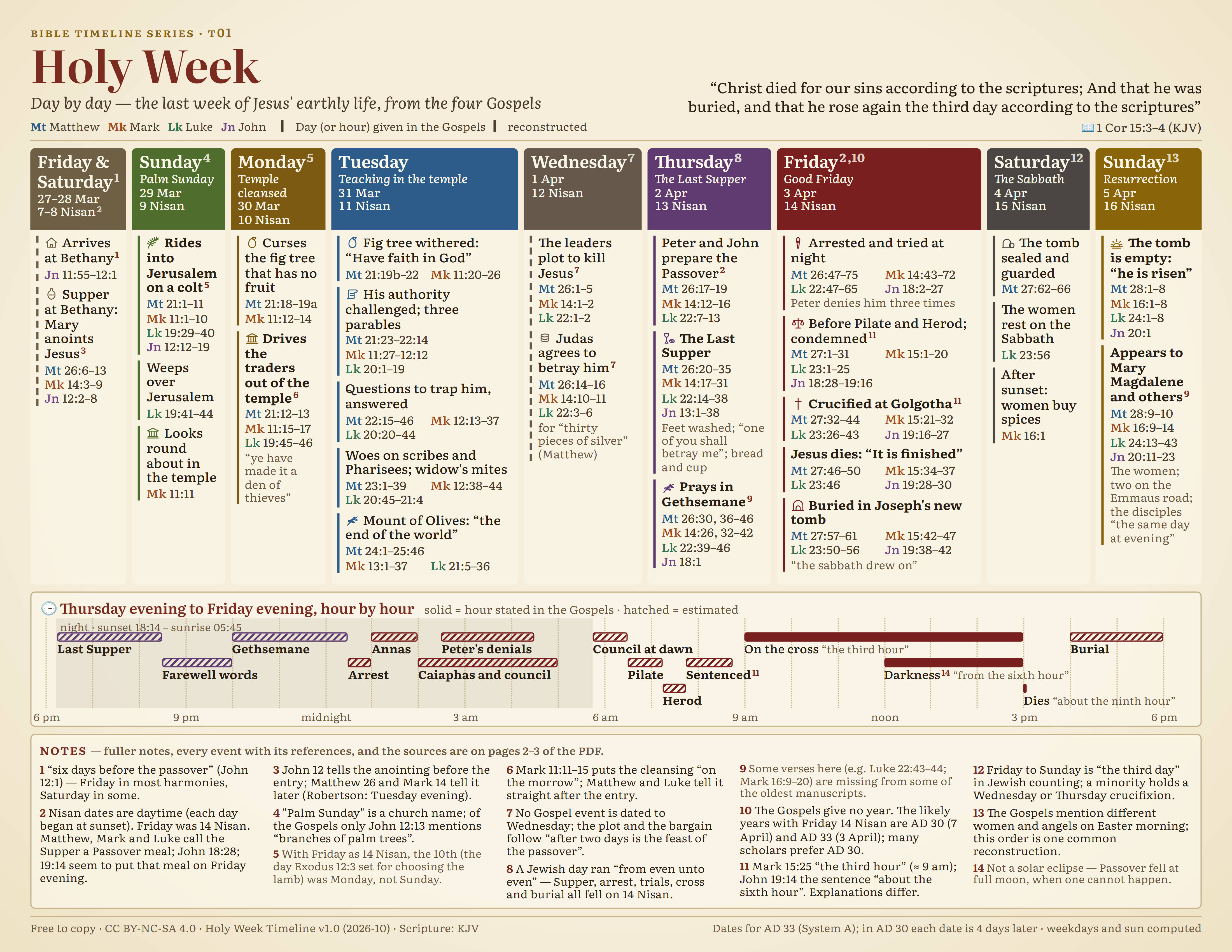

Holy Week
 1 Cor 15:3–4 (KJV)
ye have made it a den of thieves
Have faith in God
the end of the world
thirty pieces of silver(Matthew)
one of you shall betray me; bread and cup
It is finished
the sabbath drew on
he is risen
the same day at evening
 Thursday evening to Friday evening, hour by hour
solid = hour stated in the Gospels · hatched = estimated
Thursday evening to Friday evening, hour by hour
solid = hour stated in the Gospels · hatched = estimatedthe third hour
from the sixth hour
about the ninth hour
Notes — fuller notes, every event with its references, and the sources are on pages 2–3 of the PDF.
1six days before the passover
(John 12:1) — Friday in most harmonies, Saturday in some.
2Nisan dates are daytime (each day began at sunset). Friday was 14 Nisan. Matthew, Mark and Luke call the Supper a Passover meal; John 18:28; 19:14 seem to put that meal on Friday evening.
3John 12 tells the anointing before the entry; Matthew 26 and Mark 14 tell it later (Robertson: Tuesday evening).
4"Palm Sunday" is a church name; of the Gospels only John 12:13 mentions branches of palm trees
.
5With Friday as 14 Nisan, the 10th (the day Exodus 12:3 set for choosing the lamb) was Monday, not Sunday.
6Mark 11:11–15 puts the cleansing on the morrow
; Matthew and Luke tell it straight after the entry.
7No Gospel event is dated to Wednesday; the plot and the bargain follow after two days is the feast of the passover
.
8A Jewish day ran from even unto even
— Supper, arrest, trials, cross and burial all fell on 14 Nisan.
9Some verses here (e.g. Luke 22:43–44; Mark 16:9–20) are missing from some of the oldest manuscripts.
10The Gospels give no year. The likely years with Friday 14 Nisan are AD 30 (7 April) and AD 33 (3 April); many scholars prefer AD 30.
11Mark 15:25 the third hour
(≈ 9 am); John 19:14 the sentence about the sixth hour
. Explanations differ.
12Friday to Sunday is the third day
in Jewish counting; a minority holds a Wednesday or Thursday crucifixion.
13The Gospels mention different women and angels on Easter morning; this order is one common reconstruction.
14Not a solar eclipse — Passover fell at full moon, when one cannot happen.
Holy Week — Study notes
Every event on the chart, with its Bible references, certainty and notes. Dates are for AD 33 (System A); the AD 30 dates are four days later (e.g. 29 March → 2 April).
| Time | Event | Matthew | Mark | Luke | John / other | Cert. |
|---|---|---|---|---|---|---|
| Friday & Saturday · 27–28 Mar AD 33 (31 Mar – 1 Apr AD 30) · 7–8 Nisan2 | ||||||
Arrives at Bethany1six days before the passover, where Lazarus was |
11:55–12:1 | D | ||||
| Supper at Bethany: Mary anoints Jesus3 Judas objects: Why was not this ointment sold |
26:6–13 | 14:3–9 | 12:2–8 | D | ||
| Crowds come to see Lazarus15 The chief priests plan to kill Lazarus too |
12:9–11 | D | ||||
| Sunday — Palm Sunday · 29 Mar AD 33 (2 Apr AD 30) · 9 Nisan | ||||||
| Two disciples fetch the colt | 21:1–7 | 11:1–7 | 19:29–35 | B | ||
| Rides into Jerusalem on a colt5 Garments and branches spread; the crowds cry Hosanna Scripture fulfilled: Isa 62:11; Zech 9:9 (as stated in Matt 21:4–5; John 12:14–15) |
21:1–11 | 11:1–10 | 19:29–40 | 12:12–19 | B | |
| Weeps over Jerusalem Foretells the siege of the city |
19:41–44 | B | ||||
Children cry Hosannain the temple The blind and the lame healed (Matthew tells it after the cleansing) |
21:14–16 | D | ||||
Looks round about in the templenow the eventide was come— back to Bethany |
11:11 | B | ||||
| Monday — Temple cleansed · 30 Mar AD 33 (3 Apr AD 30) · 10 Nisan | ||||||
Curses the fig tree that has no fruit16on the morrow(Mark 11:12) |
21:18–19a | 11:12–14 | B | |||
Drives the traders out of the temple6ye have made it a den of thieves |
21:12–13 | 11:15–17 | 19:45–46 | B | ||
| The leaders seek to destroy him | 11:18 | 19:47–48 | B | |||
| Greeks ask to see Jesus; a voice from heaven John gives no day; Robertson places it on Monday |
12:20–36 | D | ||||
| Goes out of the city in the evening | 11:19 | B | ||||
| Tuesday — Teaching in the temple · 31 Mar AD 33 (4 Apr AD 30) · 11 Nisan | ||||||
Fig tree withered: Have faith in God16 |
21:19b–22 | 11:20–26 | B | |||
| His authority is challenged | 21:23–27 | 11:27–33 | 20:1–8 | B | ||
| Three parables against the leaders Two sons; wicked husbandmen; marriage feast |
21:28–22:14 | 12:1–12 | 20:9–19 | B | ||
| Questions to trap him Tribute to Caesar; the resurrection; the great commandment |
22:15–40 | 12:13–34 | 20:20–40 | B | ||
What think ye of Christ? |
22:41–46 | 12:35–37 | 20:41–44 | B | ||
| Woes on the scribes and Pharisees | 23:1–39 | 12:38–40 | 20:45–47 | B | ||
| The widow's two mites | 12:41–44 | 21:1–4 | B | |||
Mount of Olives: the end of the world The temple's fall foretold; his coming; parables of watching |
24:1–25:46 | 13:1–37 | 21:5–36 | B | ||
| Wednesday · 1 Apr AD 33 (5 Apr AD 30) · 12 Nisan | ||||||
The leaders plot to kill Jesus7after two days is the feast of the passover |
26:1–5 | 14:1–2 | 22:1–2 | D | ||
| Judas agrees to betray him7 for thirty pieces of silver(Matthew) |
26:14–16 | 14:10–11 | 22:3–6 | D | ||
| Thursday — The Last Supper · 2 Apr AD 33 (6 Apr AD 30) · 13 Nisan | ||||||
| ≈ 2 pm | Peter and John prepare the Passover2a large upper room furnished |
26:17–19 | 14:12–16 | 22:7–13 | A | |
| ≈ 6:15 pm | The Last Supper beginsWith desire I have desired to eat this passover |
26:20 | 14:17 | 22:14–18, 24–30 | 13:1 | A |
| ≈ 7 pm | Washes the disciples' feet | 13:2–20 | A | |||
| ≈ 7:30 pm | Judas goes out: and it was night17 |
26:21–25 | 14:18–21 | 22:21–23 | 13:21–30 | A |
| ≈ 8 pm | Bread and cup: the Lord's Supperthis do in remembrance of me |
26:26–29 | 14:22–25 | 22:17–20 | 1 Cor 11:23–26 | A |
| ≈ 8:15 pm | Foretells Peter's denial18 | 26:31–35 | 14:27–31 | 22:31–38 | 13:31–38 | B |
| ≈ 8:30 pm | Farewell teaching and prayer The vine; the Comforter promised; his prayer (John 17) |
14:1–17:26 | B | |||
| ≈ 10 pm | Prays in Gethsemane9could ye not watch with me one hour? |
26:30, 36–46 | 14:26, 32–42 | 22:39–46 | 18:1 | B |
| Friday — Good Friday · 3 Apr AD 33 (7 Apr AD 30) · 14 Nisan | ||||||
| ≈ 12:30 am | Betrayed with a kiss and arrestedwith lanterns and torches; all the disciples forsook him, and fled Scripture fulfilled: Zech 13:7 (as stated in Matt 26:31, 56; Mark 14:27, 49–50) |
26:47–56 | 14:43–52 | 22:47–53 | 18:2–12 | B |
| ≈ 1 am | Questioned by Annas20 | 18:12–14, 19–23 | D | |||
| ≈ 2 am | Condemned by the council at night Before Caiaphas: I am |
26:57, 59–68 | 14:53, 55–65 | 22:54a, 63–65 | 18:24 | B |
| ≈ 3 am | Peter denies him three times19 | 26:58, 69–75 | 14:54, 66–72 | 22:54b–62 | 18:15–18, 25–27 | B |
| ≈ 5:45 am | The council meets at dawnWhen the morning was come |
27:1 | 15:1 | 22:66–71 | A | |
| Judas hangs himself; the potter's field bought21 Scripture fulfilled: Zech 11:12–13 (words quoted in Matt 27:9–10) — Matthew links them to the field bought with the silver and names Jeremy the prophet; the words are mostly Zechariah's (see the note) |
27:3–10 | Acts 1:18–19 | D | |||
| ≈ 6:30 am | Before Pilate, then Herod22it was early; Herod Antipas mocks him (Luke) |
27:2, 11–14 | 15:1–5 | 23:1–12 | 18:28–38 | A |
| ≈ 7:45 am | Barabbas freed; Jesus scourged and condemned11 | 27:15–26 | 15:6–15 | 23:13–25 | 18:39–19:16 | D |
| ≈ 8:15 am | Soldiers mock him: the crown of thorns2311 | 27:27–31 | 15:16–20 | 19:2–3 | B | |
| ≈ 9 am | Crucified at Golgotha1124 Between two thieves; lots cast for his coat Scripture fulfilled: Ps 22:18 (as stated in John 19:24) |
27:32–44 | 15:21–32 | 23:26–43 | 19:16–27 | A |
| noon–3 pm | Darkness over all the land14 | 27:45 | 15:33 | 23:44–45 | A | |
| ≈ 3 pm | Jesus dies: It is finished25 |
27:46–50 | 15:34–37 | 23:46 | 19:28–30 | A |
| ≈ 3:05 pm | The temple veil torn; an earthquake26 | 27:51–56 | 15:38–41 | 23:45, 47–49 | A | |
| ≈ 3:30 pm | Legs not broken; his side pierced Scripture fulfilled: Exod 12:46; Num 9:12; Ps 34:20; Zech 12:10 (as stated in John 19:36–37) |
19:31–37 | A | |||
| ≈ 5 pm | Buried in Joseph's new tombthe sabbath drew on |
27:57–61 | 15:42–47 | 23:50–56 | 19:38–42 | A |
| Saturday — The Sabbath · 4 Apr AD 33 (8 Apr AD 30) · 15 Nisan | ||||||
| The tomb sealed and guarded | 27:62–66 | A | ||||
The women rest on the Sabbathaccording to the commandment |
23:56 | A | ||||
| ≈ 6:30 pm | After sunset: women buy spiceswhen the sabbath was past |
16:1 | A | |||
| Sunday — Resurrection · 5 Apr AD 33 (9 Apr AD 30) · 16 Nisan | ||||||
| ≈ 5:45 am | The tomb is empty: he is risen Early, when it was yet dark(John 20:1) |
28:1–8 | 16:1–8 | 24:1–8 | 20:1 | A |
| ≈ 6:30 am | Peter and the other disciple run to the tomb | 24:12 | 20:2–10 | A | ||
| ≈ 7 am | Appears to Mary Magdalene913 | 16:9–11 | 20:11–18 | A | ||
| ≈ 7:30 am | Appears to the other women13as they went to tell his disciples |
28:9–10 | B | |||
| ≈ 7:45 am | The women tell the apostles13their words seemed to them as idle tales |
24:9–11 | B | |||
| ≈ 8 am | The guards are paid to lie | 28:11–15 | A | |||
Appears to Simon PeterThe Lord is risen indeed, and hath appeared to Simon(the hour is not told) |
24:34 | 1 Cor 15:5 | B | |||
| ≈ 4 pm | On the road to Emmaus Known to two disciples in breaking of bread |
16:12–13 | 24:13–35 | A | ||
| ≈ 7 pm | Appears to the disciplesthe same day at evening |
16:14 | 24:36–43 | 20:19–23 | A | |
Certainty: A Stated in Scripture · B Worked out from Scripture · C Ancient record or astronomy · D Scholarly reconstruction · E Tradition / uncertain — scholars differ.
Holy Week — notes and sources
How the dates were worked out
Dates are for AD 33 (System A): crucifixion Friday 3 April AD 33, 14 Nisan. In AD 30 every date is four days later (Friday 7 April); the weekdays are the same. Weekdays, full moon and sunrise/sunset are computed. A Jewish day began at sunset; hours were counted from sunrise (third hour ≈ 9 am, sixth = noon, ninth ≈ 3 pm).
Thursday evening to Friday evening, hour by hour
≈ 6:15 pm–8:30 pm Last Supper (Matt 26:20; Luke 22:14)
≈ 8:30 pm–10 pm Farewell words (John 14:1–17:26)
≈ 10 pm–12:30 am Gethsemane (Mark 14:32–42)
≈ 12:30 am–1 am Arrest (John 18:3–12)
≈ 1 am–2 am Annas (John 18:13)
≈ 2 am–5 am Caiaphas and council (Mark 14:53–65)
≈ 2:30 am–4:30 am Peter's denials (Luke 22:54–62)
≈ 5:45 am–6:30 am Council at dawn — When the morning was come
(Matt 27:1)
≈ 6:30 am–7:15 am Pilate — it was early
(John 18:28)
≈ 7:15 am–7:45 am Herod (Luke 23:7–11)
≈ 7:45 am–8:45 am Sentenced11 (John 19:13–16)
9 am–3 pm On the cross — the third hour
(Mark 15:25)
noon–3 pm Darkness14 — from the sixth hour
(Matt 27:45)
3 pm Dies — about the ninth hour
(Matt 27:46)
≈ 4 pm–6 pm Burial — when the even was come
(Mark 15:42)
sunset 18:14 · sunrise 05:45 · sunset 18:15 (Jerusalem, sundial time, computed). Clock times are estimates, except the hours the Gospels state (third, sixth, ninth).
 Notes
Notes
1 six days before the passover
(John 12:1) — Friday in most harmonies, Saturday in some. Travel on the Sabbath is unlikely, so most harmonies have him arrive on Friday before sunset. (John 12:1)
2 Nisan dates are daytime (each day began at sunset). Friday was 14 Nisan. Matthew, Mark and Luke call the Supper a Passover meal; John 18:28; 19:14 seem to put that meal on Friday evening. Astronomy gives Friday 14 Nisan in both likely years (3 April AD 33; 7 April AD 30). In AD 33 that Friday cannot have been 15 Nisan (the feast day that began at sunset with the Passover meal); in AD 30 that is "not impossible, but highly improbable" (Humphreys and Waddington 1992). Explanations: the Supper was a Passover-style meal held a day early; Galileans and Judeans counted the day differently (Hoehner 1977); or Jesus kept an older or a sectarian calendar, which would move the Supper to Tuesday or Wednesday (the views of Annie Jaubert, 1957, and Colin Humphreys, 2011). Others argue that in John "the passover" means the feast's other offerings, so that all four Gospels make Friday 15 Nisan (Smith 1991) — a view that astronomy rules out for AD 33 and makes highly improbable for AD 30. Bond (2013) surveys these views. Some popular books print "15 Nisan, 3 April AD 33" — astronomy does not allow it. (Mark 14:12; Luke 22:15; John 18:28; 19:14)
3 John 12 tells the anointing before the entry; Matthew 26 and Mark 14 tell it later (Robertson: Tuesday evening). Robertson dates it Tuesday evening, the start of the Jewish Wednesday. Most harmonies see one event (Bethany, costly ointment, three hundred pence
). The woman is Mary of Bethany, sister of Martha and Lazarus (John 11:1–2; 12:2–3) — not Mary Magdalene. The anointing in Luke 7:36–50 is a different, earlier one in Galilee. (John 11:1–2; 12:1–8; Matt 26:2, 6–13; Mark 14:1–9)
4 "Palm Sunday" is a church name; of the Gospels only John 12:13 mentions branches of palm trees
. Matthew 21:8 and Mark 11:8 say branches from the trees; Luke 19:36 mentions garments only. (John 12:13; Matt 21:8; Mark 11:8; Luke 19:36)
5 With Friday as 14 Nisan, the 10th (the day Exodus 12:3 set for choosing the lamb) was Monday, not Sunday. Most harmonies (e.g. Robertson) put the entry on Sunday, On the next day
(John 12:12). Hoehner (1977), who also dates the crucifixion to 3 April AD 33, puts it on Monday 10 Nisan (30 March AD 33), the day Exodus 12:3 set for choosing the lamb — a link the Gospels do not make. (Exod 12:3; John 12:12)
6 Mark 11:11–15 puts the cleansing on the morrow
; Matthew and Luke tell it straight after the entry. Most harmonies follow Mark's day. John 2:13–22 tells of a cleansing at an earlier Passover; many count two cleansings. (Mark 11:11–15; Matt 21:12; Luke 19:45; John 2:13–22)
7 No Gospel event is dated to Wednesday; the plot and the bargain follow after two days is the feast of the passover
. Robertson places both on Tuesday evening, the start of the Jewish Wednesday. "Spy Wednesday" is a later church name for this day. (Matt 26:2, 14–16; Mark 14:1, 10–11)
8 A Jewish day ran from even unto even
— Supper, arrest, trials, cross and burial all fell on 14 Nisan. (Lev 23:32)
9 Some verses here (e.g. Luke 22:43–44; Mark 16:9–20) are missing from some of the oldest manuscripts. Many modern Bibles print these verses in brackets or with a note; the KJV prints them as part of the text. (Luke 22:43–44; 23:34; Mark 16:9–20)
10 The Gospels give no year. The likely years with Friday 14 Nisan are AD 30 (7 April) and AD 33 (3 April); many scholars prefer AD 30. AD 27 is a remote possibility (Humphreys and Waddington 1992); some (Bond 2013) hold that the exact year cannot be recovered. This chart uses AD 33, which fits Luke 3:1 (Tiberius' fifteenth year, counted from his accession in AD 14: AD 28/29) with the three Passovers of John (John 2:13; 6:4; 11:55). In AD 30 every date on this chart is four days later (e.g. Sunday 29 March AD 33 = Sunday 2 April AD 30); the weekdays and the Nisan dates stay the same. (Luke 3:1; John 2:13; 6:4; 11:55)
11 Mark 15:25 the third hour
(≈ 9 am); John 19:14 the sentence about the sixth hour
. Explanations differ. Hours were counted from sunrise and named loosely (third, sixth, ninth). Some, like Robertson (1922), think John counted from midnight (about 6 am). The hour strip shows the morning as an estimate. (Mark 15:25; John 19:14)
12 Friday to Sunday is the third day
in Jewish counting; a minority holds a Wednesday or Thursday crucifixion. Part of a day counted as a day (Esther 4:16 with 5:1; Matthew 16:21). Robertson: "a small part of Friday, all of Saturday, and 10 or 11 hours of Sunday". Those who take three days and three nights
(Matthew 12:40) literally — as 72 hours, or as three full nights — propose Wednesday (Torrey 1907) or Thursday. In AD 33 neither day was 14 Nisan; in AD 30 a Thursday 14 Nisan is "not impossible, but highly improbable" (Humphreys and Waddington 1992). (Matt 16:21; 12:40; Esth 4:16; 5:1; Mark 15:42)
13 The Gospels mention different women and angels on Easter morning; this order is one common reconstruction. No Gospel gives the full order. Matthew 28:9 says Jesus met the women as they went to tell his disciples
; Mark 16:9 says he appeared first to Mary Magdalene
(in Mark's longer ending); John 20:1–18 names only one woman, Mary Magdalene. Luke 24:9–12 tells the women's report before Peter's run; Luke seems to sum up the reports of several women (in this reconstruction Mary Magdalene's came first, John 20:2). (Matt 28:1–10; Mark 16:1–9; Luke 24:1–12; John 20:1–18)
14 Not a solar eclipse — Passover fell at full moon, when one cannot happen. The tools computed the full moon for Friday 3 April AD 33 at about 5 pm Jerusalem time. A partial lunar eclipse (NASA catalogue no. 04904) was ending as the moon rose over Jerusalem that evening; whether it could be seen is disputed (Humphreys and Waddington 1992; Schaefer 1990).
15 John gives no day for this; it is placed with his arrival at Bethany, before the entry On the next day
(John 12:12). (John 12:9–12)
16 Mark splits the fig tree over two days; Matthew 21:18–20 tells it as one. (Mark 11:12–14, 20–21; Matt 21:18–20)
17 The Gospels do not say plainly whether Judas left before or after the bread and cup (Luke 22:19–21; John 13:30). (Luke 22:19–21; John 13:30)
18 Luke 22:31–34 and John 13:36–38 place this warning in the upper room; Matthew 26:30–35 and Mark 14:26–31 after they went out to the Mount of Olives. It may have been given twice. (Luke 22:31–34; John 13:36–38; Matt 26:30–35; Mark 14:26–31)
19 Mark says the cock crowed twice (14:30, 72); the others mention once. (Mark 14:30, 72; Matt 26:74; Luke 22:60; John 18:27)
20 Only John tells of a hearing before Annas, Caiaphas' father-in-law (John 18:13); verses 19–24 can be read of either man. (John 18:13–24)
21 Matthew 27:5 says Judas hanged himself; Acts 1:18 that he fell headlong. Both tie his silver to a field. Matthew 27:9 credits the prophecy to Jeremy the prophet
; the words are mostly Zechariah 11:12–13, joined with Jeremiah's potter and field (Jeremiah 18–19; 32:6–9). (Matt 27:3–10; Acts 1:18–19)
22 Herod Antipas, ruler of Galilee (Luke 3:1) — not Herod the Great of Matthew 2. The Gospels call him Herod (Herod being tetrarch of Galilee
, Luke 3:1); the name Antipas comes from Josephus. (Luke 3:1; 23:7; Matt 2:1)
23 John 19:1–3 tells of the scourging and the crown of thorns before Pilate's final verdict (19:16); Matthew and Mark tell the scourging with the verdict (when he had scourged Jesus, he delivered him to be crucified
, Matthew 27:26; compare Mark 15:15) and the crown of thorns after it (Matthew 27:27–31; Mark 15:16–20). (John 19:1–3, 16; Matt 27:26–31; Mark 15:15–20)
24 Golgotha, a place of a skull
— no Gospel calls it a hill; Calvary (Luke 23:33) is the Latin name. (Matt 27:33; Luke 23:33)
25 No Gospel has all seven sayings from the cross; their order is traditional.
26 Matthew 27:52–53 — graves opened at his death, but the saints came out of the graves after his resurrection
. (Matt 27:52–53)
Sources
The King James translators, The Holy Bible, King James Version — Pure Cambridge Edition text (bibleprotector.com), checked against eBible.org's 1769 text, 1611 (Cambridge text).
Harold W. Hoehner, Chronological Aspects of the Life of Christ, Zondervan, Grand Rapids, 1977.
Colin J. Humphreys and W. Graeme Waddington, The Jewish Calendar, a Lunar Eclipse and the Date of Christ's Crucifixion, Tyndale Bulletin 43.2, 331–351, 1992.
Bradley E. Schaefer, Lunar visibility and the crucifixion, Quarterly Journal of the Royal Astronomical Society 31, 53–67, 1990.
Barry D. Smith, The Chronology of the Last Supper, Westminster Theological Journal 53, 29–45, 1991.
Helen K. Bond, Dating the Death of Jesus: Memory and the Religious Imagination, New Testament Studies 59, 461–475, 2013.
A. T. Robertson, A Harmony of the Gospels for Students of the Life of Christ, George H. Doran, New York, 1922.
R. A. Torrey, Difficulties and Alleged Errors and Contradictions in the Bible, ch. XXI, 1907.
Jean Meeus, Astronomical Algorithms, 2nd edition (ch. 7 Julian Day, ch. 49 phases of the Moon), Willmann-Bell, Richmond VA, 1998.
Fred Espenak and Jean Meeus, Five Millennium Canon of Lunar Eclipses: −1999 to +3000, NASA/TP-2009-214172 (catalogue no. 04904: partial eclipse of 3 April AD 33), 2009.
Only sources actually checked are listed. Copyrighted charts were used for cross-checking only.
Free to copy, print and share for non-commercial use. Licence: Creative Commons BY-NC-SA 4.0 (creativecommons.org/licenses/by-nc-sa/4.0). Scripture quotations: King James Version (KJV) (Cambridge text). Holy Week Timeline v1.0, 2026-10-06.