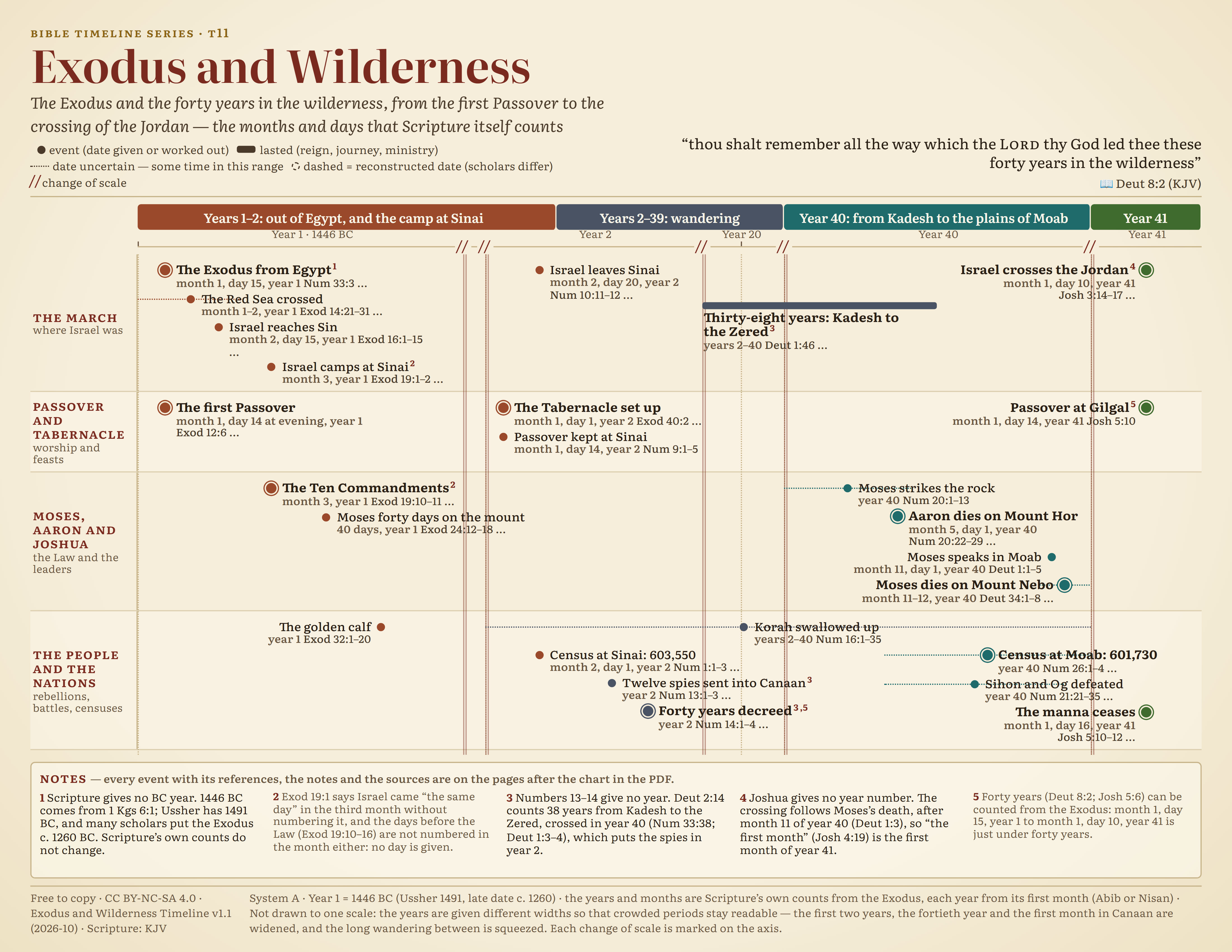

Exodus and Wilderness
 Deut 8:2 (KJV)
Notes — every event with its references, the notes and the sources are on the pages after the chart in the PDF.
1Scripture gives no BC year. 1446 BC comes from 1 Kgs 6:1; Ussher has 1491 BC, and many scholars put the Exodus c. 1260 BC. Scripture’s own counts do not change.
2Exod 19:1 says Israel came the same day
in the third month without numbering it, and the days before the Law (Exod 19:10–16) are not numbered in the month either: no day is given.
3Numbers 13–14 give no year. Deut 2:14 counts 38 years from Kadesh to the Zered, crossed in year 40 (Num 33:38; Deut 1:3–4), which puts the spies in year 2.
4Joshua gives no year number. The crossing follows Moses’s death, after month 11 of year 40 (Deut 1:3), so the first month
(Josh 4:19) is the first month of year 41.
5Forty years (Deut 8:2; Josh 5:6) can be counted from the Exodus: month 1, day 15, year 1 to month 1, day 10, year 41 is just under forty years.
Exodus and Wilderness — Study notes
Every event on the chart, with its Bible references, certainty and notes. One chronology for the whole series: the Bible's own numbers with the main ancient records. "c." = about; a range (e.g. 6–4 BC) = some time in that range.
| Date | Event | Bible references | Lane | Cert. |
|---|---|---|---|---|
| Years 1–2: out of Egypt, and the camp at Sinai · month 1, year 1 – month 2, year 2 | ||||
| month 1, day 10, year 1 | The Passover lamb chosenIn the tenth day of this month they shall take to them every man a lamb |
Exod 12:1–3 | Passover and Tabernacle | A |
| month 1, day 14 at evening, year 1 | The first Passover910 The lamb is killed in the evening, and at midnight the Lord smote all the firstborn in the land of Egypt |
Exod 12:6, 12, 29 | Passover and Tabernacle | A |
| month 1, day 15, year 1 | The Exodus from Egypt16 Israel leaves Egypt, out of Rameses on the morrow after the passover, about six hundred thousand on foot that were men, beside children Sources: Rodger C. Young |
Num 33:3; Exod 12:37, 41, 51 | The march | A |
| month 1–2, year 1 | The Red Sea crossed7 Pharaoh’s army is drowned; the sea was driven back by a strong east wind all that night, and the waters were a wall unto them on their right hand, and on their left |
Exod 14:21–31; 15:22; 16:1 | The march | B |
| month 1–2, year 1 | Marah’s bitter water healed; Elim Three days from the sea without water; at Elim twelve wells of water, and threescore and ten palm trees |
Exod 15:22–27; Num 33:8–9 | The march | B |
| month 2, day 15, year 1 | Israel reaches Sin In the wilderness of Sin the people murmur for bread; the quails and the manna are given here |
Exod 16:1–15; Num 33:11 | The march | A |
| month 2–3, year 1 | Rephidim: water from rock; Amalek defeated Moses smites the rock in Horeb; Joshua fights Amalek while Aaron and Hur hold up Moses’s hands |
Exod 17:1–16; Num 33:14 | The march | B |
| month 3, year 1 | Israel camps at Sinai2 In the third monththey come the same dayto the wilderness of Sinaiand camp before the mount |
Exod 19:1–2; Num 33:15 | The march | A |
| month 3, year 1 | The Ten Commandments2 The Law is spoken from Sinai on the third day; be ready against the third day: for the third day the Lord will come down in the sight of all the people upon mount Sinai |
Exod 19:10–11, 16–20; 20:1–17 | Moses, Aaron and Joshua | B |
| 40 days, year 1 | Moses forty days on the mount Moses goes up into the cloud and receives the two tables of testimony; Moses was in the mount forty days and forty nights |
Exod 24:12–18; 31:18 | Moses, Aaron and Joshua | B |
| year 1 | The golden calf While Moses is on the mount the people have Aaron make a calf, and Moses breaks the tables beneath the mount |
Exod 32:1–20 | The people and the nations | B |
| 40 days, year 1 | Moses forty days again; the second tables Moses cuts two new tables, And he was there with the Lord forty days and forty nights |
Exod 34:1–4, 28; Deut 10:10 | Moses, Aaron and Joshua | B |
| month 1, day 1, year 2 | The Tabernacle set up At Sinai, in the first month in the second year, on the first day of the month; the glory of the Lord filled the tabernacle |
Exod 40:2, 17, 34–35 | Passover and Tabernacle | A |
| month 1, day 14, year 2 | Passover kept at Sinaithey kept the passover on the fourteenth day of the first month at even in the wilderness of Sinai |
Num 9:1–5 | Passover and Tabernacle | A |
| month 2, day 1, year 2 | Census at Sinai: 603,55015 Men able to go to war are numbered on the first day of the second month, in the second year after they were come out of the land of Egypt, from twenty years old and upward |
Num 1:1–3, 46 | The people and the nations | A |
| month 2, day 20, year 2 | Israel leaves Sinai The cloud is taken up on the twentieth day of the second month, in the second year, after about eleven months at the mountain |
Num 10:11–12; 33:16 | The march | A |
| Years 2–39: Kadesh and the long wandering · month 3, year 2 – month 12, year 39 | ||||
| year 2 | Kibroth-hattaavah: the quails and the plague The mixed multitude lusts for meat; quails fall round the camp, and the Lord smote the people with a very great plague |
Num 11:4–35; 33:16–17 | The march | B |
| year 2 | Twelve spies sent into Canaan3 Sent from the wilderness of Paran at the time of the firstripe grapes; they come back after forty days |
Num 13:1–3, 20, 25 | The people and the nations | B |
| year 2 | Forty years decreed35 Israel refuses to enter the land; After the number of the days in which ye searched the land, even forty days, each day for a year, shall ye bear your iniquities, even forty years |
Num 14:1–4, 26–35; Deut 1:26–40 | The people and the nations | B |
| years 2–40 | Thirty-eight years: Kadesh to the Zered38 From Kadeshbarnea until Israel crossed the brook Zered, Moses says, was thirty and eight years |
Deut 1:46; 2:1, 13–14 | The march | B |
| years 2–40 | Korah swallowed up Korah, Dathan and Abiram rebel against Moses and Aaron, and the earth opened her mouth, and swallowed them up |
Num 16:1–35 | The people and the nations | B |
| Year 40: from Kadesh to the plains of Moab · year 40 | ||||
| month 1, year 40 | Israel comes to Zin; Miriam dies11 The whole congregation comes into the desert of Zin in the first month; Miriam died there, and was buried there |
Num 20:1 | The people and the nations | B |
| year 40 | Moses strikes the rock11 At Meribah, in Kadesh, water comes out of the rock, but Moses and Aaron are told, ye shall not bring this congregation into the land which I have given them |
Num 20:1–13 | Moses, Aaron and Joshua | B |
| month 5, day 1, year 40 | Aaron dies on Mount Hor Aged 123, in the fortieth year after the children of Israel were come out of the land of Egypt, in the first day of the fifth month |
Num 20:22–29; 33:38–39 | Moses, Aaron and Joshua | A |
| year 40 | The serpent of brass12 After leaving Mount Hor, the Lord sent fiery serpents among the people; Moses made a serpent of brass, and put it upon a pole |
Num 21:4–9 | The people and the nations | B |
| year 40 | Sihon and Og defeated12 Israel takes the land of the Amorites from the Arnon to the Jabbok, and Bashan; this was done before Moses spoke in the eleventh month |
Num 21:21–35; Deut 1:3–4; 2:24–3:11 | The people and the nations | B |
| year 40 | Joshua appointed to lead after Moses12 Moses lays his hand on Joshua before Eleazar the priest and all the congregation |
Num 27:12–23 | Moses, Aaron and Joshua | B |
| year 40 | Balaam blesses Israel instead of cursing it12 Balak king of Moab sends for Balaam, who instead blesses Israel these three timesand foretells a Star out of Jacob |
Num 22:1–24:25 | The people and the nations | B |
| year 40 | Baal-peor: 24,000 die; Phinehas’s zeal12those that died in the plague were twenty and four thousand |
Num 25:1–13 | The people and the nations | B |
| year 40 | Census at Moab: 601,73012 Men able to go to war are numbered after the plaguein the plains of Moab; of those counted at Sinai only Caleb and Joshua remain |
Num 26:1–4, 51, 63–65 | The people and the nations | B |
| year 40 | Vengeance on Midian12 Israel is sent against Midian before Moses is gathered to his people; Balaam is slain |
Num 31:1–54 | The people and the nations | B |
| year 40 | Two and a half tribes settle east of Jordan12 Moses gives them Gilead and Bashan on condition that their men cross the Jordan with the rest |
Num 32:1–42; Deut 3:12–20 | The people and the nations | B |
| month 11, day 1, year 40 | Moses speaks in Moabin the fortieth year, in the eleventh month, on the first day of the month, after Sihon and Og were slain, Moses begins to declare the law in the land of Moab |
Deut 1:1–5 | Moses, Aaron and Joshua | A |
| month 11–12, year 40 | Moses dies on Mount Nebo1314Moses was an hundred and twenty years old when he died; Israel wept for him thirty days |
Deut 34:1–8; 1:3; Josh 4:19 | Moses, Aaron and Joshua | B |
| Year 41: across the Jordan · month 1, year 41 | ||||
| month 1, day 10, year 41 | Israel crosses the Jordan4 Israel crosses on dry ground; the waters stood and rose up upon an heap; the people came up out of Jordan on the tenth day of the first month, and camp at Gilgal |
Josh 3:14–17; 4:19 | The march | B |
| month 1, days 10–14, year 41 | The wilderness-born circumcised At Gilgal Joshua circumcises their children, whom he raised up in their stead, born in the wilderness; the Lord said unto Joshua, This day have I rolled away the reproach of Egypt from off you |
Josh 5:2–9 | The people and the nations | B |
| month 1, day 16, year 41 | The manna ceases16 Israel eats the corn of Canaan: the manna ceased on the morrow after they had eaten of the old corn of the land; the children of Israel did eat manna forty years |
Josh 5:10–12; Exod 16:35 | The people and the nations | B |
| month 1, day 14, year 41 | Passover at Gilgal5 Israel kept the passover on the fourteenth day of the month at even in the plains of Jericho, forty years after the first Passover by Scripture’s own counts |
Josh 5:10 | Passover and Tabernacle | B |
Certainty: A Stated in Scripture · B Worked out from Scripture · C Ancient record or astronomy · D Scholarly reconstruction · E Tradition / uncertain — scholars differ.
Exodus and Wilderness — notes and sources
How the dates were worked out
The Bible counts this time from the Exodus itself. The year began with the month of the Passover (Exod 12:2, the first month, Abib or Nisan), and the dates are given as month, day and year from that start — the Exodus on the fifteenth day of the first month (Num 33:3), the Tabernacle set up on the first day of the first month of the second year (Exod 40:17), the departure from Sinai on the twentieth day of the second month of the second year (Num 10:11), Aaron’s death on the first day of the fifth month of the fortieth year (Num 33:38), Moses speaking on the first day of the eleventh month of the fortieth year (Deut 1:3) and the crossing of the Jordan on the tenth day of the first month (Josh 4:19), which the order of the text puts in year 41. This chart prints those counts as Scripture gives them, and its axis counts the years the same way (Year 1, Year 2 …), each year drawn as one stretch from its first month to its twelfth. No verse names a year of our calendar; the chart puts year 1 in 1446 BC because 1 Kings 6:1 puts the Temple in the 480th year after the Exodus (see the note on the date of the Exodus), so year 40 is 1407 BC and year 41 is 1406 BC. Where Scripture gives no month or day, the label says only what it does give ("year 40") and the dot stands where the order of the text puts it. Not drawn to one scale: the years are given different widths so that crowded periods stay readable — the first two years, the fortieth year and the first month in Canaan are widened, and the long wandering between is squeezed. Each change of scale is marked on the axis.
 Notes
Notes
1 Scripture gives no BC year. 1446 BC comes from 1 Kgs 6:1; Ussher has 1491 BC, and many scholars put the Exodus c. 1260 BC. Scripture’s own counts do not change. 1 Kings 6:1 puts the beginning of the Temple’s building in the 480th year after the Exodus, in the fourth year of Solomon, which this series dates to 967 BC. The 480th year comes 479 years after the Exodus, so 967 + 479 = 1446 BC. Young’s review of Steinmann’s book writes "Nisan 14, 1446 B.C." for the Exodus; Num 33:3 has Israel leave on the fifteenth day, on the morrow after the passover
, and this chart’s day 15 rests on that verse. Ussher dated the Exodus to 1491 BC. The late date, c. 1260 BC, reads the 480 years as a representative number for twelve generations and ties the city of Raamses (Exod 1:11) to Ramesses II; the ESV Study Bible says that both dates are held by established evangelical scholars. Another date moves every BC year on this axis, but not the months, days and years that Scripture itself counts. (1 Kgs 6:1; Exod 1:11; Num 33:3)
2 Exod 19:1 says Israel came the same day
in the third month without numbering it, and the days before the Law (Exod 19:10–16) are not numbered in the month either: no day is given. (Exod 19:1, 10–16)
3 Numbers 13–14 give no year. Deut 2:14 counts 38 years from Kadesh to the Zered, crossed in year 40 (Num 33:38; Deut 1:3–4), which puts the spies in year 2. From Sinai (month 2, day 20, year 2) Israel came to the wilderness of Paran (Num 10:11–12; 12:16) and sent the spies from there (Num 13:3); they were at Kadesh when the spies came back (Num 13:26). Deuteronomy 2:14 says that the space from Kadeshbarnea until they crossed the brook Zered was thirty and eight years. The Zered was crossed after Aaron died (month 5, year 40) and before Moses spoke (month 11, year 40) (Num 21:4–12; Deut 1:3; 2:13–14), so the 38 years end in year 40, and 40 − 38 = year 2. (Deut 2:14; Num 13:3, 26; 33:38; Deut 1:3–4)
4 Joshua gives no year number. The crossing follows Moses’s death, after month 11 of year 40 (Deut 1:3), so the first month
(Josh 4:19) is the first month of year 41. (Josh 4:19; Deut 1:3; 34:8; Josh 1:11)
5 Forty years (Deut 8:2; Josh 5:6) can be counted from the Exodus: month 1, day 15, year 1 to month 1, day 10, year 41 is just under forty years. The first two years plus the thirty-eight of Deut 2:14 come to forty. Num 14:33–34 itself ties the forty years to the sentence passed in year 2, not to the Exodus. (Deut 8:2; Josh 5:6; Num 14:33–34; Deut 2:14)
6 The Masoretic (Hebrew) text of Exod 12:40 gives 430 years in Egypt; the Septuagint says Egypt and Canaan, and Paul counts 430 years from the promise to the Law (Gal 3:17). This series takes the Masoretic (Hebrew) reading (430 years in Egypt, so Jacob went down to Egypt in 1876 BC). The Septuagint reads "while they sojourned in the land of Egypt and the land of Chanaan, was four hundred and thirty years", which leaves about 215 years in Egypt, and Paul says the law came four hundred and thirty years after
the covenant with Abraham (Gal 3:17). Ussher counts the 430 years from Abraham’s call at Haran (Gen 12:1–4), so he has 215 years in Egypt. (Exod 12:40–41; Gal 3:17)
7 The KJV’s Red sea translates the Hebrew yam suph, literally sea of reeds; where Israel crossed is not known, and several routes have been proposed. (Exod 14:21–22)
8 Numbers 33 lists the camps from Rameses to the plains of Moab (33:5–49): 41 named camps, 42 names with Rameses. It dates only the Exodus (33:3) and Aaron’s death (33:38). (Num 33:1–49)
9 The lamb is killed in the evening
of day 14 (Exod 12:6); the firstborn die at midnight, in the night that follows (Exod 12:29); Israel leaves on day 15 (Num 33:3). (Exod 12:6, 8, 12, 29; Num 33:3)
10 None of the first nine plagues (Exod 7:14–10:29) is dated; the tenth struck at midnight on the Passover night itself (Exod 12:29). The nine came after Moses and Aaron, aged 80 and 83, spoke to Pharaoh (Exod 7:7) and before the first Passover. The tenth, the death of the firstborn (Exod 12:29–30), came in the night that followed the killing of the lamb on day 14 (Exod 12:6, 12). (Exod 7:7; 7:14–10:29; 12:6, 12, 29–30)
11 Num 20:1 gives the month (the first) but not the year; the chapter ends with Aaron’s death in the fifth month of year 40 (Num 33:38), so it is placed in year 40. (Num 20:1; 33:38)
12 Numbers 21–27 and 31–32 date none of these events. Read in order, they fall between Aaron’s death (month 5) and Moses’s death (month 12 at the latest) of year 40. (Num 20:22–29; 21:4; 33:38; Deut 1:3–4; 34:8)
13 Moses began to speak on month 11, day 1 (Deut 1:3); Israel wept thirty days
(Deut 34:8) before the crossing on month 1, day 10 (Josh 4:19): he died in month 11 or 12. (Deut 1:3; 34:8; Josh 1:11; 4:19)
14 Moses was eighty when he spoke to Pharaoh (Exod 7:7) and 120 when he died (Deut 34:7): about the forty years of this chart (Acts 7:36 counts forty wilderness years). (Exod 7:7; Deut 34:7; Acts 7:36)
15 Exod 38:25–26 gives the same total, 603,550 men, for the half-shekel paid before the Tabernacle was set up (Exod 30:11–16); it does not say whether Num 1 is the same counting. (Exod 38:25–26; 30:11–16; Num 1:46)
16 Josh 5:11 puts the eating of the old corn on the morrow after the passover
(day 15, as in Num 33:3); Josh 5:12 ends the manna on the next morrow, day 16. (Josh 5:10–12; Num 33:3)
Sources
The King James translators, The Holy Bible, King James Version — Pure Cambridge Edition text (bibleprotector.com), checked against eBible.org's 1769 text, 1611 (Cambridge text).
James Ussher, Annales Veteris Testamenti (English, The Annals of the World, 1658), 1650.
ESV Study Bible (Crossway), article by the study-Bible team, The Date of the Exodus (ESV Study Bible, as published at Bible Study Tools), 2008 (online).
Lancelot C. L. Brenton (translator), The Septuagint Version of the Old Testament, with an English Translation, Exodus 12 (as published by eBible.org), 1851.
Rodger C. Young, Book Review — From Abraham to Paul: A Biblical Chronology, Part I (Associates for Biblical Research), 2012.
Wikipedia contributors, Ussher chronology (Wikipedia), online.
Rodger C. Young, Book Review — From Abraham to Paul: A Biblical Chronology, Part II (Associates for Biblical Research), 2012.
Rodger C. Young, Ussher, Explained and Corrected (Associates for Biblical Research), 2018.
Only sources actually checked are listed. Copyrighted charts were used for cross-checking only.
Free to copy, print and share for non-commercial use. Licence: Creative Commons BY-NC-SA 4.0 (creativecommons.org/licenses/by-nc-sa/4.0). Scripture quotations: King James Version (KJV) (Cambridge text). Exodus and Wilderness Timeline v1.1, 2026-10-10.