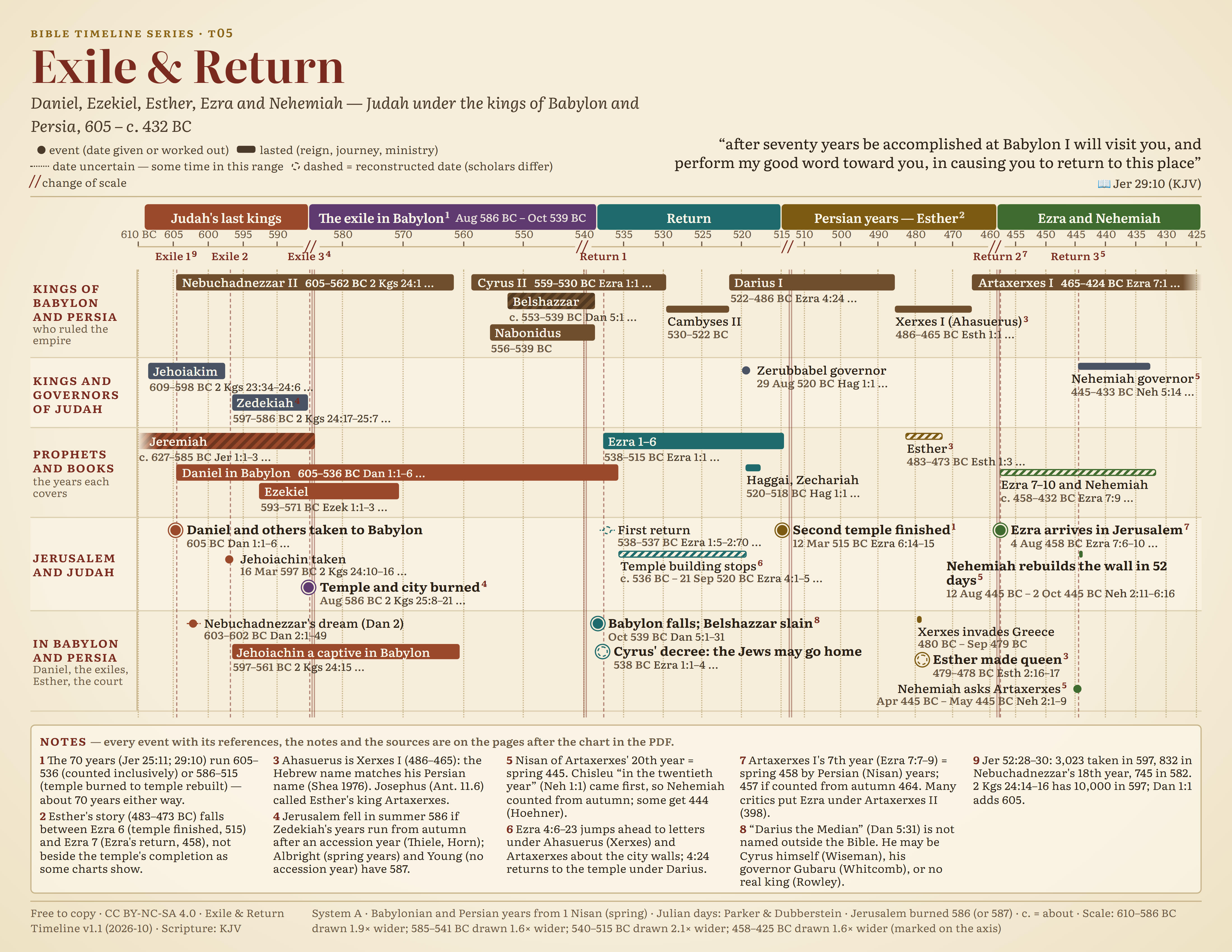

Exile & Return
 Jer 29:10 (KJV)
Notes — every event with its references, the notes and the sources are on the pages after the chart in the PDF.
1The 70 years (Jer 25:11; 29:10) run 605–536 (counted inclusively) or 586–515 (temple burned to temple rebuilt) — about 70 years either way.
2Esther's story (483–473 BC) falls between Ezra 6 (temple finished, 515) and Ezra 7 (Ezra's return, 458), not beside the temple's completion as some charts show.
3Ahasuerus is Xerxes I (486–465): the Hebrew name matches his Persian name (Shea 1976). Josephus (Ant. 11.6) called Esther's king Artaxerxes.
4Jerusalem fell in summer 586 if Zedekiah's years run from autumn after an accession year (Thiele, Horn); Albright (spring years) and Young (no accession year) have 587.
5Nisan of Artaxerxes' 20th year = spring 445. Chisleu in the twentieth year
(Neh 1:1) came first, so Nehemiah counted from autumn; some get 444 (Hoehner).
6Ezra 4:6–23 jumps ahead to letters under Ahasuerus (Xerxes) and Artaxerxes about the city walls; 4:24 returns to the temple under Darius.
7Artaxerxes I's 7th year (Ezra 7:7–9) = spring 458 by Persian (Nisan) years; 457 if counted from autumn 464. Many critics put Ezra under Artaxerxes II (398).
8Darius the Median
(Dan 5:31) is not named outside the Bible. He may be Cyrus himself (Wiseman), his governor Gubaru (Whitcomb), or no real king (Rowley).
9Jer 52:28–30: 3,023 taken in 597, 832 in Nebuchadnezzar's 18th year, 745 in 582. 2 Kgs 24:14–16 has 10,000 in 597; Dan 1:1 adds 605.
Exile & Return — Study notes
Every event on the chart, with its Bible references, certainty and notes. One chronology for the whole series: the Bible's own numbers with the main ancient records. "c." = about; a range (e.g. 6–4 BC) = some time in that range.
| Date | Event | Bible references | Lane | Cert. |
|---|---|---|---|---|
| Judah's last kings · 609 BC – Aug 586 BC | ||||
| c. 627–585 BC | Jeremiah14 13th year of Josiah to the flight into Egypt Sources: Siegfried H. Horn |
Jer 1:1–3; 25:3; 43:6–7; 44:1 | Prophets and books | D |
| 626 BC – 15 Aug 605 BC | Nabopolassar, king of Babylon Dies 8 Ab (15 Aug 605) while his son fights in Syria Sources: Babylonian Chronicle ABC 5 (BM 21946), tr. A. K. Grayson (1975), adapted by Jona Lendering; Richard A. Parker and Waldo H. Dubberstein; Siegfried H. Horn |
Kings of Babylon and Persia | C | |
| 609 BC | Jehoahaz (three months) Deposed by Pharaoh Necho, taken to Egypt Sources: Siegfried H. Horn |
2 Kgs 23:30–34; 2 Chr 36:1–4 | Kings and governors of Judah | D |
| 609–598 BC | Jehoiakim12 Autumn 609 – Dec 598; Necho's appointee, Nebuchadnezzar's vassal from 605 Sources: Siegfried H. Horn; Babylonian Chronicle ABC 5 (BM 21946), tr. A. K. Grayson (1975), adapted by Jona Lendering |
2 Kgs 23:34–24:6; 2 Chr 36:4–8 | Kings and governors of Judah | C |
| 609 BC | Josiah killed at Megiddo Pharaoh Necho marching to help Assyria at Haran Sources: Siegfried H. Horn |
2 Kgs 23:29–30; 2 Chr 35:20–24 | Jerusalem and Judah | C |
| 605–562 BC | Nebuchadnezzar II Crowned 1 Elul (7 Sept 605); dies early October 562 Sources: Babylonian Chronicle ABC 5 (BM 21946), tr. A. K. Grayson (1975), adapted by Jona Lendering; Richard A. Parker and Waldo H. Dubberstein; Flavius Josephus (tr. William Whiston) |
2 Kgs 24:1; Dan 1:1 | Kings of Babylon and Persia | C |
| 605–536 BC | Daniel in Babylon Last dated vision in Cyrus' third year (Dan 10:1) Sources: Babylonian Chronicle ABC 5 (BM 21946), tr. A. K. Grayson (1975), adapted by Jona Lendering; Richard A. Parker and Waldo H. Dubberstein |
Dan 1:1–6, 21; 10:1 | Prophets and books | C |
| 605 BC | Daniel and others taken to Babylon21 Temple vessels taken; Jehoiakim submits Sources: Babylonian Chronicle ABC 5 (BM 21946), tr. A. K. Grayson (1975), adapted by Jona Lendering; Flavius Josephus (tr. William Whiston); D. J. Wiseman |
Dan 1:1–6; 2 Chr 36:6–7 | Jerusalem and Judah | C |
| 605 BC | Battle of Carchemish: Egypt defeated21 Spring or early summer 605; Nebuchadnezzar takes Syria Sources: Babylonian Chronicle ABC 5 (BM 21946), tr. A. K. Grayson (1975), adapted by Jona Lendering; D. J. Wiseman; Siegfried H. Horn |
Jer 46:2 | In Babylon and Persia | C |
| 605–603 BC | Daniel and his friends trained three years28 | Dan 1:3–20 | In Babylon and Persia | B |
| Dec 604 BC | Jehoiakim burns Jeremiah's scroll 9th month of his 5th year — Nov/Dec 604 Sources: Richard A. Parker and Waldo H. Dubberstein |
Jer 36:1–2, 9, 20–32 | Jerusalem and Judah | B |
| 603–602 BC | Nebuchadnezzar's dream (Dan 2)28 His second year(spring 603 – spring 602) Sources: Richard A. Parker and Waldo H. Dubberstein |
Dan 2:1–49 | In Babylon and Persia | B |
| c. 601 BC | Jehoiakim rebels against Babylon After three years as vassal; Babylon and Egypt clash in 601 (Chronicle) Sources: Babylonian Chronicle ABC 5 (BM 21946), tr. A. K. Grayson (1975), adapted by Jona Lendering |
2 Kgs 24:1–2 | Jerusalem and Judah | D |
| Dec 598 BC – 16 Mar 597 BC | Jehoiachin (three months, ten days)13 Sources: Siegfried H. Horn; Babylonian Chronicle ABC 5 (BM 21946), tr. A. K. Grayson (1975), adapted by Jona Lendering; Richard A. Parker and Waldo H. Dubberstein |
2 Kgs 24:8–12; 2 Chr 36:9–10 | Kings and governors of Judah | C |
| 16 Mar 597 BC | Jehoiachin taken22 2 Adar (16 March 597, Babylonian Chronicle); 10,000 exiled Sources: Babylonian Chronicle ABC 5 (BM 21946), tr. A. K. Grayson (1975), adapted by Jona Lendering; Siegfried H. Horn; Richard A. Parker and Waldo H. Dubberstein |
2 Kgs 24:10–16; 2 Chr 36:10; Jer 52:28 | Jerusalem and Judah | C |
| 597–586 BC | Zedekiah4 16 Mar 597 – Jul 586; Babylon's "king of his own choice" (Chronicle); rebels Sources: Babylonian Chronicle ABC 5 (BM 21946), tr. A. K. Grayson (1975), adapted by Jona Lendering; Siegfried H. Horn |
2 Kgs 24:17–25:7; Jer 52:1–11 | Kings and governors of Judah | C |
| 597–561 BC | Jehoiachin a captive in Babylon29 Named on Babylonian palace ration tablets Sources: Siegfried H. Horn |
2 Kgs 24:15; 25:27–30 | In Babylon and Persia | C |
| 597–594 BC | Jeremiah's letter to the exiles1after seventy years be accomplished at Babylon |
Jer 29:1–14 | Jerusalem and Judah | D |
| 593–571 BC | Ezekiel16 Jul 593 – 26 Apr 571: called by the river Chebar; last dated word 1 Nisan 571 Sources: Richard A. Parker and Waldo H. Dubberstein; Walther Zimmerli |
Ezek 1:1–3; 29:17 | Prophets and books | C |
| Jul 593 BC | Ezekiel's call by the river Chebar1630 5th day, 4th month, 5th year of the captivity (July 593) Sources: Richard A. Parker and Waldo H. Dubberstein; Walther Zimmerli |
Ezek 1:1–3 | In Babylon and Persia | C |
| Sep 592 BC | Ezekiel's vision of the temple's idols 5th day, 6th month, 6th year (Sept 592) Sources: Richard A. Parker and Waldo H. Dubberstein |
Ezek 8:1–11:25 | In Babylon and Persia | C |
| Jan 588 BC | Siege of Jerusalem begins4 10th day of the 10th month — 15 Jan 588 (or Jan 589) Sources: Richard A. Parker and Waldo H. Dubberstein; Siegfried H. Horn; Rodger C. Young |
2 Kgs 25:1; Jer 39:1; 52:4; Ezek 24:1–2 | Jerusalem and Judah | C |
| 588–587 BC | Jeremiah, in prison, buys a field4 Zedekiah's 10th year = Nebuchadnezzar's 18th |
Jer 32:1–15 | Jerusalem and Judah | D |
| 586 BC | Gedaliah governor at Mizpah; murdered14 Killed in the 7th month — of 586 (most) or 582 |
2 Kgs 25:22–26; Jer 40:5–41:3 | Kings and governors of Judah | D |
| c. 586 BC | Lamentations17 | Lam 1:1–3 | Prophets and books | E |
| Jul 586 BC | City wall breached; Zedekiah flees4 9th day of the 4th month (18/19 July 586) Sources: Siegfried H. Horn; Richard A. Parker and Waldo H. Dubberstein |
2 Kgs 25:2–7; Jer 39:2–7; 52:5–11 | Jerusalem and Judah | C |
| The exile in Babylon · Aug 586 BC – Oct 539 BC1 | ||||
| Aug 586 BC | Temple and city burned423 5th month, 7th or 10th day (14–18 Aug 586) Sources: Siegfried H. Horn; Richard A. Parker and Waldo H. Dubberstein |
2 Kgs 25:8–21; 2 Chr 36:17–21; Jer 52:12–30 | Jerusalem and Judah | C |
| Jan 585 BC | Exiles hear: The city is smitten4 5th day, 10th month, 12th year of captivity (8 Jan 585) Sources: Richard A. Parker and Waldo H. Dubberstein |
Ezek 33:21–22 | In Babylon and Persia | C |
| 586–582 BC | Remnant flees to Egypt with Jeremiah14 | Jer 41:1–3; 43:4–7; 2 Kgs 25:25–26 | Jerusalem and Judah | D |
| 603–562 BC | The image of gold; the fiery furnace31 | Dan 3:1–30 | In Babylon and Persia | E |
| 603–562 BC | Nebuchadnezzar humbled (the tree dream)31 | Dan 4:1–37 | In Babylon and Persia | E |
| 582–581 BC | A further 745 Jews deported9 Nebuchadnezzar's 23rd year Sources: Richard A. Parker and Waldo H. Dubberstein |
Jer 52:30 | Jerusalem and Judah | B |
| 573 BC | Ezekiel's vision of a new temple16 25th year of captivity, 14th after the city fell Sources: Richard A. Parker and Waldo H. Dubberstein |
Ezek 40:1–48:35 | In Babylon and Persia | B |
| 562–560 BC | Evilmerodach Amel-Marduk, Oct 562 – Aug 560; frees Jehoiachin, then is killed Sources: Richard A. Parker and Waldo H. Dubberstein; Flavius Josephus (tr. William Whiston) |
2 Kgs 25:27; Jer 52:31 | Kings of Babylon and Persia | C |
| 561–560 BC | Evilmerodach frees Jehoiachin29 37th year of his captivity, 12th month Sources: Richard A. Parker and Waldo H. Dubberstein |
2 Kgs 25:27–30; Jer 52:31–34 | In Babylon and Persia | C |
| 560–556 BC | Neriglissar Aug 560 – Apr/May 556 Sources: Richard A. Parker and Waldo H. Dubberstein; Flavius Josephus (tr. William Whiston) |
Kings of Babylon and Persia | C | |
| 559–530 BC | Cyrus II King of Persia from 559 (Herodotus: 29 years); king of Babylon from Oct 539; dies 530 Sources: Herodotus (tr. G. C. Macaulay); Richard A. Parker and Waldo H. Dubberstein; Nabonidus Chronicle ABC 7, tr. A. K. Grayson (1975) with changes, adapted by Jona Lendering |
Ezra 1:1; Isa 44:28; 45:1; Dan 10:1 | Kings of Babylon and Persia | C |
| May 556 BC – Jun 556 BC | Labashi-Marduk (a few weeks) Tablets dated to him only in May–June 556 Sources: Richard A. Parker and Waldo H. Dubberstein; Flavius Josephus (tr. William Whiston) |
Kings of Babylon and Persia | C | |
| 556–539 BC | Nabonidus May 556 – Oct 539; years at Tema in Arabia, his son ruling in Babylon Sources: Richard A. Parker and Waldo H. Dubberstein; Nabonidus Chronicle ABC 7, tr. A. K. Grayson (1975) with changes, adapted by Jona Lendering |
Kings of Babylon and Persia | C | |
| c. 553–539 BC | Belshazzar10 Ruled Babylon for his father; slain the night Babylon fell (Oct 539) Sources: Verse Account of Nabonidus, tr. A. Leo Oppenheim (in Pritchard, ANET, 1950); Nabonidus Chronicle ABC 7, tr. A. K. Grayson (1975) with changes, adapted by Jona Lendering; D. J. Wiseman |
Dan 5:1, 30; 7:1; 8:1 | Kings of Babylon and Persia | D |
| c. 553 BC | Daniel's vision of four beasts10first year of Belshazzar |
Dan 7:1–28 | In Babylon and Persia | E |
| c. 551 BC | Daniel's vision of the ram and the goat10 Belshazzar's third year; seen at Shushan |
Dan 8:1–27 | In Babylon and Persia | E |
| 550 BC | Cyrus takes Media (Ecbatana) Nabonidus Chronicle, year 6 Sources: Nabonidus Chronicle ABC 7, tr. A. K. Grayson (1975) with changes, adapted by Jona Lendering |
Dan 5:28; 8:20 | Kings of Babylon and Persia | C |
| Return and the second temple · Oct 539 BC – Mar 515 BC | ||||
| Oct 539 BC | Babylon falls; Belshazzar slain328MENE, MENE, TEKEL, UPHARSIN— the night of 12/13 Oct 539 Sources: Nabonidus Chronicle ABC 7, tr. A. K. Grayson (1975) with changes, adapted by Jona Lendering; Richard A. Parker and Waldo H. Dubberstein; Herodotus (tr. G. C. Macaulay); D. J. Wiseman |
Dan 5:1–31 | In Babylon and Persia | C |
| 29 Oct 539 BC | Cyrus enters Babylon 3rd of the 8th month (29 Oct 539) Sources: Nabonidus Chronicle ABC 7, tr. A. K. Grayson (1975) with changes, adapted by Jona Lendering; Richard A. Parker and Waldo H. Dubberstein; D. J. Wiseman |
In Babylon and Persia | C | |
| 539–538 BC | Daniel's prayer; the seventy weeks833seventy years in the desolations of Jerusalem |
Dan 9:1–27 | In Babylon and Persia | D |
| 538–515 BC | Ezra 1–6 From Cyrus' decree (538) to the temple finished (12 Mar 515) Sources: Richard A. Parker and Waldo H. Dubberstein |
Ezra 1:1; 6:15 | Prophets and books | C |
| 539–537 BC | Daniel in the lions' den8 Under Darius the Median; shut the lions' mouths Sources: D. J. Wiseman |
Dan 5:31–6:28 | In Babylon and Persia | E |
| 538 BC | Cyrus' decree: the Jews may go home34 His first year as king of Babylon (from 24 March 538) Sources: Richard A. Parker and Waldo H. Dubberstein; Cyrus Cylinder, tr. after M. Cogan and H. Schaudig, with B. van der Spek |
Ezra 1:1–4; 6:3–5; 2 Chr 36:22–23; Isa 44:28 | In Babylon and Persia | D |
| 538–537 BC | Sheshbazzar, the prince of Judah15 Brings back 5,400 temple vessels |
Ezra 1:8–11; 5:14–16 | Kings and governors of Judah | D |
| 538–537 BC | First return1524 Led by Zerubbabel and Jeshua; 42,360 people and 7,337 servants Sources: Richard A. Parker and Waldo H. Dubberstein |
Ezra 1:5–2:70; Neh 7:66–67 | Jerusalem and Judah | D |
| 538–537 BC | Altar rebuilt; Feast of Tabernacles15 The 7th month after the return |
Ezra 3:1–6 | Jerusalem and Judah | D |
| 537–536 BC | Temple foundation laid; old men weep15wept with a loud voice— 2nd month of the 2nd year |
Ezra 3:8–13; 5:16 | Jerusalem and Judah | D |
| c. 536 BC – 21 Sep 520 BC | Temple building stops6unto the second year of the reign of Darius |
Ezra 4:1–5, 24; Hag 1:2–4 | Jerusalem and Judah | D |
| 536–535 BC | Daniel's last vision, by the Tigris 24th of the 1st month, Cyrus' 3rd year (April 536 or 535) Sources: Richard A. Parker and Waldo H. Dubberstein |
Dan 10:1–4; 12:13 | In Babylon and Persia | C |
| 530–522 BC | Cambyses II Aug 530 – 522 Sources: Richard A. Parker and Waldo H. Dubberstein; Herodotus (tr. G. C. Macaulay) |
Kings of Babylon and Persia | C | |
| 11 Mar 522 BC – 29 Sep 522 BC | Bardiya (Smerdis) Killed by Darius on 29 Sept 522 (Behistun inscription) Sources: Richard A. Parker and Waldo H. Dubberstein |
Kings of Babylon and Persia | C | |
| 522–486 BC | Darius I 29 Sept 522 – Nov 486; the Darius of Ezra 4–6, Haggai and Zechariah Sources: Richard A. Parker and Waldo H. Dubberstein |
Ezra 4:24; 6:15; Hag 1:1; Zech 1:1 | Kings of Babylon and Persia | C |
| 29 Sep 522 BC | Darius I kills Bardiya and takes the throne 29 Sept 522 (Behistun inscription) Sources: Richard A. Parker and Waldo H. Dubberstein |
In Babylon and Persia | C | |
| 29 Aug 520 BC | Zerubbabel governor With Joshua the high priest (Hag 1:1); Jehoiachin's grandson (1 Chr 3:17–19) Sources: Richard A. Parker and Waldo H. Dubberstein |
Hag 1:1; Ezra 3:2; 5:2; Zech 4:9; 1 Chr 3:17–19 | Kings and governors of Judah | C |
| 29 Aug 520 BC – 18 Dec 520 BC | Haggai's four messages18 1st of the 6th month to 24th of the 9th, Darius' 2nd year Sources: Richard A. Parker and Waldo H. Dubberstein |
Hag 1:1; 2:10, 20 | Prophets and books | C |
| 21 Sep 520 BC | Work on the temple resumes 24th day of the 6th month (21 Sept 520) Sources: Richard A. Parker and Waldo H. Dubberstein |
Hag 1:12–15; Ezra 5:1–2 | Jerusalem and Judah | C |
| Nov 520 BC – Dec 518 BC | Zechariah's dated visions 8th month of Darius' 2nd year to Chisleu of his 4th; chs 9–14 undated Sources: Richard A. Parker and Waldo H. Dubberstein |
Zech 1:1, 7; 7:1 | Prophets and books | C |
| 18 Dec 520 BC | Haggai's blessing on the foundation dayfrom this day will I bless you— 24th of the 9th month (18 Dec 520) Sources: Richard A. Parker and Waldo H. Dubberstein |
Hag 2:10–19 | Jerusalem and Judah | C |
| 520–516 BC | Tatnai's inquiry; Darius confirms the decree25 Cyrus' scroll found at Achmetha (Ecbatana) |
Ezra 5:3–6:13 | Jerusalem and Judah | B |
| Persian years — Esther · Mar 515 BC – Apr 458 BC2 | ||||
| 12 Mar 515 BC | Second temple finished261 3 Adar, Darius' 6th year (12 March 515) Sources: Richard A. Parker and Waldo H. Dubberstein |
Ezra 6:14–15 | Jerusalem and Judah | C |
| 21 Apr 515 BC | Temple dedicated; Passover kept 14th of the 1st month (21 April 515) Sources: Richard A. Parker and Waldo H. Dubberstein |
Ezra 6:16–22 | Jerusalem and Judah | C |
| 486–465 BC | Xerxes I (Ahasuerus)3 Nov 486 – Aug 465 Sources: Richard A. Parker and Waldo H. Dubberstein; Julia Neuffer; William H. Shea |
Esth 1:1; Ezra 4:6 | Kings of Babylon and Persia | C |
| 486–485 BC | Accusation sent to Ahasuerus (Xerxes)6in the beginning of his reign Sources: Richard A. Parker and Waldo H. Dubberstein |
Ezra 4:6 | Jerusalem and Judah | D |
| 483–473 BC | Esther3 Ahasuerus' 3rd to 12th year Sources: William H. Shea; Richard A. Parker and Waldo H. Dubberstein |
Esth 1:3; 3:7; 9:1 | Prophets and books | D |
| 483–482 BC | Ahasuerus' feast; Vashti deposed3third year of his reign(spring 483 – spring 482) Sources: William H. Shea; Richard A. Parker and Waldo H. Dubberstein |
Esth 1:1–22 | In Babylon and Persia | D |
| 480 BC – Sep 479 BC | Xerxes invades Greece35 Thermopylae and Salamis 480, Plataea 479; back in Sardis, then Shushan (Susa), autumn 479 Sources: Herodotus (tr. G. C. Macaulay); William H. Shea |
In Babylon and Persia | C | |
| 479–478 BC | Esther made queen3 Tebeth, Ahasuerus' 7th year (Dec 479/Jan 478) Sources: William H. Shea; Richard A. Parker and Waldo H. Dubberstein |
Esth 2:16–17 | In Babylon and Persia | D |
| Apr 474 BC | Haman casts Pur (the lot) against the Jews3 Nisan, 12th year (April 474); Esther for such a time as this Sources: Richard A. Parker and Waldo H. Dubberstein |
Esth 3:7–15; 4:14 | In Babylon and Persia | D |
| Jun 474 BC | Mordecai's counter-decree 23rd of Sivan, 12th year (25 June 474) Sources: Richard A. Parker and Waldo H. Dubberstein |
Esth 8:9–14 | In Babylon and Persia | D |
| 473 BC | Jews delivered; the first Purim36 13th–15th of Adar, 12th year (March/April 473) Sources: Richard A. Parker and Waldo H. Dubberstein |
Esth 9:1–32 | In Babylon and Persia | D |
| 465–424 BC | Artaxerxes I11 Aug 465 – Dec 424; the king of Ezra 7 and Nehemiah Sources: Richard A. Parker and Waldo H. Dubberstein; Julia Neuffer; A. E. Cowley |
Ezra 7:1, 7; Neh 2:1; 13:6 | Kings of Babylon and Persia | C |
| Aug 465 BC | Xerxes murdered; Artaxerxes I king About 4–8 August 465 (a later Babylonian tablet) Sources: Julia Neuffer; A. E. Cowley |
Kings of Babylon and Persia | C | |
| Ezra and Nehemiah · Apr 458 BC – 425 BC | ||||
| 8 Apr 458 BC – 27 Mar 457 BC | Ezra 7–10 — Ezra's return and reforms7 Sources: Richard A. Parker and Waldo H. Dubberstein |
Ezra 7:9; 10:17 | Prophets and books | C |
| 8 Apr 458 BC | Ezra sets out from Babylon7 1st of the 1st month (8 April 458); leaves the Ahava river on the 12th Sources: Richard A. Parker and Waldo H. Dubberstein |
Ezra 7:9; 8:15, 31 | In Babylon and Persia | C |
| 4 Aug 458 BC | Ezra arrives in Jerusalem7 1st day of the 5th month (4 Aug 458), after four months Sources: Richard A. Parker and Waldo H. Dubberstein; J. Stafford Wright |
Ezra 7:6–10; 8:31–32 | Jerusalem and Judah | C |
| 19 Dec 458 BC – 27 Mar 457 BC | Ezra deals with mixed marriages Assembly in the rain, 20th of the 9th month; done by 1 Nisan Sources: Richard A. Parker and Waldo H. Dubberstein |
Ezra 9:1–2; 10:9–17 | Jerusalem and Judah | C |
| 464–446 BC | Artaxerxes stops the rebuilding of the walls6 Undated; perhaps the ruin reported in Neh 1:3 |
Ezra 4:7–23; Neh 1:3 | Jerusalem and Judah | D |
| Dec 446 BC – c. 432 BC | Book of Nehemiah519 From Chisleu of Artaxerxes' 20th year to after his 32nd Sources: Richard A. Parker and Waldo H. Dubberstein |
Neh 1:1; 13:6–7 | Prophets and books | D |
| Dec 446 BC – Jan 445 BC | Nehemiah hears that the walls are down5 Chisleu, the 20th year, at Shushan Sources: Richard A. Parker and Waldo H. Dubberstein; Siegfried H. Horn |
Neh 1:1–11 | In Babylon and Persia | D |
| Apr 445 BC – May 445 BC | Nehemiah asks Artaxerxes5 Nisan, Artaxerxes' 20th year (April/May 445) Sources: Richard A. Parker and Waldo H. Dubberstein; J. Stafford Wright |
Neh 2:1–9 | In Babylon and Persia | C |
| 445–433 BC | Nehemiah governor5 Twelve years, from Artaxerxes' 20th to his 32nd year Sources: Richard A. Parker and Waldo H. Dubberstein |
Neh 5:14; 13:6 | Kings and governors of Judah | B |
| c. 460–430 BC | Malachi (undated)20 Sources: George L. Robinson |
Mal 1:1, 8; 2:11; 3:8–10 | Prophets and books | E |
| c. 445 BC | Dedication of the wall27 | Neh 12:27–43 | Jerusalem and Judah | E |
| 12 Aug 445 BC – 2 Oct 445 BC | Nehemiah rebuilds the wall in 52 days5 Finished 25 Elul (2 Oct 445) in fifty and two days Sources: Richard A. Parker and Waldo H. Dubberstein |
Neh 2:11–6:16 | Jerusalem and Judah | C |
| 7 Oct 445 BC | Ezra reads the Law; Tabernacles kept 1st day of the 7th month (7 Oct 445); they gave the sense Sources: Richard A. Parker and Waldo H. Dubberstein |
Neh 8:1–18 | Jerusalem and Judah | C |
| 30 Oct 445 BC | Fast, confession and a sealed covenant 24th of the 7th month (30 Oct 445) Sources: Richard A. Parker and Waldo H. Dubberstein |
Neh 9:1–10:39 | Jerusalem and Judah | C |
| 433–432 BC | Nehemiah goes back to the king1911two and thirtieth year of Artaxerxes Sources: Richard A. Parker and Waldo H. Dubberstein; A. E. Cowley |
Neh 13:6 | In Babylon and Persia | B |
| c. 432 BC | Nehemiah's second visit and reforms19 Tobiah thrown out; tithes, sabbath, mixed marriages |
Neh 13:6–31 | Jerusalem and Judah | D |
Certainty: A Stated in Scripture · B Worked out from Scripture · C Ancient record or astronomy · D Scholarly reconstruction · E Tradition / uncertain — scholars differ.
Exile & Return — notes and sources
How the dates were worked out
Dates follow the series' System A: first deportation 605 BC, Jehoiachin taken 16 March 597, Jerusalem and the Temple burned in August 586 (many scholars: 587), Babylon taken in October 539, Cyrus' decree 538, Ezra 458 (some: 457; many critics: 398), Nehemiah 445 (some: 444). The years of the kings of Babylon and Persia come from dated cuneiform tablets and chronicles (Parker & Dubberstein; the Babylonian Chronicles). Babylon and Persia counted a king's years from 1 Nisan in spring, the first part-year being his "accession year"; Judah's own kings were most likely counted from 1 Tishri in autumn, so one Bible year can straddle two of ours. Where the Bible gives a year, month and day (Ezek 1:1–2; Hag 1:1; Ezra 6:15; Neh 6:15 with 2:1 …) the Julian date is read from Parker & Dubberstein's tables of Babylonian months: a day began at sunset, months began with the new crescent, and a table date can be a day out (and Jerusalem's month sometimes began a day before Babylon's). Day dates are shown only where they are secure; otherwise the month or the year. Scale: 610–586 BC drawn 1.9× wider; 585–541 BC drawn 1.6× wider; 540–515 BC drawn 2.1× wider; 458–425 BC drawn 1.6× wider (marked on the axis).
Dated lines on the chart
Exile 19 — 605 BC (Dan 1:1–6; Cert. C)
Exile 2 — 16 Mar 597 BC (2 Kgs 24:10–16; Cert. C)
Exile 34 — Aug 586 BC (2 Kgs 25:8–11; Cert. C)
Return 124 — 538 BC (Ezra 1:1–2:70; Cert. D)
Return 27 — 4 Aug 458 BC (Ezra 7:7–9; Cert. C)
Return 35 — 445 BC (Neh 2:1–11; Cert. C)
 Notes
Notes
1 The 70 years (Jer 25:11; 29:10) run 605–536 (counted inclusively) or 586–515 (temple burned to temple rebuilt) — about 70 years either way. Jer 25:11–12 — the nations shall serve the king of Babylon seventy years
, then Babylon is punished: 609 (Assyria's last stand at Haran) to 539 = 70; 605 to 539 = 66. Jer 29:10 — after seventy years be accomplished at Babylon I will visit you
: 605 to 536 counted inclusively = 70 (605 − 536 + 1). 2 Chr 36:21 links the 70 years to the land's sabbaths, ending with Cyrus. Dan 9:2 — Daniel reads Jeremiah in the first year of Darius (539/538), 67 years after 605. Zech 1:12 (Feb 519) these threescore and ten years
and Zech 7:5 (Dec 518) count from the destruction: 586 → 519 = 67, 586 → 518 = 68; from the burning (Aug 586) to the finished temple (12 March 515) is 70 years 7 months. Some take 70 as a round number for a lifetime. (Jer 25:11–12; 29:10; 2 Chr 36:21; Dan 9:2; Zech 1:12; 7:5)
2 Esther's story (483–473 BC) falls between Ezra 6 (temple finished, 515) and Ezra 7 (Ezra's return, 458), not beside the temple's completion as some charts show. (Ezra 6:15; 7:7; Esth 1:3; 3:7)
3 Ahasuerus is Xerxes I (486–465): the Hebrew name matches his Persian name (Shea 1976). Josephus (Ant. 11.6) called Esther's king Artaxerxes. Shea's table of the name: Old Persian Khshayarsha, Aramaic hshy'rsh (Elephantine papyri), Akkadian (a)hshi'arshu, Hebrew 'Ahashwerosh (Esth 1:1; Ezra 4:6). The book's dates then fit Xerxes' reign: his 3rd year (Esth 1:3) = 483/482, the year of the planning for the Greek war; his 7th (2:16) = 479/478, after his return from Greece; his 12th (3:7) = 474/473. Josephus, Antiquities 11.6.1, names the king "Cyrus, whom the Greeks called Artaxerxes" and puts Ezra and Nehemiah under Xerxes — a different order from the Bible's. (Esth 1:1, 3; 2:16; 3:7; Ezra 4:6)
4 Jerusalem fell in summer 586 if Zedekiah's years run from autumn after an accession year (Thiele, Horn); Albright (spring years) and Young (no accession year) have 587. The Bible dates the breach to the 9th day of the 4th month of Zedekiah's 11th year (2 Kgs 25:2–4; Jer 39:2; 52:5–7) and Nebuzaradan's coming, followed by the burning, to the 5th month of Nebuchadnezzar's 19th year (the 7th day in 2 Kgs 25:8–9, the 10th in Jer 52:12–13); no Babylonian record of the event survives. Counting Zedekiah's years from 1 Tishri (autumn) and from an accession year, his 11th year is autumn 587 – autumn 586, and Nebuchadnezzar's 19th year (Babylonian count from Nisan 586, or Judean count from Tishri 587) contains the 4th and 5th months only in 586: breach 18 July, Nebuzaradan's coming (the 7th of Ab) 14 August 586 (Horn 1967, using Parker and Dubberstein's tables). Horn's figures for a spring-to-spring count of Zedekiah's years are 29 July and 25 August 587. Young (2004) argues for 587 from autumn years too, but with Zedekiah's and Nebuchadnezzar's years counted without an accession year, the siege beginning in January 589 and Ezekiel's years counted from autumn 598. Jer 52:29 (832 taken in Nebuchadnezzar's 18th year) is read either as the fall (the usual 587 view) or as a deportation during the siege (the usual 586 view). This chart follows System A (586). (2 Kgs 25:1–9; Jer 39:1–2; 52:4–13, 29; Ezek 24:1–2; 33:21)
5 Nisan of Artaxerxes' 20th year = spring 445. Chisleu in the twentieth year
(Neh 1:1) came first, so Nehemiah counted from autumn; some get 444 (Hoehner). Persian years ran from 1 Nisan: Artaxerxes' 20th year = 13 April 445 – 3 April 444 (Parker & Dubberstein), so Neh 2:1 = Nisan (13 April – 11 May) 445, and the wall was finished on 25 Elul = 2 October 445 (Neh 6:15). But Neh 1:1 puts Chisleu in the same 20th year BEFORE that Nisan — possible only in a year that began in autumn (Horn 1967). Xerxes was murdered about 4–8 August 465 (a later Babylonian tablet, Neuffer 1968): if Artaxerxes' first autumn year began Tishri 465, his 20th ran Tishri 446 – Tishri 445 → Chisleu (Dec 446/Jan 445), Nisan 445. If it began only in Tishri 464 (Elephantine papyrus AP 6 still calls January 464 his "accession year"), the 20th year is Tishri 445 – 444 → Chisleu (Dec 445/Jan 444), Nisan 444, the date used by Hoehner (1977) for Daniel's seventy weeks. Others think "twentieth" in 1:1 is a slip. This chart: 445. (Neh 1:1; 2:1; 6:15)
6 Ezra 4:6–23 jumps ahead to letters under Ahasuerus (Xerxes) and Artaxerxes about the city walls; 4:24 returns to the temple under Darius. The chapter is arranged by subject — opposition to the Jews — not in time order (Ahasuerus = Xerxes, 486–465; Artaxerxes I, 465–424). (Ezra 4:5–7, 23–24)
7 Artaxerxes I's 7th year (Ezra 7:7–9) = spring 458 by Persian (Nisan) years; 457 if counted from autumn 464. Many critics put Ezra under Artaxerxes II (398). 1st of the 1st month = 8 April 458; 1st of the 5th month = 4 August 458 (Parker & Dubberstein). The 457 date (Horn and Wood, followed by some charts) counts Artaxerxes' years from Tishri 464. The 398 view (Van Hoonacker, Batten), which Wright (1958) found "accepted almost without question in recent books", reads Ezra 7's Artaxerxes as Artaxerxes II so that Ezra comes after Nehemiah; Wright argues that the Bible's order (Ezra 458, Nehemiah 445, both under Artaxerxes I) stands. The Elephantine papyri (407 BC) name Sanballat's sons and Johanan the high priest, which fits Nehemiah under Artaxerxes I (Cowley 1923). (Ezra 7:7–9; 8:31; Neh 8:9; 12:26)
8 Darius the Median
(Dan 5:31) is not named outside the Bible. He may be Cyrus himself (Wiseman), his governor Gubaru (Whitcomb), or no real king (Rowley). The Nabonidus Chronicle says Ugbaru, governor of Gutium, entered Babylon with Cyrus' army on the 16th of Tashritu, that Cyrus entered on 3 Arahsamnu (29 October 539), that "Gubaru, his governor" appointed officers, and that Ugbaru died on the 11th of Arahsamnu. Wiseman (1965) surveys the identifications: Whitcomb (following Albright) takes Darius as Gubaru, the governor of Babylon; Rowley rejected that and held Darius to be fictitious, a confusion with Darius I; Wiseman proposes that Darius the Median
is another name for Cyrus, translating Dan 6:28 "in the reign of Darius, even (namely, or i.e.) the reign of Cyrus the Persian". Rowley had also rejected Cambyses, Astyages and Cyaxares. Josephus (Ant. 10.11.4) makes Darius a son of Astyages who "had another name among the Greeks". (Dan 5:31; 6:1, 28; 9:1; 11:1)
9 Jer 52:28–30: 3,023 taken in 597, 832 in Nebuchadnezzar's 18th year, 745 in 582. 2 Kgs 24:14–16 has 10,000 in 597; Dan 1:1 adds 605. Nebuchadnezzar's 7th and 23rd years here follow the Babylonian count (the Chronicle's 7th year = 597). The total in Jer 52:30 is 4,600. (Jer 52:28–30; 2 Kgs 24:14–16; Dan 1:1–3)
10 Belshazzar was Nabonidus' son, left to rule Babylon (Nabonidus Chronicle; Verse Account). His first year
(Dan 7:1) is probably c. 553. The Verse Account says that "when the third year was about to begin" Nabonidus "entrusted the kingship" to his eldest son and went to Tema; Nabonidus' 3rd year began 7 April 553. The Nabonidus Chronicle has the king at Tema and "the prince" in Akkad in years 7, 9, 10 and 11. Belshazzar's years are not counted in any Babylonian document, so Dan 7:1 and 8:1 can only be dated roughly (c. 553 and c. 551). Daniel 5 calls Nebuchadnezzar his father
, which can mean a predecessor. (Dan 5:2, 30; 7:1; 8:1)
11 An Elephantine letter of Darius II's 17th year (407) names the sons of Sanballat, governor of Samaria, and Johanan the high priest — so Nehemiah's king is Artaxerxes I. Cowley (1923, papyrus 30) concludes that the 32nd year of Neh 13:6 is 433 BC under Artaxerxes I. Cowley dates the letter 408; Darius II's 17th year by Parker & Dubberstein ran from spring 407. (Neh 12:22; 13:6, 28)
12 Jehoiakim slept with his fathers
(2 Kgs 24:6), in December 598; 2 Chr 36:6 says Nebuchadnezzar bound him in fetters, to carry him to Babylon
. Horn (1967) works back from 2 Adar 597 by Jehoiachin's three months and ten days (2 Chr 36:9) to 22 Marcheshvan, about 10 December 598. How Jehoiakim died is not told (Jer 22:18–19; 36:30). (2 Kgs 24:6; 2 Chr 36:6, 9; Jer 22:18–19; 36:30)
13 2 Kgs 24:8 says Jehoiachin was eighteen years old
when he began to reign; 2 Chr 36:9 says eight years old
(and adds ten days to the three months). (2 Kgs 24:8; 2 Chr 36:9)
14 Gedaliah was killed in the seventh month
(2 Kgs 25:25), year not given — 586 for most, 582 for some (Jer 52:30). Jeremiah was then taken to Egypt. (2 Kgs 25:25–26; Jer 41:1–2; 43:6–7; 52:30)
15 Cyrus' first year began in spring 538. Ezra 3 dates the altar and the foundation by month only, so they fall in 538 or 537 and in 537 or 536. (Ezra 1:1; 3:1, 8)
16 Ezekiel counts years from king Jehoiachin's captivity
(597). His call fell in July 593 — 1 July in the 1942 tables, 31 July as Zimmerli cites them. Year 5, month 4, day 5 (Ezek 1:2): Parker & Dubberstein's 1942 table gives 1 July 593; Zimmerli's commentary (citing Parker–Dubberstein) gives 31 July 593 — a one-month difference that comes from where an extra month was inserted. His last dated word (29:17), 1st of the 1st month of the 27th year, = 26 April 571 in both. Ezek 40:1 (the five and twentieth year of our captivity
, the fourteenth year after that the city was smitten
) = 573. (Ezek 1:1–2; 29:17; 33:21; 40:1)
17 Lamentations names no author and gives no date; it mourns the fallen city (Lam 1:1–3). (Lam 1:1–3)
18 Julian days are read from Parker & Dubberstein's Babylonian tables; a few may be a day out, and Jerusalem's month could begin a day before Babylon's. Parker & Dubberstein (1942, pp. 23–24) say about 70 % of their dates are exact and the rest may be one day out; the crescent was visible at Jerusalem 37 minutes earlier than at Babylon. Their 1956 edition changed a few month starts by a day (e.g. 9 Tammuz 586 = 18 July in Horn's 1956 figures, 19 July in the 1942 table). A computer check of every month start used (new moon by Meeus' method) found none that is impossible.
19 Nehemiah went back to Artaxerxes in his 32nd year (433/432) and returned after certain days
(Neh 13:6); how long he was away is not told. (Neh 13:6–7)
20 Malachi is undated. Its governor (1:8), working temple and mixed marriages (2:11) fit 460–430: before Ezra (Stade) or between Nehemiah's visits (Robinson). Robinson (ISBE 1915) dates the book between 445 and 432, since the abuses it attacks (mixed marriages, unpaid tithes, careless priests) are those Nehemiah found on his second visit (Neh 13); he notes that Stade, Cornill and Kautzsch argued for a date before Ezra. (Mal 1:8, 10; 2:11; 3:8–10; Neh 13:10–29)
21 Dan 1:1 says the third year
of Jehoiakim, Jer 46:2 the fourth year
for the events of 605 — two ways of counting a reign (Wiseman 1965). Wiseman: Daniel may count with an accession year (the Babylonian way) and Jeremiah without one; Horn instead keeps Tishri years and reads Jer 46:2 as dating the prophecy. The Babylonian Chronicle does not mention a siege of Jerusalem in 605, but Berossus (in Josephus, Against Apion 1.19) says Nebuchadnezzar took captives "from the Jews" when he hurried home on his father's death. (Dan 1:1; Jer 46:2; 25:1)
22 The Chronicle dates the capture to Nebuchadnezzar's 7th year; 2 Kgs 24:12 says his eighth year
— Judah counted his years from autumn 605 (Horn). Horn (1967): Judah counted Nebuchadnezzar's first year from 1 Tishri 605 (7 October), so its 8th year began in autumn 598; the Babylonian 7th year ran 27 March 598 – 12 April 597. Others explain the 8th year by the deportation itself taking place after Nisan 597 (2 Chr 36:10 when the year was expired
). (2 Kgs 24:12; 2 Chr 36:10)
23 2 Kgs 25:8 gives the 7th day of the 5th month, Jer 52:12 the 10th day (14 and 17 Aug 586 in Horn's figures). (2 Kgs 25:8; Jer 52:12)
24 Three returns are recorded: with Zerubbabel and Jeshua (538/537, Ezra 1–2), with Ezra (458, Ezra 7–8) and with Nehemiah (445, Neh 2). (Ezra 2:1–2; 7:7; Neh 2:9–11)
25 Ezra gives no date for Tatnai's inquiry; it began after work resumed in Darius' 2nd year (Ezra 4:24; 5:1–3) and ended before his 6th (Ezra 6:15). (Ezra 4:24; 5:1–3; 6:15)
26 3 Adar of Darius' 6th year = 12 March 515 (Parker & Dubberstein). His 6th year began in spring 516, but its 12th month fell in 515. (Ezra 6:15)
27 Nehemiah 12:27–43 gives no date for the dedication of the wall. (Neh 12:27)
28 The dream in Nebuchadnezzar's second year
(Dan 2:1) came after three years' training (Dan 1:5) — counting 605 as his accession year, 604 his first. (Dan 1:5; 2:1)
29 27th (2 Kgs 25:27) or 25th (Jer 52:31) of the 12th month = 31 March–2 April 561, or 20–22 March 560, as the 37 years are counted. Counting the 37 years from Nebuchadnezzar's 7th year (598/597) gives Adar 561, in Evilmerodach's accession year (in the year that he began to reign
); counting like Ezekiel from 597/596 gives Adar 560, in his first year (in the first year of his reign
, Jer 52:31). Evilmerodach reigned October 562 – August 560 (Parker & Dubberstein). Babylonian ration tablets from Nebuchadnezzar's palace list Jehoiachin as a captive (published by Weidner, 1939; Horn 1967). (2 Kgs 25:27; Jer 52:31)
30 Ezekiel 1:1 the thirtieth year
does not say thirtieth year of what; verse 2 dates the vision by Jehoiachin's captivity. (Ezek 1:1–2)
31 Daniel 3 and 4 give no year; they fall within Nebuchadnezzar's reign (605–562). (Dan 3:1; 4:1, 28–33)
32 Babylon fell on the 16th of the 7th month (Nabonidus Chronicle) — the day that began at sunset on 12 October 539 (Parker & Dubberstein 1942). The Babylonian day began at sunset, so the night of 12/13 October; the tables count it as 13 October. Herodotus (1.191) says the Babylonians were holding a festival when the city was taken. (Dan 5:30)
33 Dan 9:25 counts from the commandment to restore and to build Jerusalem
— taken as Cyrus' (538), Artaxerxes' to Ezra (458/457) or to Nehemiah (445/444). (Dan 9:24–27; Ezra 1:1–4; 7:11–26; Neh 2:1–8)
34 Cyrus' first year
(Ezra 1:1) as king of Babylon began 1 Nisan = 24 March 538; he had taken Babylon in October 539. The Cyrus Cylinder records that he returned the gods of conquered cities to their shrines and "gathered all their inhabitants and returned to them their dwellings"; it does not name the Jews. (Ezra 1:1)
35 Between Esther 1 (3rd year, 483) and Esther 2:16 (7th year, winter 479/478) Xerxes was away invading Greece (Herodotus) — a gap the book does not mention. (Esth 1:3; 2:16)
36 Xerxes' 12th year had a second Adar; 13 Adar = 6 March 473, or 5 April if the second Adar was meant (Parker & Dubberstein). (Esth 3:13; 9:1)
Sources
The King James translators, The Holy Bible, King James Version — Pure Cambridge Edition text (bibleprotector.com), checked against eBible.org's 1769 text, 1611 (Cambridge text).
Flavius Josephus, Antiquities of the Jews; The Jewish War, c. AD 75–94.
Jean Meeus, Astronomical Algorithms, 2nd edition (ch. 7 Julian Day, ch. 49 phases of the Moon), Willmann-Bell, Richmond VA, 1998.
Fred Espenak and Jean Meeus, Five Millennium Canon of Solar Eclipses, NASA TP-2006-214141 (ΔT polynomials), 2006.
Richard A. Parker and Waldo H. Dubberstein, Babylonian Chronology 626 B.C.–A.D. 45 (Studies in Ancient Oriental Civilization 24), University of Chicago Press (Oriental Institute), Chicago, 1942.
Babylonian Chronicle ABC 5 (BM 21946), tr. A. K. Grayson (1975), adapted by Jona Lendering, ABC 5 (Jerusalem Chronicle) — Livius.org, 6th century BC (tr. 1975).
Nabonidus Chronicle ABC 7, tr. A. K. Grayson (1975) with changes, adapted by Jona Lendering, ABC 7 (Nabonidus Chronicle) — Livius.org, 6th century BC (tr. 1975).
Verse Account of Nabonidus, tr. A. Leo Oppenheim (in Pritchard, ANET, 1950), Verse Account of Nabonidus — Livius.org, 6th century BC (tr. 1950).
Cyrus Cylinder, tr. after M. Cogan and H. Schaudig, with B. van der Spek, Cyrus Cylinder — translation, Livius.org, 539/538 BC.
A. E. Cowley, Aramaic Papyri of the Fifth Century B.C., Clarendon Press, Oxford, 1923.
Herodotus (tr. G. C. Macaulay), The History of Herodotus (Project Gutenberg, volumes 1 and 2), c. 430 BC (tr. 1890).
Flavius Josephus (tr. William Whiston), Against Apion, book 1, chs. 19–21 (quoting Berossus) — Project Gutenberg, c. AD 97 (tr. 1737).
Siegfried H. Horn, The Babylonian Chronicle and the Ancient Calendar of the Kingdom of Judah, Andrews University Seminary Studies 5, 12–27, 1967.
Rodger C. Young, When Did Jerusalem Fall? Journal of the Evangelical Theological Society 47/1, 21–38, 2004.
Julia Neuffer, The Accession of Artaxerxes I, Andrews University Seminary Studies 6, 60–87, 1968.
D. J. Wiseman, Some Historical Problems in the Book of Daniel, in D. J. Wiseman (ed.), Notes on Some Problems in the Book of Daniel, pp. 9–18, Tyndale Press, London, 1965.
J. Stafford Wright, The Date of Ezra's Coming to Jerusalem, Tyndale Press, London, 1958.
William H. Shea, Esther and History, Andrews University Seminary Studies 14, 227–246, 1976.
George L. Robinson, Malachi, in The International Standard Bible Encyclopedia (1915), 1915.
Walther Zimmerli, Ezekiel 1 (Hermeneia), p. 11 — preview at biblia.com, Fortress Press, Philadelphia, 1979 (English edition).
Only sources actually checked are listed. Copyrighted charts were used for cross-checking only.
Free to copy, print and share for non-commercial use. Licence: Creative Commons BY-NC-SA 4.0 (creativecommons.org/licenses/by-nc-sa/4.0). Scripture quotations: King James Version (KJV) (Cambridge text). Exile & Return Timeline v1.1, 2026-10-10.