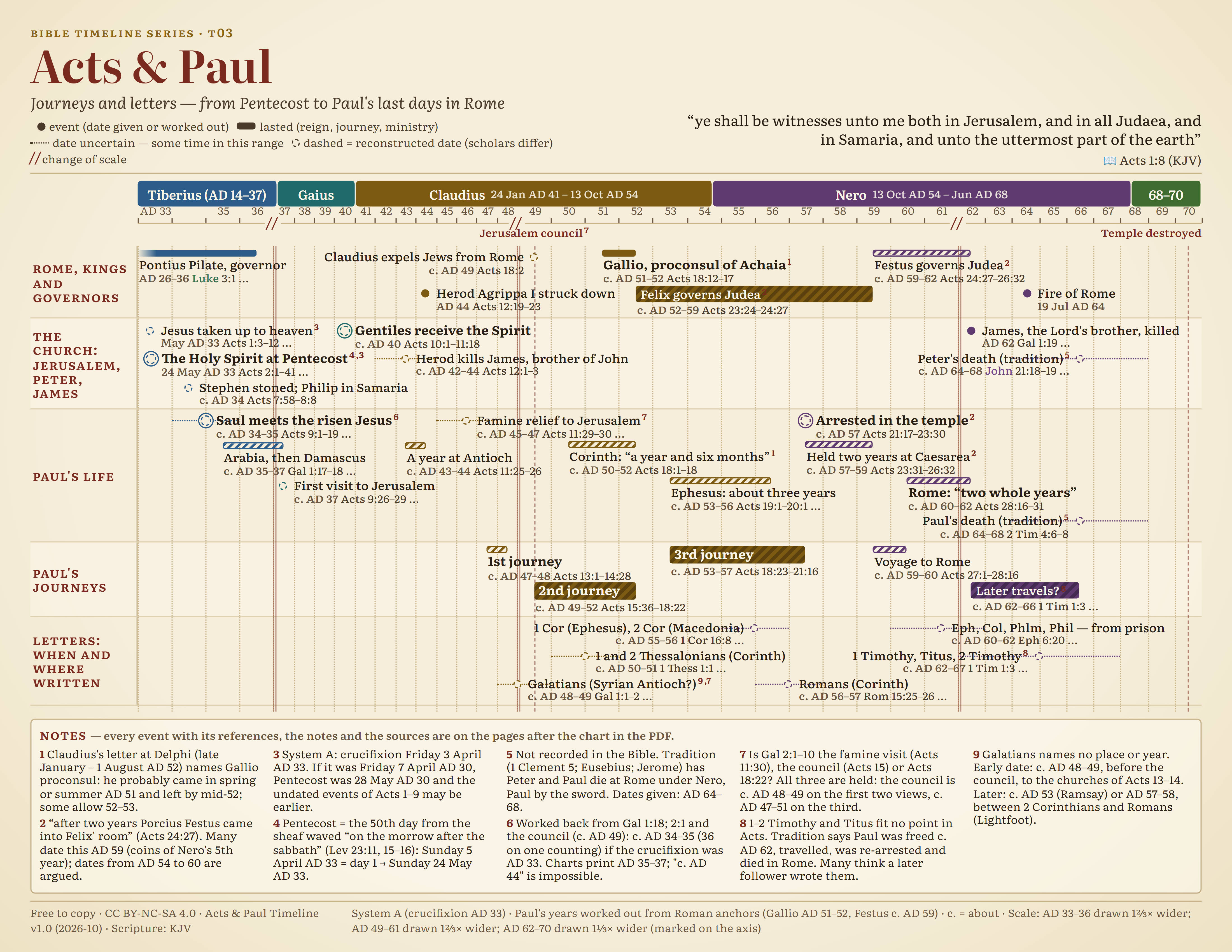

Acts & Paul
 Acts 1:8 (KJV)
Notes — every event with its references, the notes and the sources are on the pages after the chart in the PDF.
1Claudius's letter at Delphi (late January – 1 August AD 52) names Gallio proconsul: he probably came in spring or summer AD 51 and left by mid-52; some allow 52–53.
2after two years Porcius Festus came into Felix' room
(Acts 24:27). Many date this AD 59 (coins of Nero's 5th year); dates from AD 54 to 60 are argued.
3System A: crucifixion Friday 3 April AD 33. If it was Friday 7 April AD 30, Pentecost was 28 May AD 30 and the undated events of Acts 1–9 may be earlier.
4Pentecost = the 50th day from the sheaf waved on the morrow after the sabbath
(Lev 23:11, 15–16): Sunday 5 April AD 33 = day 1 → Sunday 24 May AD 33.
5Not recorded in the Bible. Tradition (1 Clement 5; Eusebius; Jerome) has Peter and Paul die at Rome under Nero, Paul by the sword. Dates given: AD 64–68.
6Worked back from Gal 1:18; 2:1 and the council (c. AD 49): c. AD 34–35 (36 on one counting) if the crucifixion was AD 33. Charts print AD 35–37; "c. AD 44" is impossible.
7Is Gal 2:1–10 the famine visit (Acts 11:30), the council (Acts 15) or Acts 18:22? All three are held: the council is c. AD 48–49 on the first two views, c. AD 47–51 on the third.
81–2 Timothy and Titus fit no point in Acts. Tradition says Paul was freed c. AD 62, travelled, was re-arrested and died in Rome. Many think a later follower wrote them.
9Galatians names no place or year. Early date: c. AD 48–49, before the council, to the churches of Acts 13–14. Later: c. AD 53 (Ramsay) or AD 57–58, between 2 Corinthians and Romans (Lightfoot).
Acts & Paul — Study notes
Every event on the chart, with its Bible references, certainty and notes. One chronology for the whole series: the Bible's own numbers with the main ancient records. "c." = about; a range (e.g. 6–4 BC) = some time in that range.
| Date | Event | Bible references | Lane | Cert. |
|---|---|---|---|---|
| Tiberius (AD 14–37) · AD 33 – 16 Mar AD 37 | ||||
| 9 BC – AD 40 | Aretas IV, king of the Nabataeans (to AD 40)10 His governor held Damascus when Paul escaped Sources: Richard Gottheil and Louis Ginzberg; Bryan Windle; F. F. Bruce |
2 Cor 11:32 | Rome, kings and governors | C |
| AD 14 – 16 Mar AD 37 | Tiberius emperor (died 16 March AD 37)11 Sources: Suetonius (tr. J. C. Rolfe) |
Luke 3:1 | Rome, kings and governors | C |
| AD 26–36 | Pontius Pilate, governor12 Sent to Rome by Vitellius after ten years Sources: Flavius Josephus |
Luke 3:1; Acts 3:13; 4:27 | Rome, kings and governors | C |
| May AD 33 | Jesus taken up to heaven213being seen of them forty days— about Thursday 14 May |
Acts 1:3–12; Luke 24:50–51 | The church: Jerusalem, Peter, James | D |
| May AD 33 | Matthias chosen in place of Judas21 | Acts 1:15–26 | The church: Jerusalem, Peter, James | B |
| 24 May AD 33 | The Holy Spirit at Pentecost43 Sunday 24 May AD 33; about three thousand soulsadded |
Acts 2:1–41; Lev 23:15–16 | The church: Jerusalem, Peter, James | D |
| c. AD 33 | Lame man healed; Peter and John arrested22 | Acts 3:1–4:31 | The church: Jerusalem, Peter, James | D |
| c. AD 34 | Ananias and Sapphira22 | Acts 5:1–11 | The church: Jerusalem, Peter, James | D |
| c. AD 34 | Apostles beaten; Gamaliel's advice22 | Acts 5:17–42 | The church: Jerusalem, Peter, James | D |
| c. AD 34 | Seven chosen to serve, Stephen and Philip22 | Acts 6:1–7 | The church: Jerusalem, Peter, James | D |
| c. AD 34 | Stephen stoned23 Saul was consenting unto his death |
Acts 6:8–8:4; 22:20 | The church: Jerusalem, Peter, James | D |
| c. AD 34 | Philip preaches in Samaria22 Peter and John follow (Acts 8:14) |
Acts 8:5–25 | The church: Jerusalem, Peter, James | D |
| c. AD 34 | Philip baptizes an Ethiopian official22 | Acts 8:26–40 | The church: Jerusalem, Peter, James | D |
| c. AD 34 | Saul persecutes the church23he made havock of the church(Acts 8:3) |
Acts 8:3; 9:1–2; 26:9–11; Gal 1:13 | Paul's life | D |
| c. AD 34–35 | Saul meets the risen Jesus628Saul, Saul, why persecutest thou me? Sources: Kenneth Berding (Talbot School of Theology); F. F. Bruce |
Acts 9:1–19; 22:6–16; 26:12–18; Gal 1:15–16; 1 Cor 15:8 | Paul's life | D |
| c. AD 35–37 | Arabia, then Damascus28after three yearshe went up to Jerusalem (Gal 1:18) |
Gal 1:17–18; Acts 9:19–25 | Paul's life | D |
| Gaius (Caligula) · 16 Mar AD 37 – 24 Jan AD 41 | ||||
| 16 Mar AD 37 – 24 Jan AD 41 | Gaius (Caligula) emperor11 Sources: Suetonius (tr. J. C. Rolfe) |
Rome, kings and governors | C | |
| c. AD 37 | Let down the wall in a basket at Damascus10 Sources: Richard Gottheil and Louis Ginzberg; Bryan Windle; F. F. Bruce |
Acts 9:23–25; 2 Cor 11:32–33 | Paul's life | D |
| c. AD 37 | First visit to Jerusalem28 Barnabas brings him to the apostles; he sees James the Lord's brother |
Acts 9:26–29; 22:17–21; Gal 1:18–19 | Paul's life | D |
| c. AD 37–43 | Tarsus, Syria and Cilicia28 Few details known (Acts 9:30; Gal 1:21) |
Acts 9:30; 11:25; Gal 1:21 | Paul's life | D |
| c. AD 38 | Peter at Lydda and Joppa; Dorcas raised24 | Acts 9:31–43 | The church: Jerusalem, Peter, James | D |
| c. AD 40 | Gentiles receive the Spirit24 Peter preaches in the house of Cornelius the centurion |
Acts 10:1–11:18 | The church: Jerusalem, Peter, James | D |
| Claudius · 24 Jan AD 41 – 13 Oct AD 54 | ||||
| 24 Jan AD 41 – 13 Oct AD 54 | Claudius emperor11 Named in Acts 11:28 and 18:2 Sources: Suetonius (tr. J. C. Rolfe) |
Acts 11:28; 18:2 | Rome, kings and governors | C |
| AD 41–44 | Herod Agrippa I, king of Judea13 King in the north from AD 37; Claudius adds Judea in AD 41 Sources: Flavius Josephus; F. F. Bruce |
Acts 12:1 | Rome, kings and governors | C |
| c. AD 41 | Greeks believe at Antioch24 | Acts 11:19–24 | The church: Jerusalem, Peter, James | D |
| c. AD 41 | Caught up to the third heaven29 2 Corinthians (c. AD 55–56) says above fourteen years ago→ c. AD 41–42 or earlier |
2 Cor 12:2 | Paul's life | D |
| c. AD 42–44 | Herod kills James, brother of John13 Before Peter's arrest at Passover (Acts 12:2–3) Sources: Flavius Josephus; F. F. Bruce |
Acts 12:1–3 | The church: Jerusalem, Peter, James | D |
| c. AD 42–44 | Peter freed from prison by an angel1325Then were the days of unleavened bread(Acts 12:3) Sources: Flavius Josephus; F. F. Bruce |
Acts 12:3–19 | The church: Jerusalem, Peter, James | D |
| c. AD 43–44 | A year at Antioch14 The disciples called Christians first in Antioch |
Acts 11:25–26 | Paul's life | D |
| AD 44 | Herod Agrippa I struck down13 The people shout: It is the voice of a god, and not of a man Sources: Flavius Josephus; F. F. Bruce |
Acts 12:19–23 | Rome, kings and governors | C |
| AD 44–52 | Roman governors again: Fadus to Cumanus14 Cuspius Fadus AD 44, Tiberius Alexander c. AD 45/46, Cumanus AD 48 Sources: Flavius Josephus; F. F. Bruce |
Rome, kings and governors | C | |
| AD 44–48 | Famine in Judea14 Agabus foretold great dearth throughout all the world Sources: Flavius Josephus; F. F. Bruce |
Acts 11:27–30 | Rome, kings and governors | C |
| c. AD 45–47 | Famine relief to Jerusalem147 Sent by the hands of Barnabas and Saul(Acts 11:30) Sources: Flavius Josephus; F. F. Bruce |
Acts 11:29–30; 12:25 | Paul's life | D |
| c. AD 47 | The deputy Sergius Paulus believes at Paphos3027Saul, (who also is called Paul,)— the name Paul from here on Sources: F. F. Bruce |
Acts 13:4–12 | Paul's life | D |
| c. AD 47 | John Mark leaves them at Perga27 | Acts 13:13; 15:38 | Paul's life | D |
| c. AD 47 | Antioch in Pisidia: we turn to the Gentiles27 |
Acts 13:14–52 | Paul's life | D |
| c. AD 47–48 | 1st journey2730 Cyprus and south Galatia, with Barnabas (and John Mark as far as Perga) Sources: Kenneth Berding (Talbot School of Theology) |
Acts 13:1–14:28 | Paul's journeys | D |
| c. AD 48 | Stoned at Lystra and left for dead27once was I stoned(2 Cor 11:25) |
Acts 14:8–20; 2 Cor 11:25 | Paul's life | D |
| c. AD 48 | long timewith the church at Antioch27 |
Acts 14:26–28 | Paul's life | D |
| c. AD 48–49 | Galatians (Syrian Antioch?)97 Early date; others put it c. AD 53, or between 2 Corinthians and Romans Sources: F. F. Bruce; Kenneth Berding (Talbot School of Theology); W. M. Ramsay; J. B. Lightfoot |
Gal 1:1–2; 2:1–14; 4:13 | Letters: when and where written | E |
| c. AD 49 | Claudius expels Jews from Rome15 Aquila and Priscilla move to Corinth (Acts 18:2) Sources: Suetonius (tr. J. C. Rolfe); Paulus Orosius; Cassius Dio (tr. E. Cary); F. F. Bruce |
Acts 18:2 | Rome, kings and governors | D |
| c. AD 49 | Council: Gentiles need not be circumcised267 James's judgment; a letter sent to Antioch, Syria and Cilicia |
Acts 15:1–35; Gal 2:1–10 | The church: Jerusalem, Peter, James | D |
| c. AD 49 | Paul withstands Peter at Antioch7 | Gal 2:11–14 | The church: Jerusalem, Peter, James | E |
| c. AD 49 | Barnabas takes Mark to Cyprus27 | Acts 15:36–39 | The church: Jerusalem, Peter, James | D |
| c. AD 49 | Paul and Barnabas report at the council26declaring what miracles and wonders God had wrought among the Gentiles |
Acts 15:2–4, 12 | Paul's life | D |
| c. AD 49 | Paul and Barnabas part; Silas joins Paul27 | Acts 15:36–41 | Paul's life | D |
| c. AD 49 | Timothy joins Paul at Lystra27 | Acts 16:1–3 | Paul's life | D |
| c. AD 49–52 | 2nd journey27 Galatia, Macedonia and Achaia, with Silas; Timothy joins at Lystra Sources: Kenneth Berding (Talbot School of Theology); F. F. Bruce |
Acts 15:36–18:22 | Paul's journeys | D |
| c. AD 50–93 | Herod Agrippa II, king16 King of Chalcis c. AD 50; Philip's former lands from AD 53 Sources: Flavius Josephus; F. F. Bruce |
Acts 25:13; 26:32 | Rome, kings and governors | C |
| c. AD 50 | Troas vision: Come over into Macedonia2731 The narrator's webegins (Acts 16:10) — by tradition Luke |
Acts 16:6–10 | Paul's life | D |
| c. AD 50 | Philippi: Paul and Silas jailed27 At midnight they prayed, and sang praises unto God |
Acts 16:11–40 | Paul's life | D |
| c. AD 50 | Thessalonica, then Berea27three sabbath daysin the synagogue at Thessalonica (Acts 17:2) |
Acts 17:1–15 | Paul's life | D |
| c. AD 50 | Athens: Paul speaks on Mars' hill27 | Acts 17:16–34 | Paul's life | D |
| c. AD 50–52 | Corinth: a year and six months321 With Aquila and Priscilla; then yet a good while(Acts 18:18) Sources: Adolf Deissmann (tr. L. R. M. Strachan); Kirsopp Lake; F. F. Bruce |
Acts 18:1–18 | Paul's life | D |
| c. AD 50–51 | 1 Thessalonians — from Corinth38 After Timothy's good report (1 Thess 3:6; Acts 18:5) |
1 Thess 1:1; 3:1–6; Acts 18:5 | Letters: when and where written | D |
| c. AD 50–51 | 2 Thessalonians — from Corinth38 Sources: Peter Kirby (Early Christian Writings) |
2 Thess 1:1; 2:2; 3:17 | Letters: when and where written | D |
| c. AD 51–52 | Gallio, proconsul of Achaia1 Dated by Claudius's letter found at Delphi Sources: Adolf Deissmann (tr. L. R. M. Strachan); Kirsopp Lake; F. F. Bruce; Seneca (tr. R. M. Gummere) |
Acts 18:12–17 | Rome, kings and governors | C |
| c. AD 51–52 | Gallio dismisses the case against Paul1Gallio cared for none of those things(Acts 18:17) Sources: Adolf Deissmann (tr. L. R. M. Strachan); Kirsopp Lake; F. F. Bruce |
Acts 18:12–17 | Paul's life | C |
| c. AD 52–59 | Felix governs Judea172 With his wife Drusilla (Acts 24:24) Sources: Flavius Josephus; Tacitus (tr. A. J. Church and W. J. Brodribb); F. F. Bruce |
Acts 23:24–24:27 | Rome, kings and governors | D |
| c. AD 52 | Apollos teaches at Ephesus, then Corinth27 | Acts 18:24–19:1 | The church: Jerusalem, Peter, James | D |
| c. AD 52 | To Jerusalem and Antioch via Ephesus277 | Acts 18:18–22 | Paul's life | D |
| c. AD 53–56 | Ephesus: about three years33 Teaching daily in the school of one Tyrannus(Acts 19:9) |
Acts 19:1–20:1, 31 | Paul's life | D |
| c. AD 53–57 | 3rd journey2735 Galatia, Ephesus, Macedonia and Greece; Paul hastened to be at Jerusalem for Pentecost if it were possible(Acts 20:16) Sources: Kenneth Berding (Talbot School of Theology) |
Acts 18:23–21:16 | Paul's journeys | D |
| c. AD 45–62 | Letter of James (date uncertain)39 Before AD 62 if written by the Lord's brother Sources: Flavius Josephus; Eusebius of Caesarea (tr. A. C. McGiffert, NPNF 2nd series vol. 1) |
Jas 1:1 | Letters: when and where written | E |
| Nero · 13 Oct AD 54 – Jun AD 68 | ||||
| 13 Oct AD 54 – Jun AD 68 | Nero emperor11 The Caesarto whom Paul appealed (Acts 25:11) Sources: Suetonius (tr. J. C. Rolfe); Cassius Dio (tr. E. Cary) |
Acts 25:11–12, 21 | Rome, kings and governors | C |
| c. AD 54–55 | An earlier letter to Corinth (lost)29 | 1 Cor 5:9 | Letters: when and where written | D |
| c. AD 55–56 | 1 Corinthians — from Ephesus29I will tarry at Ephesus until Pentecost(1 Cor 16:8) Sources: Kenneth Berding (Talbot School of Theology) |
1 Cor 16:8, 19 | Letters: when and where written | D |
| c. AD 55–56 | A letter written with many tears(lost?)29 |
2 Cor 2:3–4; 7:8 | Letters: when and where written | D |
| c. AD 55–56 | 2 Corinthians — from Macedonia29 After Titus brought news from Corinth (2 Cor 7:5–7) Sources: Kenneth Berding (Talbot School of Theology) |
2 Cor 2:12–13; 7:5–7; 8:1; 9:2–4 | Letters: when and where written | D |
| c. AD 56 | Riot of the silversmiths at Ephesus33 Demetrius stirs the city (Acts 19:24) |
Acts 19:23–41 | Paul's life | D |
| c. AD 56–57 | Macedonia, then three months in Greece34 | Acts 20:1–3; 2 Cor 2:12–13; 7:5–7 | Paul's life | D |
| c. AD 56–57 | Romans (Corinth)34 Phebe of Cenchrea; Gaius mine host(Rom 16:1, 23) Sources: Kenneth Berding (Talbot School of Theology); F. F. Bruce |
Rom 15:25–26; 16:1, 23; Acts 20:2–3 | Letters: when and where written | D |
| c. AD 57 | Troas: Eutychus falls from the window35 | Acts 20:6–12 | Paul's life | D |
| c. AD 57 | Farewell to the Ephesian elders at Miletus35 | Acts 20:15–38 | Paul's life | D |
| c. AD 57 | Arrested in the temple235 About Pentecost (Acts 20:16); a Roman citizen (Acts 22:25–29) Sources: F. F. Bruce; W. M. Ramsay |
Acts 21:17–23:30 | Paul's life | D |
| c. AD 57–59 | Held two years at Caesarea2 Felix left Paul bound(Acts 24:27) |
Acts 23:31–26:32 | Paul's life | D |
| c. AD 57 | Paul before Felix and Drusilla2Felix trembled(Acts 24:25) |
Acts 24:1–27 | Paul's life | D |
| c. AD 59–62 | Festus governs Judea2 Died in office (Josephus) Sources: Flavius Josephus; F. F. Bruce; Roman Provincial Coinage Online (Ashmolean Museum, Oxford); Harvard Art Museums |
Acts 24:27–26:32 | Rome, kings and governors | D |
| c. AD 59 | I appeal unto Caesar2 |
Acts 25:1–12 | Paul's life | D |
| c. AD 59 | Paul's defence before King Agrippa II16Almost thou persuadest me to be a Christian |
Acts 25:13–26:32 | Paul's life | D |
| c. AD 59 | Shipwreck on Melita (Malta)36 Three months on the island (Acts 28:11) Sources: W. M. Ramsay; F. F. Bruce |
Acts 27:9–28:11 | Paul's life | D |
| c. AD 59–60 | Voyage to Rome3631 With Aristarchus and the narrator ( we— by tradition Luke); the centurion Julius (Acts 27:1–2) Sources: W. M. Ramsay; F. F. Bruce |
Acts 27:1–28:16 | Paul's journeys | D |
| c. AD 60–62 | Rome: two whole years37 Under guard, no man forbidding him(Acts 28:31) Sources: F. F. Bruce; Kenneth Berding (Talbot School of Theology) |
Acts 28:16–31 | Paul's life | D |
| c. AD 60–62 | Ephesians — from prison (Rome?)40 Carried by Tychicus (Eph 6:21–22) Sources: J. B. Lightfoot; Kenneth Berding (Talbot School of Theology); Peter Kirby (Early Christian Writings) |
Eph 3:1; 4:1; 6:20–22 | Letters: when and where written | D |
| c. AD 60–62 | Colossians — from prison (Rome?)40 Tychicus and Onesimus carry it (Col 4:7–9) Sources: J. B. Lightfoot; Kenneth Berding (Talbot School of Theology) |
Col 4:3, 7–10, 18 | Letters: when and where written | D |
| c. AD 60–62 | Philemon — from prison (Rome?)40 For Onesimus, who had left his master (Phlm 10–16) Sources: J. B. Lightfoot; Adolf Deissmann (tr. L. R. M. Strachan); Kenneth Berding (Talbot School of Theology) |
Phlm 1, 9–16, 22–24 | Letters: when and where written | D |
| c. AD 61–62 | Philippians — from prison (Rome?)40they that are of Caesar's household(Phil 4:22) Sources: J. B. Lightfoot; Kenneth Berding (Talbot School of Theology) |
Phil 1:7, 12–14; 2:19–30; 4:22 | Letters: when and where written | D |
| AD 62–64 | Albinus governor of Judea18 Sources: Flavius Josephus |
Rome, kings and governors | C | |
| AD 62 | James, the Lord's brother, killed18 Stoned on the high priest Ananus's orders (Josephus) Sources: Flavius Josephus; Eusebius of Caesarea (tr. A. C. McGiffert, NPNF 2nd series vol. 1) |
Gal 1:19; Acts 15:13; 21:18 | The church: Jerusalem, Peter, James | C |
| c. AD 62–66 | Later travels?8 Only in the Pastoral letters (1 Tim 1:3; Titus 1:5; 3:12; 2 Tim 4:13, 20) Sources: Eusebius of Caesarea (tr. A. C. McGiffert, NPNF 2nd series vol. 1); Kenneth Berding (Talbot School of Theology) |
1 Tim 1:3; Titus 1:5; 3:12; 2 Tim 4:13, 20 | Paul's journeys | E |
| c. AD 62–64 | 1 Timothy — from Macedonia?8 Sources: Eusebius of Caesarea (tr. A. C. McGiffert, NPNF 2nd series vol. 1); Kenneth Berding (Talbot School of Theology); Peter Kirby (Early Christian Writings) |
1 Tim 1:3; 3:14–15 | Letters: when and where written | E |
| c. AD 62–64 | Titus — place of writing not stated8 Paul plans to winter at Nicopolis (Titus 3:12) Sources: Kenneth Berding (Talbot School of Theology); Peter Kirby (Early Christian Writings) |
Titus 1:5; 3:12 | Letters: when and where written | E |
| c. AD 62–64 | 1 Peter — from Babylon(Rome?)39 Sources: Eusebius of Caesarea (tr. A. C. McGiffert, NPNF 2nd series vol. 1) |
1 Pet 1:1; 5:12–13 | Letters: when and where written | E |
| c. AD 62–66 | To Spain? (planned in Romans; tradition)8I will come by you into Spain(Rom 15:28) Sources: Clement of Rome (tr. J. B. Lightfoot; also Keith, ANF 9); Unknown (tr. S. D. F. Salmond, ANF 5) |
Rom 15:24, 28 | Paul's journeys | E |
| 19 Jul AD 64 | Fire of Rome19 The fire began on 19 July AD 64; afterwards Nero punished the Christians (Tacitus) Sources: Tacitus (tr. A. J. Church and W. J. Brodribb); Suetonius (tr. J. C. Rolfe) |
Rome, kings and governors | C | |
| c. AD 60–70 | Hebrews — author not named39 c. AD 60–70 if written while the Temple stood (priests offer gifts, Heb 8:4; Timothy set at liberty, 13:23); many date it c. AD 80–95 Sources: Eusebius of Caesarea (tr. A. C. McGiffert, NPNF 2nd series vol. 1) |
Heb 8:4; 10:1–2; 13:23–24 | Letters: when and where written | E |
| c. AD 64–67 | Imprisoned again in Rome (tradition)8 Sources: Eusebius of Caesarea (tr. A. C. McGiffert, NPNF 2nd series vol. 1) |
2 Tim 1:8, 16–17; 4:6–18 | Paul's life | E |
| c. AD 64–67 | 2 Timothy (prison, Rome)8the time of my departure is at hand(2 Tim 4:6) Sources: Eusebius of Caesarea (tr. A. C. McGiffert, NPNF 2nd series vol. 1); Kenneth Berding (Talbot School of Theology); Peter Kirby (Early Christian Writings) |
2 Tim 1:8, 16–17; 4:6–21 | Letters: when and where written | E |
| May AD 66 | Jewish revolt begins20 Nero's 12th year, month Artemisius (about April–May) Sources: Flavius Josephus |
Rome, kings and governors | C | |
| c. AD 64–68 | Peter's death (tradition)5 Foretold in John 21:18–19; 2 Pet 1:14 Sources: Clement of Rome (tr. J. B. Lightfoot; also Keith, ANF 9); Eusebius of Caesarea (tr. A. C. McGiffert, NPNF 2nd series vol. 1); Jerome (tr. E. C. Richardson, NPNF 2nd series vol. 3; Latin text on Wikisource); Jerome (Latin version of Eusebius's Chronicle; tr. R. Pearse and others 2005 from Fotheringham's text) |
John 21:18–19; 2 Pet 1:14 | The church: Jerusalem, Peter, James | E |
| c. AD 64–68 | Paul's death (tradition)5I have finished my course(2 Tim 4:7) Sources: Clement of Rome (tr. J. B. Lightfoot; also Keith, ANF 9); Eusebius of Caesarea (tr. A. C. McGiffert, NPNF 2nd series vol. 1); Jerome (tr. E. C. Richardson, NPNF 2nd series vol. 3; Latin text on Wikisource); Jerome (Latin version of Eusebius's Chronicle; tr. R. Pearse and others 2005 from Fotheringham's text) |
2 Tim 4:6–8 | Paul's life | E |
| c. AD 64–68 | 2 Peter — written as Peter's farewell39 Many scholars think it was written after Peter's death, in his name |
2 Pet 1:14; 3:15–16 | Letters: when and where written | E |
| After Nero · Jun AD 68 – AD 70 | ||||
| AD 70 | Jerusalem and the Temple destroyed20 Foretold by Jesus (Matt 24:1–2; Luke 21:5–6, 20) Sources: Flavius Josephus |
Matt 24:1–2; Luke 21:5–6, 20 | Rome, kings and governors | C |
Certainty: A Stated in Scripture · B Worked out from Scripture · C Ancient record or astronomy · D Scholarly reconstruction · E Tradition / uncertain — scholars differ.
Acts & Paul — notes and sources
How the dates were worked out
Dates follow the series' System A: the crucifixion on Friday 3 April AD 33 (14 Nisan). Pentecost (Sunday 24 May AD 33) and the forty days before the Ascension are computed from it. Acts gives no years, so Paul's dates are worked out from outside anchors, each read in the ancient text: Aretas IV died c. AD 40; Herod Agrippa I died in AD 44; the famine came under the governors of AD 44–48; Orosius dates Claudius' expulsion of the Jews from Rome to AD 49 (some prefer AD 41); Gallio was proconsul of Achaia from about mid-51 to mid-52 (the Delphi inscription); Felix was sent about AD 52; Festus came about AD 59 (coins of Nero's fifth year); Festus was dead and Albinus on his way in AD 62; Rome burned from 19 July AD 64. Between these anchors the numbers given by Paul and by Luke set the order and the lengths (Gal 1:18; 2:1; Acts 18:11; 19:10; 20:31; 24:27; 28:30). Most of Paul's dates are therefore "about" (c.) and grade D; the Pastoral letters and the deaths of Peter and Paul rest on tradition (grade E). If Festus came in AD 60, everything from Paul's arrest to his two years in Rome moves one year later. Calendar days are Julian. Scale: AD 33–36 drawn 1⅔× wider; AD 49–61 drawn 1⅔× wider; AD 62–70 drawn 1⅓× wider (marked on the axis).
Dated lines on the chart
Jerusalem council267 — c. AD 49 (Acts 15:1–35; Cert. D)
Temple destroyed20 — AD 70 (Matt 24:1–2; Luke 21:5–6; Cert. C)
 Notes
Notes
1 Claudius's letter at Delphi (late January – 1 August AD 52) names Gallio proconsul: he probably came in spring or summer AD 51 and left by mid-52; some allow 52–53. The letter is dated by Claudius's 12th tribunician year and 26th acclamation as imperator; his 27th is attested by 1 August AD 52 (aqueduct inscription CIL VI 1256; Frontinus). Deissmann (1912, with H. Dessau): the letter falls between "the beginning of 52 and 1 August, 52", so Gallio "entered on his proconsulship in the summer (nominally 1 July?) of 51", and Paul came to Corinth "in the first months of the year 50". Bruce (1986): the wording suggests Gallio "was proconsul of Achaia, but is so no longer"; Claudius made governors leave Rome by mid-April (Dio 60.17.3), so Gallio began "not later than May, A.D. 51" and ill health (Seneca, Epistles 104.1) cut his term short; Paul's 18 months ran "from the Fall of A.D. 50 to the Spring or early Summer of 52". Lake (1933) is more cautious: Gallio held office in the year from January 52, "but we do not know whether he became proconsul in that year or in the year previous (51)". (Acts 18:11–17)
2 after two years Porcius Festus came into Felix' room
(Acts 24:27). Many date this AD 59 (coins of Nero's 5th year); dates from AD 54 to 60 are argued. For AD 59: a new coin issue of Nero's 5th year (AD 58/59) is "more likely to be the work of a new procurator" (E. M. Smallwood, quoted by Bruce 1986); RPC I 4972 dates the issue AD 59 and Harvard Art Museums 2008.2.58 labels it "Coin of the Roman Procurator Porcius Festus"; Ramsay's "the Fast" of AD 59 (5 October) and Plooij (named by Lake) also give 59. For AD 55/56: Eusebius's Chronicle (Jerome: Nero's 2nd year = AD 56; the Armenian: Claudius's 14th = AD 54); Felix was saved by his brother Pallas (Josephus, Antiquities 20.8.9), who lost his office in AD 55 (Tacitus, Annals 13.14) — but Bruce notes Pallas's influence lasted till AD 62. Lake (1933) chose 55 or 56, reading "two years" as Felix's term, not Paul's custody. C. Erbes corrected Eusebius's "second" to "sixth" year of Nero (= AD 60) (named by Bruce). Festus died in office in AD 62 after "not more than two or three years" (Bruce), which tells against an early date. Paul's arrest is two years before. (Acts 24:27)
3 System A: crucifixion Friday 3 April AD 33. If it was Friday 7 April AD 30, Pentecost was 28 May AD 30 and the undated events of Acts 1–9 may be earlier. The year of the crucifixion is the series' System A choice (Data\Chronology\System_A.yaml; Docs/04). AD 30 is the other astronomically possible year and is held by many scholars (K. Lake in 1933 wrote that "modern scholars generally accept 29 or 30"). Paul's later dates do not depend on it: they hang on outside anchors (Agrippa I AD 44, Gallio AD 51–52, Festus c. AD 59). Only the spacing of Acts 1–9 changes. (Acts 2:1)
4 Pentecost = the 50th day from the sheaf waved on the morrow after the sabbath
(Lev 23:11, 15–16): Sunday 5 April AD 33 = day 1 → Sunday 24 May AD 33. Computed (Julian calendar): Friday 3 April AD 33 = 14 Nisan; Saturday 4 April = 15 Nisan, both the first day of unleavened bread and the weekly Sabbath; Sunday 5 April = 16 Nisan = day 1; day 50 = 5 April + 49 days = Sunday 24 May AD 33 (JDN 1733206 + 49 = 1733255). Josephus (Antiquities 3.10.5–6) puts the sheaf on 16 Nisan, "the second day of unleavened bread", and Pentecost on "the fiftieth day"; the Boethusians (Mishnah Menachot 10:3) counted from the Sunday after the weekly Sabbath. In AD 33 (and in AD 30) both ways give the same Sunday, because 15 Nisan fell on a Saturday. AD 30: Sunday 9 April = day 1 → Sunday 28 May AD 30. (In a year like AD 57 the two ways differ by a day: Saturday 28 or Sunday 29 May — computed, and as F. F. Bruce gives it.) "50 days after the death of Christ" or "after Passover" are common errors. (Lev 23:11, 15–16; Acts 2:1)
5 Not recorded in the Bible. Tradition (1 Clement 5; Eusebius; Jerome) has Peter and Paul die at Rome under Nero, Paul by the sword. Dates given: AD 64–68. 1 Clement 5 (c. AD 96; Lightfoot): Peter and Paul among "the noble examples which belong to our generation", no year or place given. Eusebius, Church History 2.25.5: "Paul was beheaded in Rome itself, and ... Peter likewise was crucified under Nero"; 2.25.8 (from Dionysius of Corinth): "at the same time"; 3.1: Peter "crucified head-downwards" (from Origen). Jerome, Lives 5: Paul was beheaded "in the fourteenth year of Nero on the same day with Peter" (Nero's 14th year = 13 Oct AD 67 – June 68); the Latin adds "anno post passionem Domini tricesimo septimo" (37th year — the NPNF English wrongly prints "twenty-seventh"). Jerome's Chronicle: Nero's 14th year; the Armenian Eusebius: Nero's 13th. Tacitus puts Nero's punishment of Christians after the fire of July AD 64. Paul's own words: the time of my departure is at hand
(2 Tim 4:6). (John 21:18–19; 2 Tim 4:6–8)
6 Worked back from Gal 1:18; 2:1 and the council (c. AD 49): c. AD 34–35 (36 on one counting) if the crucifixion was AD 33. Charts print AD 35–37; "c. AD 44" is impossible. Arithmetic (council c. AD 49 = Gal 2:1): fourteen years counted from the conversion → AD 35 (36 if counted inclusively); counted after the first visit (3 + 14) → only possible with inclusive counting: 49 − 13 − 2 = AD 34. K. Berding (2021, AD 33 crucifixion) gives AD 34 and the same two ways of counting; F. F. Bruce (1986) says "most students" date the conversion "in the early 30s". AD 36 needs the fourteen years counted inclusively from the conversion with the council in AD 49; the chart shows the range the other countings give. A conversion in AD 44 (printed on one page of a popular chart book) would put the council in AD 57 at the earliest — the year of Paul's arrest. Outside check: the escape from Damascus (Acts 9:25; 2 Cor 11:32–33) came just before the visit "after three years" (Gal 1:18) and before Aretas IV died (AD 40). (Gal 1:15–18; 2:1; Acts 9:1–25)
7 Is Gal 2:1–10 the famine visit (Acts 11:30), the council (Acts 15) or Acts 18:22? All three are held: the council is c. AD 48–49 on the first two views, c. AD 47–51 on the third. With an AD 33 crucifixion the famine-visit view needs the "fourteen years" to run from the conversion and a late visit (c. AD 47): conversion AD 33/34 + 13 or 14 years. The council view fits both ways of counting (see the note on Gal 1:18 and 2:1); Lightfoot held it (Lake 1933). J. Knox and G. Lüdemann identify Gal 2:1–10 with the visit of Acts 18:22 and build a different chronology, with the meeting c. AD 51 (Knox) or AD 47/50 (Lüdemann) (Bruce 1986, who rejects it: "The dating of Paul's first stay in Corinth between 50 and 52 cannot be so easily overthrown"). Galatians does not mention the council's letter (Acts 15:23–29) — one argument for the early view. (Gal 2:1–10; Acts 11:29–30; 15:1–29; 18:22)
8 1–2 Timothy and Titus fit no point in Acts. Tradition says Paul was freed c. AD 62, travelled, was re-arrested and died in Rome. Many think a later follower wrote them. Eusebius, Church History 2.22.2 (McGiffert): "after he had made his defense it is said that the apostle was sent again upon the ministry of preaching, and that upon coming to the same city a second time he suffered martyrdom. In this imprisonment he wrote his second epistle to Timothy". 1 Clement 5 (c. AD 96) says Paul reached "the farthest bounds of the West"; the Muratorian fragment speaks of Paul's journey "from the city — Rome — to Spain" (Rom 15:24, 28). Berding (2021): release AD 62–64?, last imprisonment and death AD 65?. Against: N. Perrin and W. G. Kümmel (quoted by Kirby) argue the Pastorals were written after Paul's time ("Paul's situation as envisaged in the Pastorals can in no way be fitted into any reconstruction of Paul's life" — Perrin). (1 Tim 1:3; Titus 1:5; 3:12; 2 Tim 4:6–21; Rom 15:24, 28)
9 Galatians names no place or year. Early date: c. AD 48–49, before the council, to the churches of Acts 13–14. Later: c. AD 53 (Ramsay) or AD 57–58, between 2 Corinthians and Romans (Lightfoot). Who were "the churches of Galatia" (Gal 1:2) — the south-Galatian cities of Acts 13–14 or the ethnic Galatians of the north (Acts 16:6; 18:23)? W. M. Ramsay (1895) argued for the south against "the dominant North-Galatian theory" but still dated the letter "A.D. 53 ... just when he was starting on his third journey". J. B. Lightfoot (10th ed. 1890) put it "between the Second to the Corinthians and the Romans ... from Macedonia or Achaia, in the winter or spring of the years 57, 58 A.D." (his chronology is a year later than this chart's: about AD 56–57 on this chart's years). F. F. Bruce (1986) holds that Galatians "is some years earlier than the Corinthian and Roman correspondence"; Berding (2021): AD 49, "from Antioch?". The chart shows the early date with grade E. (Gal 1:2; 4:13; Acts 13:14–14:23; 16:6; 18:23)
10 Damascus was guarded by the governor under Aretas the king
(2 Cor 11:32): Aretas IV of Nabataea, who died c. AD 40 — so Paul escaped before AD 40. Aretas IV reigned about 9 BC – AD 40 (Jewish Encyclopedia 1906; Bruce 1986; Windle 2023, citing Barkay 2019 for dated coins over his 48 years: 9 BC + 48 years = AD 40, no year 0). Whether his "ethnarch" ruled the city or only the Nabataean colony in Damascus is debated (Bruce: "probably the head of the Nabataean colony"); the date limit holds either way. Bruce thinks the escape "is probably to be dated before A.D. 37". (2 Cor 11:32–33; Acts 9:23–25)
11 Suetonius: Tiberius died 16 March AD 37; Gaius was killed 24 January AD 41; Claudius died 13 October AD 54. Nero died in June AD 68 (Suetonius, Dio). Suetonius (Rolfe): Tiberius 73 "on the seventeenth day before the Kalends of April, in the consulship of Gnaeus Acerronius Proculus and Gaius Pontius Nigrinus" (AD 37); Caligula 58–59 "on the ninth day before the Kalends of February", after ruling "three years, ten months and eight days" (16 Mar 37 + 3 y 10 m 8 d = 24 Jan 41); Claudius 45 "on the third day before the Ides of October in the consulship of Asinius Marcellus and Acilius Aviola" (AD 54), "the fourteenth of his reign"; Nero 57 died "on the anniversary of the murder of Octavia". Dio 63.29.3: Nero "ruled thirteen years and eight months" (from 13 Oct 54 → June 68).
12 Josephus: Pilate "tarried ten years in Judea"; Vitellius sent him to Rome, but Tiberius died (16 March AD 37) before he arrived. So Pilate governed AD 26–36. (Acts 3:13; 4:27)
13 Josephus: Agrippa I died at Caesarea after reigning "three years over all Judea" (given him in AD 41) → AD 44. James's death and Peter's arrest came before (AD 42–44). Josephus, Antiquities 19.8.2 (Whiston): "when Agrippa had reigned three years over all Judea, he came to the city Caesarea ... exhibited shows in honor of Caesar"; the people cried "that he was a god"; he died after five days, "in the fifty-fourth year of his age, and in the seventh year of his reign; for he reigned four years under Caius Caesar ... three years under the reign of Claudius". Gaius ruled March AD 37 – January AD 41, so the 7th year ends in AD 44. The Passover of Acts 12:3–4 came before the death. Bruce (1986): if the games were Caesarea's festival of 5 March, Agrippa was dead before Passover AD 44 and the arrest was in AD 42 or 43 ("the year 42 or 43 is most probable"); if they were for Claudius's birthday (1 August), Passover AD 44 is possible. Lake (1933): "the spring of 43 or 44". (Acts 12:1–23)
14 in the days of Claudius Caesar
(Acts 11:28). Josephus: a great famine in Judea under the governors Fadus and Tiberius Alexander (AD 44–48), at its worst c. 45–48. Josephus, Antiquities 20.5.2: "Under these procurators that great famine happened in Judea, in which queen Helena bought corn in Egypt"; 20.2.5: Helena of Adiabene sent to Alexandria for grain and to Cyprus for dried figs. Bruce (1986): the manuscripts read "under these" (Fadus c. 44–45 and Tiberius Alexander c. 45–48), the Epitome "under him" (Alexander); "There was an urgent need in Judaea between 45 and 48"; J. Jeremias added that AD 47–48 was a sabbatical year. Lake (1933): "not earlier than 46". So the relief visit (Acts 11:30) is c. AD 45–47 (Berding 2021 puts it in AD 44). (Acts 11:27–30)
15 Acts 18:2; Suetonius: Jews expelled for riots "at the instigation of Chrestus". Orosius (AD 417) dates it to Claudius's 9th year = AD 49; some prefer AD 41 (Dio). Suetonius, Claudius 25.4 (Rolfe): "Since the Jews constantly made disturbances at the instigation of Chrestus, he expelled them from Rome" — no year given; Rolfe notes "Chrestus" may be "another form of Christus". Orosius 7.6.15 (Latin): "Anno eiusdem nono expulsos per Claudium urbe Iudaeos Iosephus refert" — "in his ninth year ... Josephus reports", but no such passage survives in Josephus (Bruce: Orosius "may have quoted from an interpolated text of Josephus, or he may simply have made a mistake"). Claudius's 9th year = 25 January AD 49 – 24 January AD 50. Cassius Dio 60.6.6 (AD 41): Claudius "did not drive them out" but forbade their meetings. G. Lüdemann dates the expulsion AD 41; Bruce (following E. M. Smallwood) sees two separate measures, AD 41 and c. 49, and calls 49 "quite probably true" (Bruce 1986). (Acts 18:2)
16 Agrippa II, son of Agrippa I: king of Chalcis c. AD 50, then of Philip's former lands from AD 53 (Josephus); king through the revolt of AD 66–70 and after it; died c. AD 92/93 (or c. AD 100). Josephus, Antiquities 20.5.2: Herod of Chalcis died in Claudius's 8th year (AD 48) and Claudius gave his kingdom to "Agrippa, junior"; 20.7.1: when Claudius "had already completed the twelfth year of his reign" (after 24 January AD 53) he gave Agrippa Philip's tetrarchy and took Chalcis "when he had been governor thereof four years". Jewish War 2.14.4: the war began in Nero's 12th year, "the seventeenth of the reign of Agrippa" (AD 66 → year 1 = AD 50). Bruce (1986): Nero added Tiberias and Taricheae; as appointer of the high priest he was "an influential person among the Jews". He kept his kingdom after the war; his death is dated c. AD 92/93 from coins and inscriptions, or AD 100 by Photius (citing Justus of Tiberias). (Acts 25:13; 26:28–32)
17 Claudius sent Felix after Cumanus (c. AD 52; Josephus); Tacitus has him ruling Samaria already. Paul: of many years a judge unto this nation
(Acts 24:10). Josephus, Antiquities 20.7.1 "So Claudius sent Felix" — just before the grant to Agrippa II made when Claudius "had already completed the twelfth year of his reign" (after 24 January AD 53). Tacitus, Annals 12.54 (events of AD 52): Felix "had for some time been governor of Judæa"; Samaria under Felix, Galilee under Cumanus. Bruce (1986): appointment as procurator of all Judea "may thus be dated in 52"; Drusilla's marriage to Felix "cannot be dated earlier than A.D. 54". (Acts 24:10, 24)
18 Josephus (Antiquities 20.9.1): after Festus died and before Albinus arrived, Ananus had "the brother of Jesus, who was called Christ, whose name was James" stoned — AD 62. Albinus was in office by the Feast of Tabernacles "four years before the war began" (Jewish War 6.5.3) — autumn AD 62; the war began in AD 66 (Nero's 12th year). So Festus died and James was killed in AD 62 (Bruce 1986: "the generally accepted date of A.D. 62 ... cannot be wide of the mark"). Jerome (Chronicle; Lives 2) puts it in Nero's 7th year (AD 60/61). (Gal 1:19)
19 Tacitus (Annals 15.41, 15.44): the fire began on 19 July AD 64; Nero blamed the Christians and put many to death. Suetonius (Nero 16) records the punishment too.
20 Josephus: the war began in AD 66 (Nero's 12th year); the Temple was burned on the 10th of the month Lous (Ab), AD 70 — as Jesus foretold (Luke 21:6). (Luke 21:5–6, 20)
21 being seen of them forty days
(Acts 1:3). Day 40 from Sunday 5 April is Thursday 14 May AD 33, the traditional Ascension Day; Acts gives no exact day. Computed: 5 April AD 33 (day 1) + 39 days = Thursday 14 May (JDN 1733245); counted "40 days after" it would be Friday 15 May. The text says Jesus was seen over forty days and that the Spirit would come not many days hence
(Acts 1:5). Luke 24:50 says as far as to Bethany
; Acts 1:12 names the mount called Olivet
— Bethany lies on that hill. (Acts 1:3, 5, 12; Luke 24:50)
22 Acts 3–8 gives no years. These events fall between Pentecost (AD 33) and Saul's conversion (c. AD 34–35); their spacing on the chart is estimated. (Acts 3:1; 6:1; 9:1)
23 Acts does not date Stephen's death; it came before Saul's conversion (Acts 8:1; 22:20). With System A that means c. AD 34; with AD 30, c. AD 31–34. (Acts 7:58–8:1; 22:20)
24 Acts 10 is not dated. It falls between Saul's first visit to Jerusalem (Acts 9:26, c. AD 37) and Agrippa I's persecution (Acts 12, c. AD 42–44); charts print c. AD 40. Bruce (1986): the conversion of Cornelius "must antedate the events of Acts 12", and the first approaches to Gentiles (the Ethiopian, Cornelius, the Greeks of Antioch) were "probably" made "independently around the same time". (Acts 9:26–31; 10:1; 11:20; 12:1)
25 KJV intending after Easter
(Acts 12:4) means after the Passover feast — verse 3: Then were the days of unleavened bread.
(Acts 12:3–4)
26 The council (Acts 15) is dated c. AD 48–49 — after the 1st journey and before Paul reached Corinth on the 2nd journey (c. AD 50; Gallio AD 51–52). Berding (2021): council AD 49. Lake (1933), who identified the council with the famine visit, put it as early as AD 46. (Acts 14:26–15:2; 18:1, 12)
27 Acts does not number Paul's journeys or give their years. The years are worked out from the Gallio anchor and Acts' time words; charts differ by a year or two. Berding (2021): 1st journey 47–48, 2nd 49–52, 3rd 52–57. Popular charts print 46–48 / 49–52 / 53–57 or 47–49 / 49–51 / 52–57 (Docs/08 and the workshop's survey of existing charts). "Three missionary journeys" is a modern way of dividing Acts. (Acts 13:1–21:16)
28 Gal 1:18 after three years
; Gal 2:1 fourteen years after
. Counted from the conversion, or one after the other (3 + 14); ancient counting was often inclusive. Inclusive counting (the starting year counted as year 1) makes "after three years" about 2+ years and "fourteen years" about 13+. So the conversion-to-Gal 2 interval is 13 to 17 years. Bruce (1986): "It is disputed whether the 'fourteen years' of Gal. 2:1 are reckoned from the same point of departure as Paul's earlier Jerusalem visit 'after three years' (Gal. 1:18) or from that earlier visit itself." Both readings are held; neither is stated in the text. (Gal 1:18; 2:1)
29 Paul wrote to Corinth at least three times: an earlier letter (1 Cor 5:9), 1 Corinthians and 2 Corinthians. Most scholars add a fourth, the letter written with many tears
(2 Cor 2:4). 2 Corinthians was written from Macedonia after Titus came (2 Cor 7:5–7), about a year after Achaia was ready a year ago
(2 Cor 9:2). 2 Cor 12:2 above fourteen years ago
counted back from c. AD 55–56 gives a vision c. AD 41–42 or earlier. The letter with many tears
(2 Cor 2:4; 7:8): most think it lost; some find it in 2 Cor 10–13; older writers took it to be 1 Corinthians. The closing line printed in the KJV after 1 Cor 16:24, "written from Philippi", is a later scribe's note, not part of the letter: 1 Cor 16:8 and 16:19 show Paul was at Ephesus, in Asia. (1 Cor 5:9; 2 Cor 2:3–4; 7:5–8; 9:2; 12:2)
30 Acts calls him Saul until Paphos: Saul, (who also is called Paul,)
(Acts 13:9). The name Paul was not given at his conversion. (Acts 13:9)
31 Acts does not name its author. From the late 2nd century (Irenaeus) tradition names Luke, Paul's companion (Col 4:14; Phlm 24; 2 Tim 4:11), as the narrator of the we
passages. The we
passages: Acts 16:10–17; 20:5–21:18; 27:1–28:16. Many scholars accept Luke; others read the we
as a travel diary used by the author or as a literary style. (Acts 16:10–17; 20:5–6; 27:1; Col 4:14; Phlm 24; 2 Tim 4:11)
32 Acts 18:11 a year and six months
, then yet a good while
(18:18). Aquila was lately come from Italy
(18:2) → Paul in Corinth c. AD 50–52. (Acts 18:2, 11, 18)
33 Acts 19:8, 10: three months, then two years
, and more (19:22). Paul calls it by the space of three years
(Acts 20:31) — counted inclusively. (Acts 19:8–10, 22; 20:31)
34 Written in the three months in Greece (Acts 20:2–3) as Paul set out with the collection for Jerusalem (Rom 15:25–26) — winter AD 56/57, months before his arrest. (Acts 20:2–3; Rom 15:25–26; 16:1, 23)
35 Paul hurried to be at Jerusalem the day of Pentecost
(Acts 20:16). Ramsay dated this trip AD 57 from the weekdays of Acts 20:6–7; Bruce agrees but calls it unproved. Ramsay (1895): "In A.D. 57 Passover fell on Thursday, April 7. The company left Philippi on the morning of Friday, April 15" (computed weekdays agree: 7 April 57 = Thursday, 15 April = Friday, 24 April = Sunday). Bruce (1986): "I believe that A.D. 57 was indeed the year in question, but this cannot be established conclusively by Ramsay's argument"; Pentecost AD 57 fell on "28/29 May". Lake (1933) also doubts the argument. (Acts 20:6–7, 16)
36 Sailing was dangerous because the fast was now already past
(Acts 27:9) — the Day of Atonement (10 Tishri): about 5 October in AD 59 (computed; Ramsay, Bruce). Computed from the full moons (Meeus): in AD 59 the Passover full moon was 16 April (the 18 March one fell before the equinox), so Tishri's full moon was 9 October and 10 Tishri about 4–5 October. In AD 58 it was about 16 September, in AD 60 about 23 September. The calendar was set by observation and a leap month, so ±1 day (or a month). Ramsay (1895): "The great Fast fell in 59 on Oct. 5"; Bruce (1986): "just about as late as it was possible for it to fall"; the dangerous season ran from 14 September to 11 November (Vegetius, cited by both). (Acts 27:9–12)
37 Acts ends with Paul two whole years
in Rome (28:30): c. AD 60–62 (61–63 if Festus came in AD 60). Acts does not say how his case ended. Bruce (1986): "the end of the two years which Paul spent under house-arrest in Rome (Acts 28:30) cannot be dated later than A.D. 62"; whether the hearing ended in condemnation or release "the available evidence is of the scantiest". Eusebius 2.22.6 thought Luke wrote Acts at that time. (Acts 28:30–31)
38 Paul, Silas and Timothy were together at Corinth (Acts 18:5; 1 Thess 1:1; 2 Thess 1:1) → both letters c. AD 50–51. Many critical scholars date 2 Thess later. Paul had sent Timothy from Athens (1 Thess 3:1–2) and wrote when Timothy came back (1 Thess 3:6; Acts 18:5). Kirby's introduction quotes N. Perrin ("must be an imitation of 1 Thessalonians written to meet a later situation") and B. Ehrman ("many New Testament scholars believe that 2 Thessalonians is itself non-Pauline"). The closing line printed in the KJV after 1 Thess 5:28 and 2 Thess 3:18, "written from Athens", is a later scribe's note, not part of the letters: 1 Thess 3:1–6 was written after Timothy had come back from Thessalonica, and Acts 18:5 places that return at Corinth. (Acts 18:5; 1 Thess 1:1; 3:1–6; 2 Thess 1:1)
39 James, 1–2 Peter and Hebrews give no date. Scholars' dates for them range widely, so they are listed in the study notes, not drawn on the chart. James: if by the Lord's brother, before his death in AD 62 (Josephus); Eusebius 2.23.25 says it "is disputed". 1 Peter: "Babylon" (1 Pet 5:13) = Rome "by a figure" (Clement and Papias in Eusebius 2.15). 2 Peter: Peter expects to die soon (2 Pet 1:14); many scholars think it was written after his death, in his name. Hebrews: author unnamed — Origen: "who wrote the epistle, in truth, God knows" (Eusebius 6.25.14); it speaks as if priests still offer (Heb 8:4; 10:1–2) and mentions Timothy's release (Heb 13:23); others date it c. AD 80–95. These belong on chart T13. (Jas 1:1; 1 Pet 5:13; 2 Pet 1:14; Heb 8:4; 13:23)
40 Written in bonds
(Eph 6:20; Col 4:3). Tradition and many scholars place these letters in Rome (c. AD 60–62); others in Caesarea (c. 57–59) or a possible imprisonment at Ephesus (c. 53–55). Rome: "The oldest tradition or conjecture dated all four epistles from Rome: and this is the opinion of most modern writers" (Lightfoot, Philippians); Berding 2021: Rome, AD 60–62. Caesarea: Böttger, Thiersch, Reuss and Meyer assigned Ephesians, Colossians and Philemon to it (listed by Lightfoot). Ephesus: Deissmann (1912) believed Paul was "then also a prisoner at Ephesus" when he wrote Philemon. Acts records no imprisonment at Ephesus, but Paul speaks of prisons more frequent
(2 Cor 11:23). Many critical scholars also doubt that Paul wrote Ephesians (Kirby, quoting Kümmel), and many doubt Colossians. (Eph 6:20; Col 4:3; Phil 1:13; Phlm 9; 2 Cor 11:23)
Sources
The King James translators, The Holy Bible, King James Version — Pure Cambridge Edition text (bibleprotector.com), checked against eBible.org's 1769 text, 1611 (Cambridge text).
Flavius Josephus, Antiquities of the Jews; The Jewish War, c. AD 75–94.
Jean Meeus, Astronomical Algorithms, 2nd edition (ch. 7 Julian Day, ch. 49 phases of the Moon), Willmann-Bell, Richmond VA, 1998.
Suetonius (tr. J. C. Rolfe), The Lives of the Twelve Caesars (Loeb Classical Library, 1914), c. AD 121 (tr. 1914).
Tacitus (tr. A. J. Church and W. J. Brodribb), The Annals, c. AD 116 (tr. 1876).
Cassius Dio (tr. E. Cary), Roman History (Loeb Classical Library, 1914–1927), c. AD 230 (tr. 1924–25).
Paulus Orosius, Historiae adversus paganos, book 7 (Latin text, The Latin Library), AD 417.
Seneca (tr. R. M. Gummere), Moral Letters to Lucilius, Letter 104 (Loeb Classical Library, 1925), c. AD 64 (tr. 1925).
Mishnah (William Davidson edition, English), Mishnah Menachot 10:3, c. AD 200.
Richard Gottheil and Louis Ginzberg, Aretas, The Jewish Encyclopedia vol. 2, 1906.
Bryan Windle, Aretas IV: An Archaeological Biography, Bible Archaeology Report, 2023.
Clement of Rome (tr. J. B. Lightfoot; also Keith, ANF 9), The First Epistle of Clement to the Corinthians, ch. 5–6, c. AD 96 (tr. 1891).
Unknown (tr. S. D. F. Salmond, ANF 5), The Muratorian Fragment, c. AD 170–200 (some: 4th century).
Eusebius of Caesarea (tr. A. C. McGiffert, NPNF 2nd series vol. 1), Church History, c. AD 325 (tr. 1890).
Jerome (tr. E. C. Richardson, NPNF 2nd series vol. 3; Latin text on Wikisource), Lives of Illustrious Men (De viris illustribus), ch. 1, 2, 5, 7, 8, AD 392 (tr. 1892).
Jerome (Latin version of Eusebius's Chronicle; tr. R. Pearse and others 2005 from Fotheringham's text), The Chronicle of Jerome, AD 41–68 entries, c. AD 380 (tr. 2005).
F. F. Bruce, Chronological Questions in the Acts of the Apostles, Bulletin of the John Rylands University Library of Manchester 68, 273–295, 1986.
Adolf Deissmann (tr. L. R. M. Strachan), St. Paul: A Study in Social and Religious History (p. 18; Appendix I, “The Proconsulate of L. Junius Gallio”), Hodder and Stoughton, London, 1912.
Kirsopp Lake, The Chronology of Acts, Note XXXIV in F. J. Foakes Jackson and K. Lake (eds.), The Beginnings of Christianity, Part I, vol. 5, pp. 445–474, Macmillan, London, 1933.
W. M. Ramsay, St. Paul the Traveller and the Roman Citizen, Hodder and Stoughton, London, 1895.
J. B. Lightfoot, Saint Paul's Epistle to the Galatians, 10th edition (Introduction: The Date of the Epistle), Macmillan, London, 1890.
J. B. Lightfoot, Saint Paul's Epistle to the Philippians (Introduction: Order of the Epistles of the Captivity), Macmillan, London, 1903 printing (1st ed. 1868).
Kenneth Berding (Talbot School of Theology), Chronology of the Apostle Paul, The Good Book Blog, Biola University, 2021.
Roman Provincial Coinage Online (Ashmolean Museum, Oxford), RPC I, 4972 — Judaea (Jerusalem), Nero, year 5 prutah, online.
Harvard Art Museums, Coin of the Roman Procurator Porcius Festus, object 2008.2.58, online.
Peter Kirby (Early Christian Writings), Introduction pages for 1 Timothy, 2 Thessalonians and Ephesians, online.
Only sources actually checked are listed. Copyrighted charts were used for cross-checking only.
Free to copy, print and share for non-commercial use. Licence: Creative Commons BY-NC-SA 4.0 (creativecommons.org/licenses/by-nc-sa/4.0). Scripture quotations: King James Version (KJV) (Cambridge text). Acts & Paul Timeline v1.0, 2026-10-09.